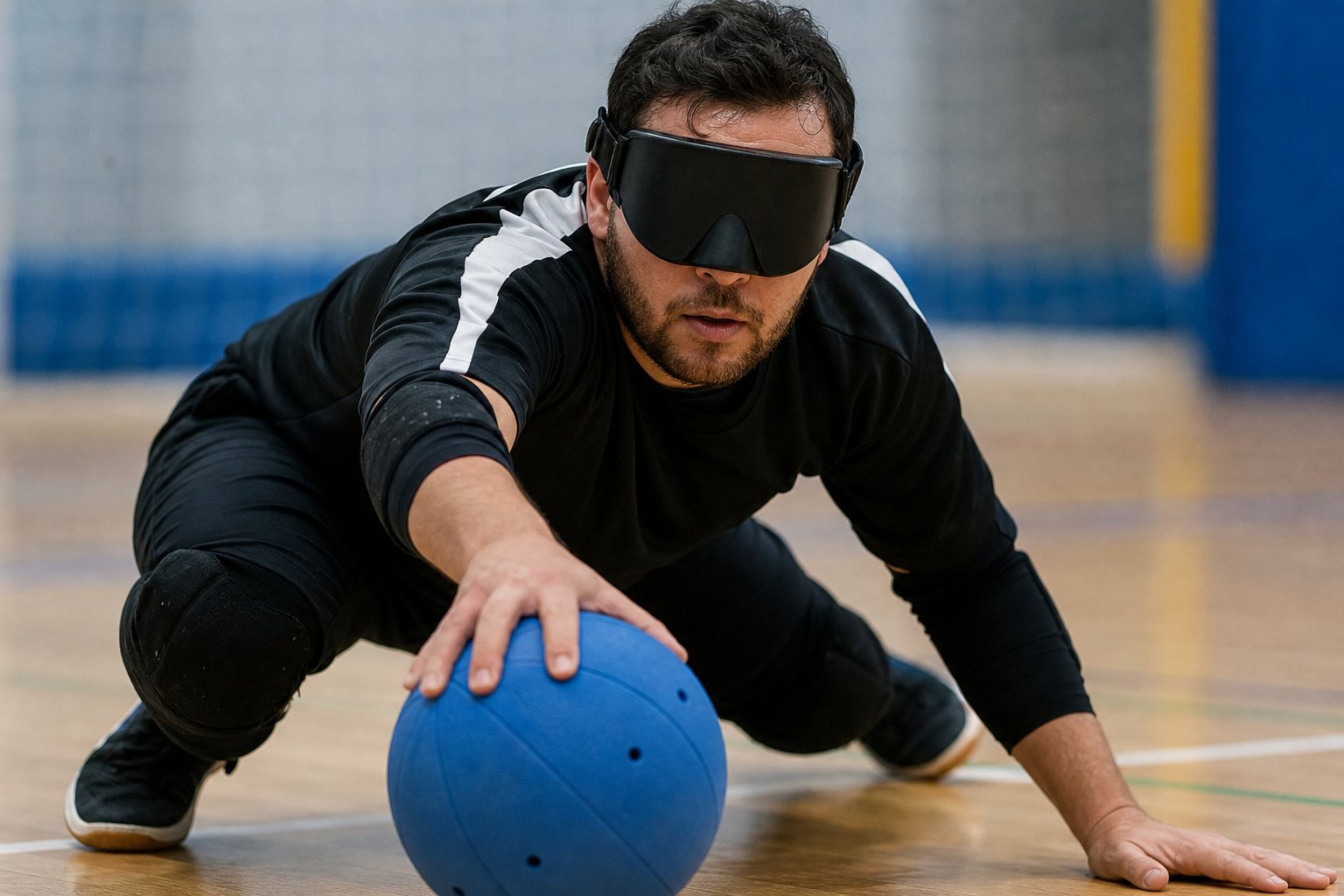
Three games in one day is a normal tournament. By the third, the legs are heavy, the dives are slower, and the throws that were crisp in the morning drift. Goalball training is the work that gets a player ready for that: quick explosive throws and blocks repeated for 24 minutes, with enough aerobic base to keep going and enough strength to take the floor contact.
Quick answer: Published goalball research is small, mostly from national-team samples, so there is no proven training plan. What the studies show is a high-intensity intermittent sport built on aerobic fitness, with key actions (throws, dives) powered by short explosive efforts. Throwing speed is linked to jump power and arm strength, core strength helps balance, and several games in a day cause fatigue that hurts technique. Ask a coach or sports medicine professional before starting hard training.
General information, not medical advice. For rules and starting out see the rules page; for protecting your body see injury prevention. Everything starts at the goalball hub.
What a goalball game asks of the body
Alves and colleagues (Frontiers in Physiology, 2018) tested seven players from the Brazilian national team in a lab and in simulated games. They described goalball as a high-intensity intermittent effort in which performance rests mostly on aerobic metabolism, while the decisive actions rely on the short-burst, alactic energy system. In games, oxygen use averaged about 25.8 mL per kg per minute and blood lactate about 2.0 mM, much lower than the lab peaks of 47.3 and 10.2, so a game is demanding in bursts rather than all-out for 24 minutes.
A 2024 study of six players wearing trunk sensors for a full game (Comeras-Chueca and colleagues, Sports) counted more total impacts, and more very high ones, in the first half than the second, alongside lower heart rate in the second half. A defender’s body takes repeated floor contact, which is part of why conditioning and skin and joint care come up on our injury prevention page.
Strength, power and fitness numbers: what the tests found
Goulart-Siqueira and colleagues (Sports, 2018) tested 11 elite Brazilian players (seven men, four women). Averages were a handgrip of 41.5 kgf, a countermovement jump of 34.8 cm, a throw velocity of 14.2 metres per second and 505 m on the Yo-Yo intermittent recovery test, with an estimated VO2max of about 40.6. Jump height tracked with throwing velocity (r = 0.75), and the authors suggested the jump test as a simple monitoring tool and noted that high body fat could be detrimental to anaerobic performance. These are small-group averages, not targets.
In eight women from the Turkish national team (Makaraci and colleagues, Journal of Exercise Rehabilitation, 2022), a smaller sway area while standing on one leg went with better shooting accuracy, and sway measures were linked to core and grip strength. The authors argued for core strength work to maintain postural stability in visually impaired athletes.
A scoping review of fitness testing in goalball (Petrigna and colleagues, Heliyon, 2020) found seven papers and 222 participants and a wide variety of tests, with no agreed standard battery. Treat any one test result as a personal baseline, not a pass mark.
A sensible weekly shape
No goalball study we found publishes a proven weekly plan, so what follows is common sports-training practice and is labelled that way. Many clubs combine team skills sessions (throwing, blocking, positioning, communication) with two or three non-court sessions: strength and power work, conditioning and mobility. Hard days are followed by easier ones, and one day a week is left clear. The IOC consensus on load and injury (Soligard and colleagues, British Journal of Sports Medicine, 2016) names rapid jumps in training load as a risk, so raise volume gradually and ask your coach to track how sessions feel.
- Skills and tactics: low-load, high-repetition practice of the legal throw, orientation and call-outs.
- Strength and power: legs and hips for diving and recovering, core for stability, shoulders and forearms for throwing. A band set like the one on our gear page suits light shoulder work.
- Conditioning: short hard efforts with recovery, in the spirit of the game’s intermittent demands.
- Mobility and rest: see our recovery page.
Tournament days and planning the year
Cursiol and colleagues (Adapted Physical Activity Quarterly, 2022) had ten male players play three simulated games on one day. Knee-extensor force and voluntary activation fell after the second and third games, a sign of central fatigue, and players who felt more tired threw less often. Heart rate stayed mostly in a moderate-intensity range. The authors suggested the findings matter for managing physical training and for how many games are scheduled per day. For an athlete, the practical idea is simple: practise repeated games, plan food and rest between them, and tell your coach when throws start slipping.
Periodisation simply means arranging the year into phases: a build phase for fitness and strength, a skills and tactics phase closer to competition, and an easier phase after. This is general training theory, not goalball-specific research, and a coach should set the dates around your national championships or qualifiers.
Vision level and training
Players in B1, B2 and B3 train together. In 17 male players (Goksen and Ince, PLoS One, 2024), shoulder joint position sense and a single-leg balance test were different between B1 and B3 players but not between B1 and B2 or B2 and B3. This is a small study, and we would not tailor a programme from it, but it is a reminder that balance and body awareness work help everyone.
Goalball training: FAQs
How fit do you need to be for goalball?
There is no published standard. Studies of elite players report average numbers for jump, grip and the Yo-Yo test, but they are small groups. Beginners start with whatever fitness they have and build with a coach.
What muscles does goalball use most?
Throwing relies on the arm and shoulder, with the legs and trunk driving the motion, and defending involves diving and recovering from the floor. A 2024 study linked ball velocity to forearm and arm flexor muscles.
Is goalball cardio or strength?
Both. Researchers describe a high-intensity intermittent sport with an aerobic base and short explosive actions.
How many games can I play in a day?
Tournaments often schedule several. Cursiol and colleagues found central fatigue after the second and third of three games in one day, so rest, food and fluids between games matter.
Do I need to lift weights for goalball?
Strength work is common practice and fits the sport’s demands. The research on goalball strength training is limited, so a coach or physical therapist should set it up, especially for young athletes.
Sources
- Alves et al., aerobic and anaerobic parameters and game performance in elite goalball, Front Physiol 2018
- Goulart-Siqueira et al., field test performance in elite goalball players, Sports 2018
- Comeras-Chueca et al., trunk impact dynamics in goalball, Sports 2024
- Cursiol et al., three simulated goalball games in one day, Adapt Phys Activ Q 2022
- Makaraci et al., postural stability, fitness and shooting accuracy in female goalball players, J Exerc Rehabil 2022
- Petrigna et al., physical fitness assessment in goalball: scoping review, Heliyon 2020
- Goksen and Ince, sensory function and throwing in goalball players, PLoS One 2024
- Goksen et al., EMG of traditional and spin throws in goalball, BMC Sports Sci Med Rehabil 2024
- Soligard et al., IOC consensus on load in sport and risk of injury, Br J Sports Med 2016
- USOPC, Sport overview: goalball
- IPC, Introduction to goalball
General information for education only, not medical advice. It does not replace a visit with a doctor, physical therapist or athletic trainer. See how we write and check our pages in our editorial policy.