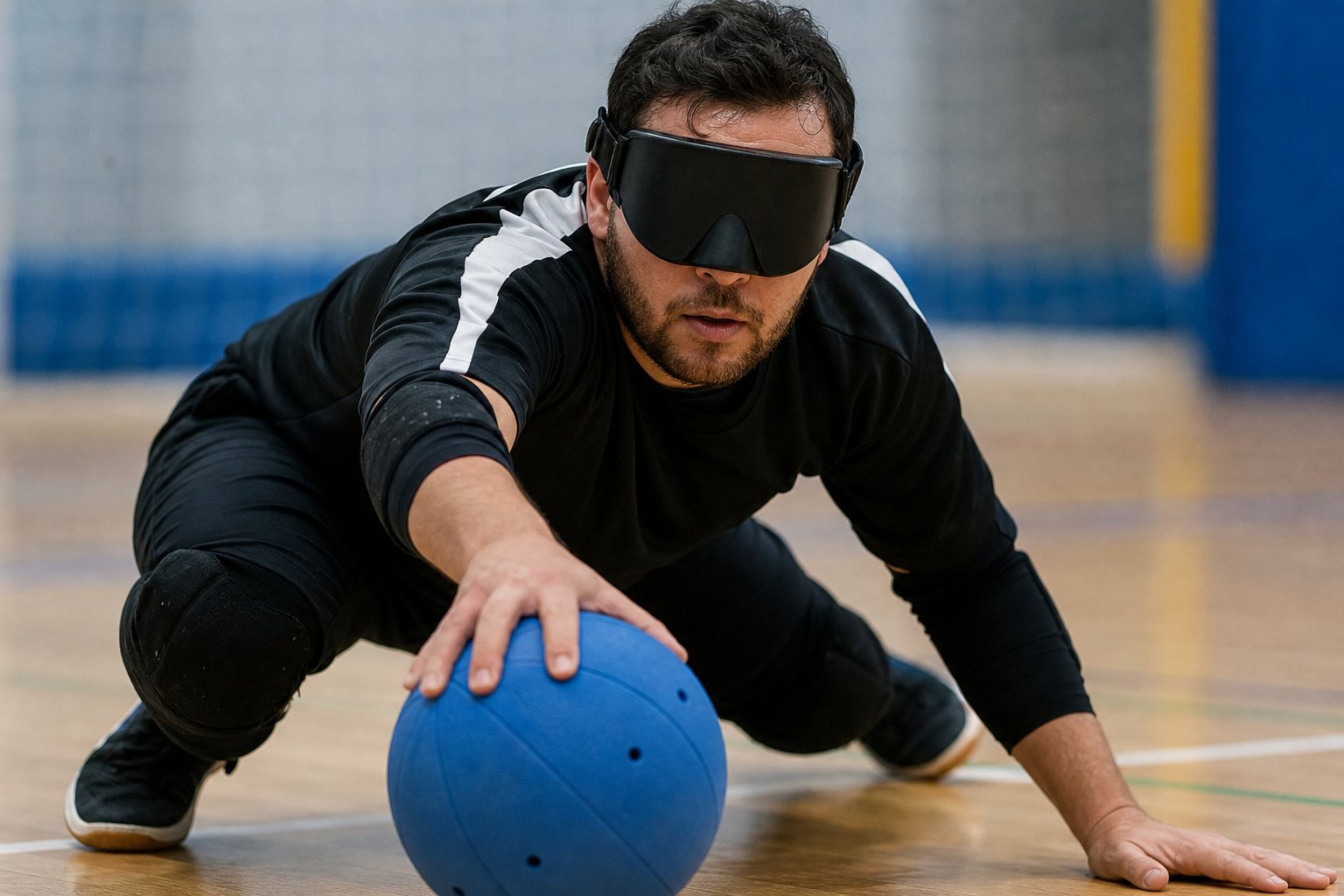
The score is 3-3, the gym is silent, and the referee has just called a penalty. One player will stand alone on the court and defend a single throw while teammates and the crowd can only listen. Goalball mental training is the set of skills, focus, confidence, routines and calm communication, that athletes practise to play their best when the moment is tense. It is separate from mental health, which we cover briefly below.
Quick answer: Sport psychology has studied confidence, mental practice (imagery), goal setting, anxiety and team cohesion more than most topics, but we found no goalball-specific trial, so treat any technique as something to try with a coach, not a guarantee. Simple routines for focus, calm self-talk and clear team calls are common practice. Anxiety, depression, disordered eating or burnout are health matters: talk to a qualified professional, and in the US call or text 988 in a crisis.
General information, not medical advice. For physical preparation see training; for rules and positions see rules. Start at the goalball hub.
What research says about mental skills in sport
A 2025 scoping review of 50 years of sport-psychology research (Lochbaum and Lane, Sports) found 73 meta-analyses linking psychological factors to performance, with mental practice, confidence, achievement goals, anxiety, cohesion and mindfulness among the most studied. The review maps what has been studied rather than testing what works, so it supports trying these skills, not promising results. A 2026 survey of 111 Turkish Paralympic athletes, 50 of them with visual impairments and including goalball players (Topuzoglu and colleagues, BMC Sports Science, Medicine and Rehabilitation), measured how athletes use imagery and found it related to sport experience.
Focus in a sound-based game
Goalball asks for attention to the ball’s sound, your position on the tape lines and your teammates’ calls, while crowds are asked to stay silent during play. Sport psychologists often teach athletes a simple pre-throw or pre-block routine: the same few breaths, a cue word, a check of your position. We found no goalball-specific study of focus routines, so the most useful step is to build one with your coach and keep it short enough to repeat under pressure.
Confidence and goal setting
Confidence is among the most studied factors in the 2025 review. In goalball, one finding may help: in a 2024 study of the 2016 and 2020 Paralympics (Martin and colleagues, Journal of Sports Sciences), players of different vision classes performed similarly, with no significant differences between B1, B2 and B3. Whatever your class, you are competing on even terms.
For goals, many coaches use three types: outcome goals (win the game), performance goals (hit the legal throw 8 times in 10) and process goals (take the same routine each throw). The split is common practice; achievement goals were among the topics mapped in the 2025 scoping review, which does not rank which goal types work best.
Imagery and visualization
Mental imagery is widely used in sport. A 2026 scoping review (Zhao and colleagues, Frontiers in Psychology) charted 39 studies on imagery for stress management in athletes and said the evidence is varied, with no meta-analysis or formal quality appraisal. We did not find research on imagery in blind athletes, and a sight-based picture is not the only possibility: athletes may “rehearse” through sound, touch and movement. A coach or sport psychologist can help you design this.
Handling pressure: penalties and overtime
Pressure moments are real in goalball. In the penalty study (Furtado and colleagues, 2021), penalties made up around 25% of all goals across 122 elite men’s matches, winners were awarded about 62% of penalties and converted 66%, compared with 31% and 53% for losers. The authors suggested aiming at specific sectors of the court could lift success above 80%. Practising penalties and extra throws, with a fixed routine, builds familiarity. The rules for these are on our rules page.
Setbacks, teamwork and decision-making
A goal against, a penalty call or a tired third game can pull focus. Common practice is a short reset: a breath, a cue word, back to the next ball. Teamwork matters because three players cover one wide goal by sound and call-outs; agree who talks, when, and what the words mean. A 2026 interview study of nine goalball coaches in the US and Canada (De Luna Vazquez and colleagues) found coaches valuing athlete-centered coaching but finding it hard to apply, a reminder to ask your coach for a say in decisions. Tactical decisions, such as where to throw and when to use a time-out or substitution, are learned in practice games with feedback.
Preparing for competition
- Practise the full day: several games, travel, waiting. Our training page covers the fatigue research.
- Agree routines before the tournament, not during it.
- Prepare food, fluids and sleep; see nutrition and recovery.
- Use time-outs deliberately: 45 seconds is enough for a reset and a plan.
Mental health is different from mental performance
Mental skills help you perform; they are not treatment. The IOC consensus statement on mental health in elite athletes (Reardon and colleagues, 2019) says mental health symptoms and disorders are common among elite athletes, that they can impair performance and increase injury risk, and that management needs qualified professionals. A Portuguese study of Paralympic-preparation athletes (Coelho and colleagues, 2026) found sleep and motivation were associated with better mental health. If you or a teammate have ongoing anxiety, low mood, disordered eating, burnout or thoughts of self-harm, talk to a doctor, psychologist or counsellor. In the US, call or text 988 for the Suicide and Crisis Lifeline; elsewhere, use your local emergency number or crisis line.
Goalball mental training: FAQs
How do goalball players stay focused?
Research on goalball focus is limited. Many athletes use a repeatable routine, a cue word and clear calls with teammates; a coach or sport psychologist can help you build one.
Does visualization work for blind athletes?
We found no study of imagery in blind athletes. Imagery is widely used in sport, but evidence is varied, and it may involve sound, touch and movement rather than sight. Treat it as something to try, not a guarantee.
How do I handle a penalty throw?
Practise it. A study of elite men’s matches found penalties were about a quarter of all goals, and the authors suggested aiming at specific sectors of the court. A fixed routine helps you repeat it under pressure.
Is anxiety before games normal?
Some nerves are common, and anxiety is one of the most studied topics in sport psychology. If worry is constant or interferes with sleep, school, work or daily life, talk to a doctor or psychologist.
Where can I get help right now?
In the US, call or text 988 (Suicide and Crisis Lifeline). If someone is in immediate danger, call emergency services. For ongoing support, talk to a doctor or qualified mental health professional.
Sources
- Lochbaum and Lane, mapping 50 years of sport psychology-performance meta-analyses, Sports 2025
- Topuzoglu et al., imagery in Paralympic athletes, BMC Sports Sci Med Rehabil 2026
- Zhao et al., mental imagery for stress management in athletes: scoping review, Front Psychol 2026
- Martin et al., impairment and performance in goalball, J Sports Sci 2024
- Furtado et al., factors associated with penalty outcome in male elite goalball, Adapt Phys Activ Q 2021
- De Luna Vazquez et al., goalball coaches and athlete-centered coaching, Front Sports Act Living 2026
- Reardon et al., mental health in elite athletes: IOC consensus statement, Br J Sports Med 2019
- Coelho et al., mental health predictors in Portuguese Paralympic preparation athletes, Sports 2026
- 988 Suicide and Crisis Lifeline
- IBSA, Goalball Rules and Regulations 2025 (copy hosted by the Japan Goalball Association)
- Cursiol et al., three simulated goalball games in one day, Adapt Phys Activ Q 2022
General information for education only, not medical advice. It does not replace a visit with a doctor, physical therapist or athletic trainer. See how we write and check our pages in our editorial policy.