This article contains affiliate links: if you buy through them we may earn a commission, at no extra cost to you. Read our affiliate disclosure.
A coach unzips the equipment bag: a blue ball that jingles, a stack of opaque eyeshades, a roll of tape and string for the lines, and a pile of knee and elbow pads. Goalball gear is simpler than most sports, but the details come from a rulebook, and some are checked by a technical delegate at tournaments. This page sorts what the official rules say from what a maker claims.
Quick answer: The ball, eyeshades, court markings and goals follow the IBSA rulebook, which sets exact sizes. Players also wear elbow and knee pads (per the USOPC), and padding may not extend more than 10 cm from the body. We found no goalball-specific pad standard, so pads sold for volleyball are practice-level choices to check with your coach, not certified goalball gear. Pads cannot promise to prevent injuries.
General information, not medical advice. Related: injury prevention and rules. Start at the goalball hub.
The ball
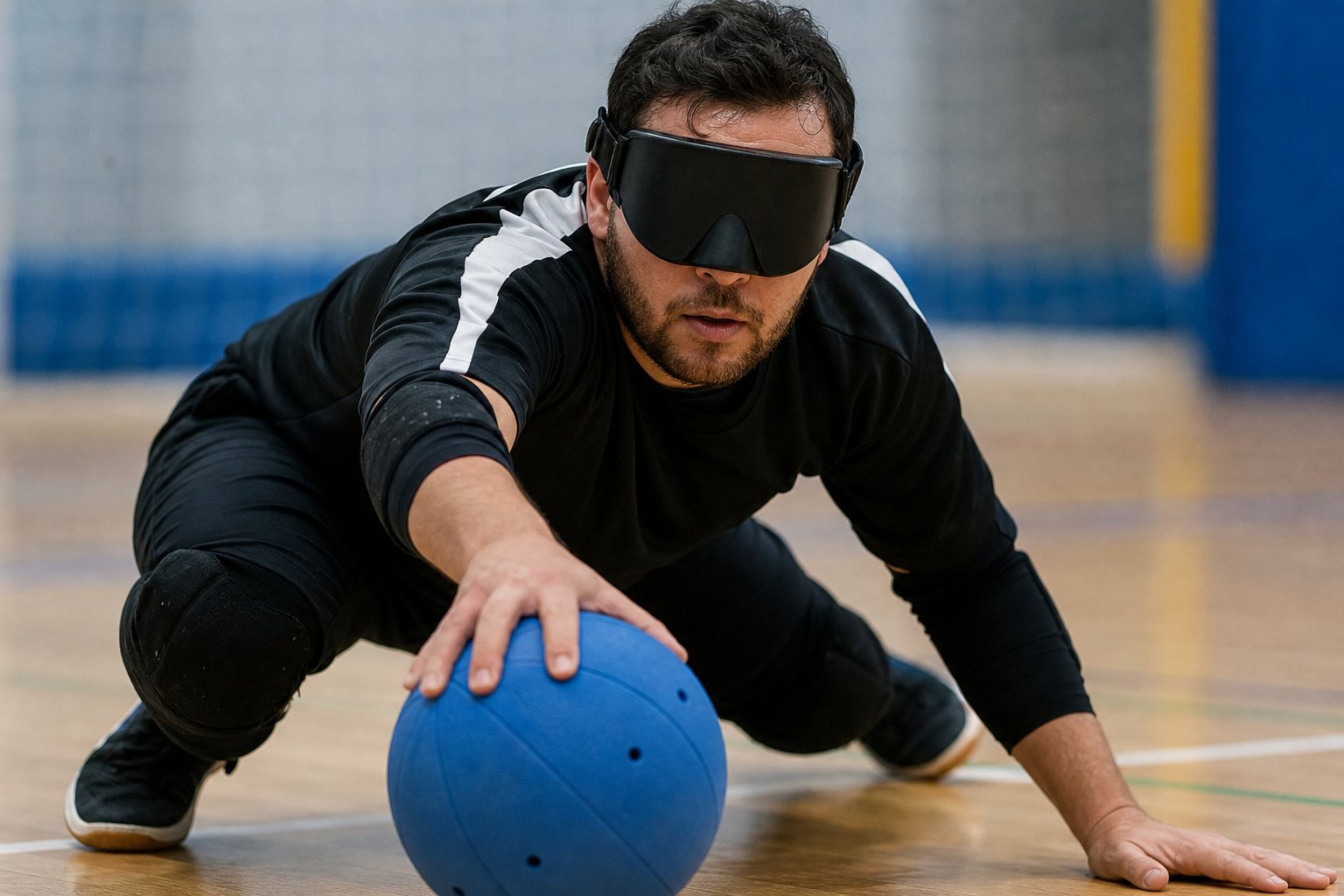
The IBSA rulebook (2025) specifies a round ball 24 to 25 cm in diameter and 75.5 to 78.5 cm around, weighing 1.25 kg give or take 50 g, with two bells and sound holes (four in each hemisphere, staggered), made of natural rubber, blue, with a knobbed surface. At IBSA championships the ball is approved by the technical delegate. For club practice, ask your coach which ball is used; a ball that is lighter or a different size changes the throw and the sound.
Eyeshades and patches
All players on court wear opaque eyeshades, from the eyeshade check at the start of a half until it ends. At IBSA-sanctioned tournaments and the Paralympic Games, eyeshades must have a beak (nose cover) and players’ eyes are covered with gauze patches or an equivalent under supervision, and the organiser announces the patch brand 60 days ahead. Players cannot wear glasses, contact lenses or hearing aids on court. Fit should be comfortable and secure; adjusting eyeshades mid-play without the referee’s permission is a penalty. If you have a skin or eye condition, ask your eye-care provider about patches and skin products before you try.
Uniform, padding and what the rules limit
- Padding limit. Clothing, equipment and padding must not extend more than 10 cm from the body.
- Head padding. Any padding on the head may not interfere with eyeshade positioning or function.
- Jerseys. Players wear identical team jerseys with permanent numbers on the front and back, and teams must carry spare uniform items in case of blood.
- Elbow and knee pads. The USOPC lists them as needed equipment; the IBSA text we read only limits size.
Knee pads and elbow pads: fit and checking
Pads protect skin and bruise-prone areas; that is a purpose, not a promise of injury prevention. When choosing pads: check they stay in place when you dive, do not slide onto the eyeshades or limit your arm swing, and are not so thick they exceed the 10 cm rule. Inspect pads before sessions for torn stitching, flattened foam or loose straps. Most clubs and coaches know which brands local players use. We list no elbow pad because we have not verified one for this sport.
As practice-level examples, two volleyball knee pads are below. The makers describe them for volleyball; we have not confirmed that any meets a goalball rule, so ask your coach first. The band kit is for the light shoulder work a clinician may suggest.

Mizuno LR6 Volleyball Kneepad
- Low-rise, no-fold design
- Kneecap and side protection
- Volleyball pad, not goalball-certified

ASICS Gel-Rally Kneepad
- Volleyball kneepad
- Adult and kid sizes sold
- Not goalball-certified

THERABAND Resistance Band Beginner Kit
- 3 latex bands
- Yellow, red, green
- For light strength work
Court, tape and goals
The court is 18 m by 9 m with 5 cm tape over 3 mm string (rule dimensions as read from the IBSA text), a resilient wood, plastic or synthetic floor, and goals 9.0 m wide and 1.3 m high with rigid crossbars. Posts and crossbar must not exceed 0.15 m in diameter. A club can rebuild a practice court on a gym floor with tape and string; check that the floor is smooth and clear of hazards and that the tape is firmly laid. See our injury prevention page for safety notes.
Standards versus maker claims
Verified rules here are the IBSA dimensions, weights and the 10 cm padding limit. Maker claims, such as “protects” or “maximum comfort”, are descriptions, not standards. We did not find an independent test or certification program for goalball pads, and we state no brand as better than another.
Goalball gear: FAQs
What equipment do you need to play goalball?
A goalball, opaque eyeshades, a taped court with string lines and goals, and usually elbow and knee pads. Clubs often supply the shared items; ask before buying.
Can I use volleyball knee pads for goalball?
Many players use pads from other sports for practice. We have not confirmed that any volleyball pad meets a goalball rule, so check with your coach, and keep padding within 10 cm of the body.
Do goalball players wear helmets?
We found no helmet requirement in the IBSA rules, only that head padding must not interfere with the eyeshades. Ask your coach and doctor.
What size is a goalball?
Per the IBSA rules: 24 to 25 cm diameter, 75.5 to 78.5 cm circumference and 1.25 kg, with two bells.
Can players wear glasses or hearing aids?
No. The IBSA rules do not allow glasses, contact lenses or hearing aids on court.
Sources
- IBSA, Goalball Rules and Regulations 2025 (copy hosted by the Japan Goalball Association)
- USOPC, Sport overview: goalball
- IPC, Introduction to goalball
- Rebai et al., mechanisms of sports injuries in Paralympic goalball, Am J Phys Med Rehabil 2023
- Mizuno LR6 kneepad (Amazon listing)
- ASICS Gel-Rally kneepad (Amazon listing)
- THERABAND resistance band beginner kit (Amazon listing)
General information for education only, not medical advice. It does not replace a visit with a doctor, physical therapist or athletic trainer. See how we write and check our pages in our editorial policy.