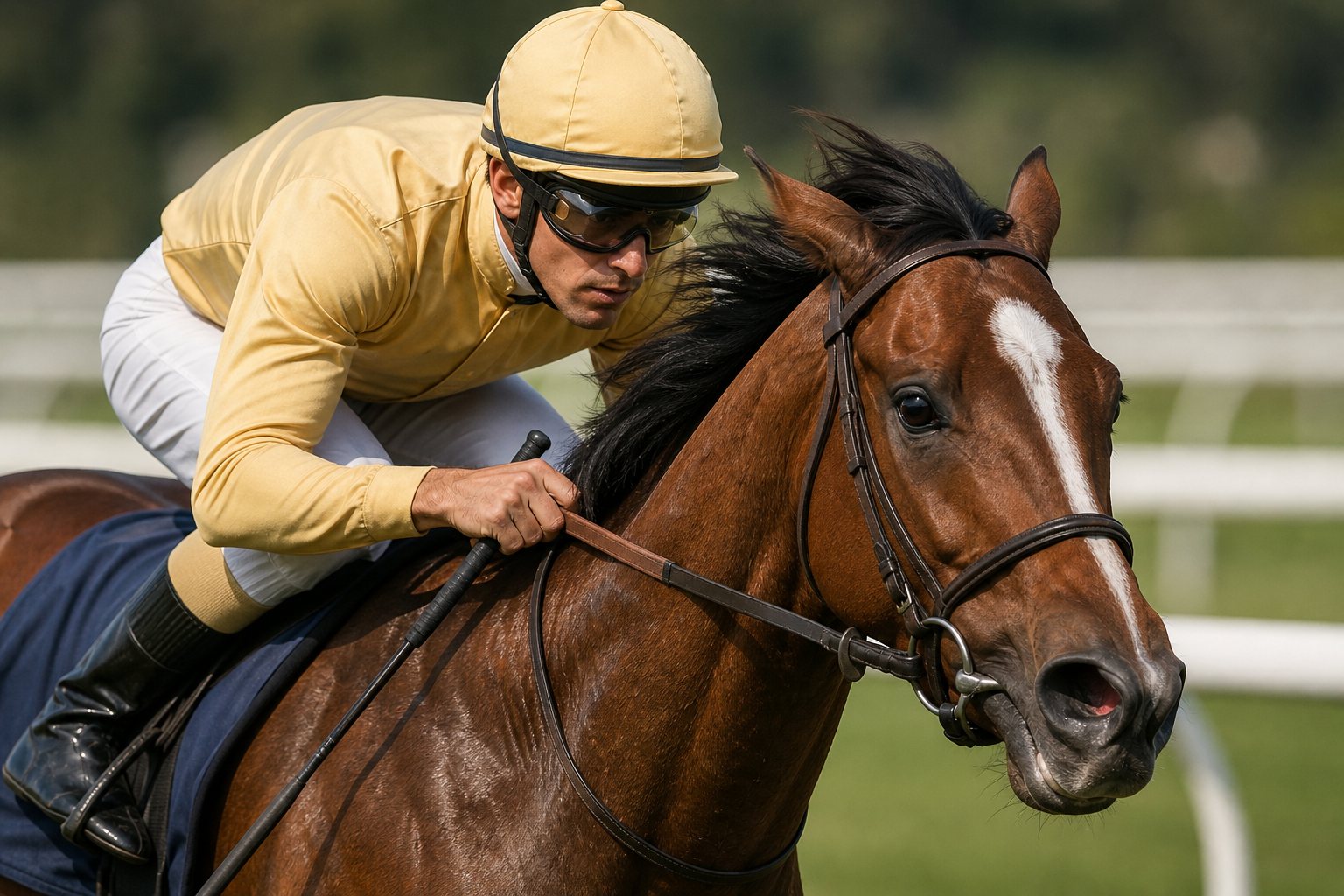
A 16-year-old stands in a classroom at a racing school with a sheet of questions about the rulebook, and the first thing she learns is that nobody gets on a racehorse in a race just because they can ride. Horse racing, as a rider sees it, is a licensed profession with its own rules, levels and routes in. This page covers the basic skills, how a race is decided and how a beginner might start. For the overview, see the horse racing hub.
Quick answer: Racing is won by the first horse across the line, and riders must be licensed by a racing authority before they can ride in races. There is no single worldwide route: in Great Britain, for example, an apprentice or conditional licence requires employment with a licensed trainer. Learn to ride well first, then ask the racing authority or a racing school where you want to ride. This is general information, not advice.
How a race is decided
A flat race is run on a measured distance on dirt, turf or a synthetic surface from a starting gate; jump races add fences. The first horse across the finish line wins, but results can change afterwards: racing authorities have stewards who review the race and can change the order after an inquiry, and each jurisdiction has its own rule book. We did not read a full rule book for this page, so for the exact wording read the one that applies where you ride.
In the United States, the Horseracing Integrity and Safety Authority (HISA) sets national racetrack safety and anti-doping rules. Its safety program began on July 1, 2022 and its anti-doping program on May 22, 2023, according to HISA and news coverage of the launch. State racing commissions still license riders and tracks. Other countries run their own: the British Horseracing Authority (BHA) in Great Britain and the Irish Horseracing Regulatory Board (IHRB) in Ireland.
The basic skills a racing rider needs
Published research gives some clues about what the job asks. A 2025 study that put accelerometers on 12 apprentice and 2 senior jockeys (Legg and colleagues, Scientific Reports) found that head movement fell as horse speed rose and as the jockey gained experience, so staying balanced and quiet on a galloping horse is a skill that grows with riding. A 2024 study of 46 elite Australian jockeys (Farley and colleagues) found they were lighter and shorter than the general population and that their hearts showed adaptations to the sport.
- Balance and a secure position at speed, learned first on well-schooled horses.
- Control and communication with the horse, including at the starting gate.
- Race awareness: pace, position and keeping out of trouble. A coach or trainer teaches this, and we do not have a study to quote on it.
- Fitness and weight management, covered on our training and nutrition pages.
How a beginner starts
Racing is not a school or college league. A common route is horsemanship first, then work as an exercise rider or stable hand and then a licence. The British Horseracing Authority lists a licence for apprentice or conditional jockeys that requires full-time employment with a licensed trainer who nominates the applicant. New applicants attend a one-day pre-licence assessment and a two-week course at the British Racing School or the National Horseracing College, according to the BHA page we read (as of 2026). Professional licences need a set number of winners or an age over 26, and amateur riders have their own categories with assessment courses.
Requirements differ in every country and state, and our search showed pages from Western Australia, Victoria and New Zealand that set their own age, weight and medical conditions. We did not confirm the United States requirements for this page. Ask the racing commission in your state, a licensed trainer or a racing school. Our injuries page explains why the early riding years matter for safety.
Levels
- Exercise riders work horses in the morning, usually not in races.
- Apprentice jockeys are new professionals riding under an apprentice licence.
- Professional jockeys ride for a living, in flat or jump racing.
- Amateur riders ride in point-to-point and amateur races, which are a separate group in the injury research.
Where to find the rules and a program
Start with your national or state racing authority: HISA at hisaus.org for United States safety and anti-doping rules, the BHA at britishhorseracing.com for Great Britain, and the IHRB at ihrb.ie for Ireland. Horse racing is not on the Olympic or Paralympic programme as far as we found; check olympics.com and paralympic.org for the current Games. For riding without racing, see horseback riding, polo and rodeo.
Frequently asked questions
Do you need a licence to ride in races?
Yes. Racing authorities license riders; the type and requirements depend on the country or state. In Great Britain the BHA issues apprentice or conditional, professional and amateur licences.
How old do you have to be to become a jockey?
It depends on the jurisdiction. We found different minimums in the places we looked, and the BHA page we read does not state one, so check the racing authority where you plan to ride.
Can you learn to ride racehorses without owning a horse?
Racing schools and licensed trainers offer training and employment routes. We did not find a single official programme for everyone, so ask the authority or school directly.
Is there a school or college racing league?
As far as we found, no. See our horseback riding hub for riding options at school and club level.
Where can I read the official rules?
On the website of the racing authority that governs the track: HISA and your state racing commission in the United States, or the BHA or IHRB in Great Britain and Ireland.
Sources
- HISA, About us
- British Horseracing Authority, Jockey licensing
- Legg KA et al., Head kinematics in race riding jockeys, Sci Rep 2025
- Farley A et al., Cardiac structure of elite Australian jockeys, 2024
- IHRB, Irish Horseracing Regulatory Board
General information for education only, not medical advice. It does not replace a sports medicine doctor, physical therapist, athletic trainer or registered dietitian who knows you. See our editorial policy for how we research and write.