This article contains affiliate links: if you buy through them we may earn a commission, at no extra cost to you. Read our affiliate disclosure.
Two weeks into the first term, the beginner’s uniform has been washed twice, the belt knot will not stay tied and a new student has asked the dojo whether the hand pads on the shelf are required. Karate gear starts simply: a karategi (uniform) and a belt. Sparring and competition add protection that is set by rules, and the right fit matters more than any brand name. This page explains what to buy, when and how to check claims.
Quick answer: To start, you need a well-fitting karategi and belt, and many dojos sell them. For sparring you will need protection set by the rules your club uses: under the World Karate Federation (WKF) rules this includes mitts, a mouthguard and other listed protection, with a helmet and chest protector for under-14s. “WKF approved” on a shop listing is the seller’s claim; check the federation’s current equipment list for your event. A mouthguard reduces dental injuries; the American Academy of Pediatrics says there is no evidence headgear reduces concussion.
The uniform (karategi) and belt
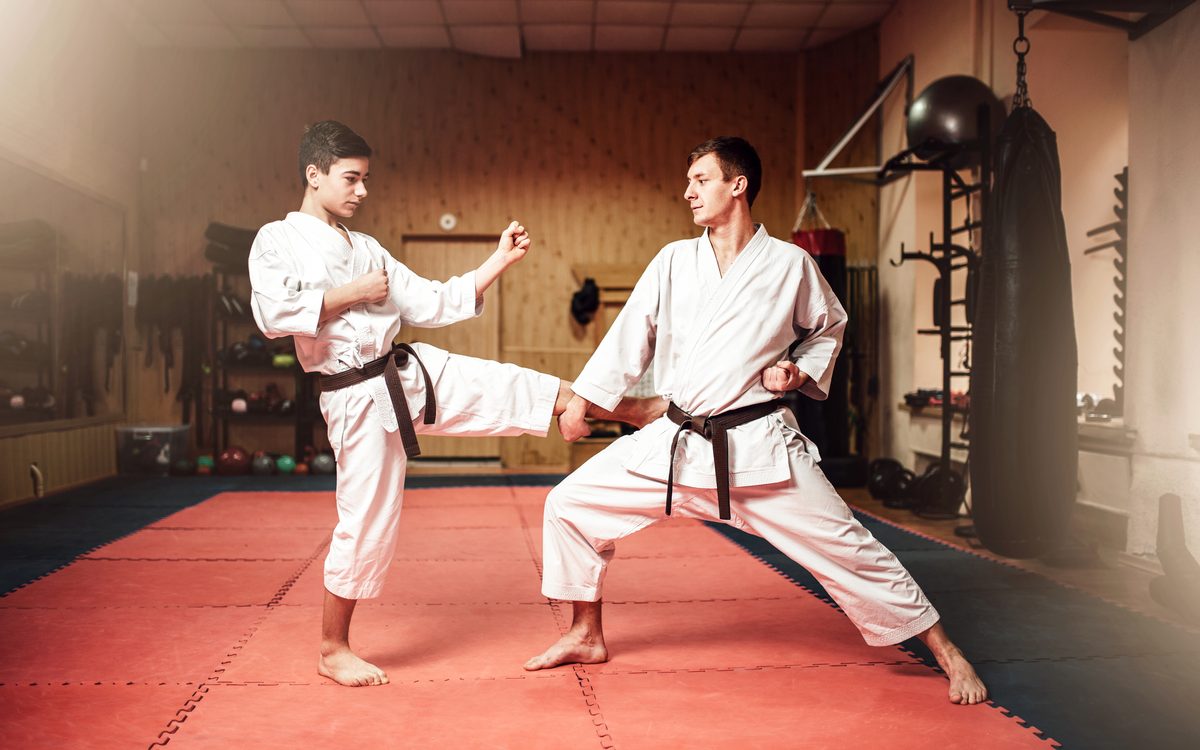
The karategi is a jacket and trousers, usually white, with a belt that shows rank. Class uniforms are commonly cotton; lighter and medium-weight cloth are both used, and some competition uniforms use a polyester-cotton blend. Pick by use: a student uniform for class and gradings, a competition uniform only if your events require one. Check that:
- Sleeves and trouser legs match the length your instructor asks for, and allow for shrinkage after washing; ask the dojo about its rule.
- The jacket closes without strain across the shoulders and chest, and you can lift your leg to head height without the trousers binding.
- Kids’ sizes are bought for the child now, not for next year, since too-long trousers are a trip hazard.
- The belt is the right length and wrapped as your school teaches; a double-wrap belt in a solid color is common. Belt colors and rank systems belong to your school or organization, so ask before buying.
Some dojos require a specific crest or patch, so check before purchase. Wash uniforms after each use; the National Athletic Trainers’ Association (NATA) says to launder clothing daily and not to share towels, soap or gear, because skin infections spread on mats.
What the rules require
The WKF kumite rules, as recorded in our notes for the 2023 and 2026 editions, set these points: fingernails must be short; mitts, a gum shield (mouthguard), a body protector, shin pads and foot protection are compulsory protection, with a groin guard for men; glasses are not allowed; and athletes under 14 wear a face mask or helmet and a chest protector. We recorded the equipment list from the 2023 edition and the under-14 rule from both; the 2026 PDF was not re-read for every item, so read your tournament’s current rulebook. Local and style-based events often have their own rules. Kata athletes compete in the uniform and belt without sparring protection.
Mitts, mouthguards and other protection
- Mitts (hand protectors). They should fit snugly without pinching, allow a full fist and let the fingers close. Replace them when the foam flattens, the seams open or the straps stretch.
- Mouthguard. The AAP says mouthguards reduce dental and oral injuries. A 2026 Brazilian study of martial artists found that 15 of 19 with dental trauma were not wearing one. Boil-and-bite types fit by softening in hot water and biting; a dentist can make a custom one, which is worth asking about if you have braces. Replace it when it is worn, cracked or no longer fits.
- Helmet and chest protector. Required for under-14s in WKF rules. Headgear can reduce scrapes and cuts but, per the AAP, there is no evidence it reduces concussion, so rules about head contact and supervision still matter.
- Shin pads, foot protection and groin guard. Listed in the rules for sparring; check size and fit.
Standards versus maker claims
A standard comes from a body such as the WKF, which publishes the rules and a list of approved equipment. A maker’s claim is a statement on a product page or a box. The WKF approval wording we saw on retail listings was copied from the listing, not from the federation’s list, so we mark it “(listing)” on the cards below. Before buying competition gear, check the WKF list and what your event’s organizer accepts. Sizing charts are the maker’s; try before you buy where you can.
Gear care and inspection
- Check mitts, pads and mouthguards before every sparring session for cracks, flat padding or loose straps.
- Air gear out after use and do not leave it in a hot car, which can warp a mouthguard.
- Trim fingernails and toenails short; this is both a WKF rule for nails and a safety habit.
- Clean mats and wash gear regularly. See our injury prevention page for hygiene advice.
Picks that fit this guide
These products are examples of the categories above, listed on Amazon. We have not tested them. Specs come from the listings.

Ronin Lightweight Karate Gi
- 100% cotton (listing)
- Lightweight student uniform
- Kids and adult sizes

Ronin Medium Weight Karate Gi
- 9.5 oz cloth (listing)
- White belt included (listing)
- Check sizing chart

Daedo Shodan Karate Uniform
- WKF approved (listing)
- 80/20 poly-cotton
- Check your tournament's rules
$98.99 at Amazon, as of Nov 17, 2026 01:07 UTC
Check price on Amazon
Daedo WKF Approved Karate Gloves
- WKF approved (listing)
- Padded sparring mitts
- Check size and rules

Tokaido WKF Karate Mitt
- WKF mitt (listing)
- Check size and rules
- Check your event's list

Shock Doctor Gel Max Mouthguard
- Boil-and-bite gel-fit liner
- Breathing channels
- Youth and adult
$11.99 at Amazon, as of Nov 17, 2026 01:07 UTC
Check price on Amazon
MACS Double-Wrap Karate Belt
- Solid color (listing)
- Double wrap
- Check rank color with your school
Karate gear FAQs
What do I need for my first karate class? Usually just comfortable clothes until the dojo tells you otherwise. Most schools sell a uniform and belt after the first weeks.
Is “WKF approved” on a listing proof? No. It is the seller’s wording. Check the WKF equipment list and your event’s rules.
Do I need a mouthguard? For sparring, yes in most dojos. The AAP says mouthguards reduce dental injuries. Ask your dojo and your dentist, especially if you have braces.
What do kids under 14 need for kumite? Under the WKF rules we recorded, a helmet and a chest protector, plus the other listed protection. Check your event’s current rules.
How should I wash a karategi? Follow the label, wash after each use, and do not share. Shrinkage varies, so ask the dojo how to size.
Sources
- WKF Kumite Competition Rules 2026 (PDF)
- WKF Kumite Competition Rules 2023 (mirror PDF)
- AAP: Youth Participation and Injury Risk in Martial Arts (2016)
- Dental trauma in martial arts practitioners, Brazil, 2026 (PubMed 42645484)
- NATA position statement on skin diseases (PDF)
- Amazon listing: Ronin Lightweight Karate Gi (B01MY6JSKP)
- Amazon listing: Ronin Medium Weight Karate Gi (B078VJYJSG)
- Amazon listing: Daedo Shodan Karate Uniform (B0FMFQDQHZ)
- Amazon listing: Daedo Karate Gloves (B0FLF87Z3X)
- Amazon listing: Tokaido WKF Karate Mitt (B00LCP2M3K)
- Amazon listing: MACS karate belt (B086HG5TZS)
General information for education only, not medical advice. It does not replace a visit with a doctor, physical therapist or athletic trainer. See how we write and check our pages in our editorial policy.