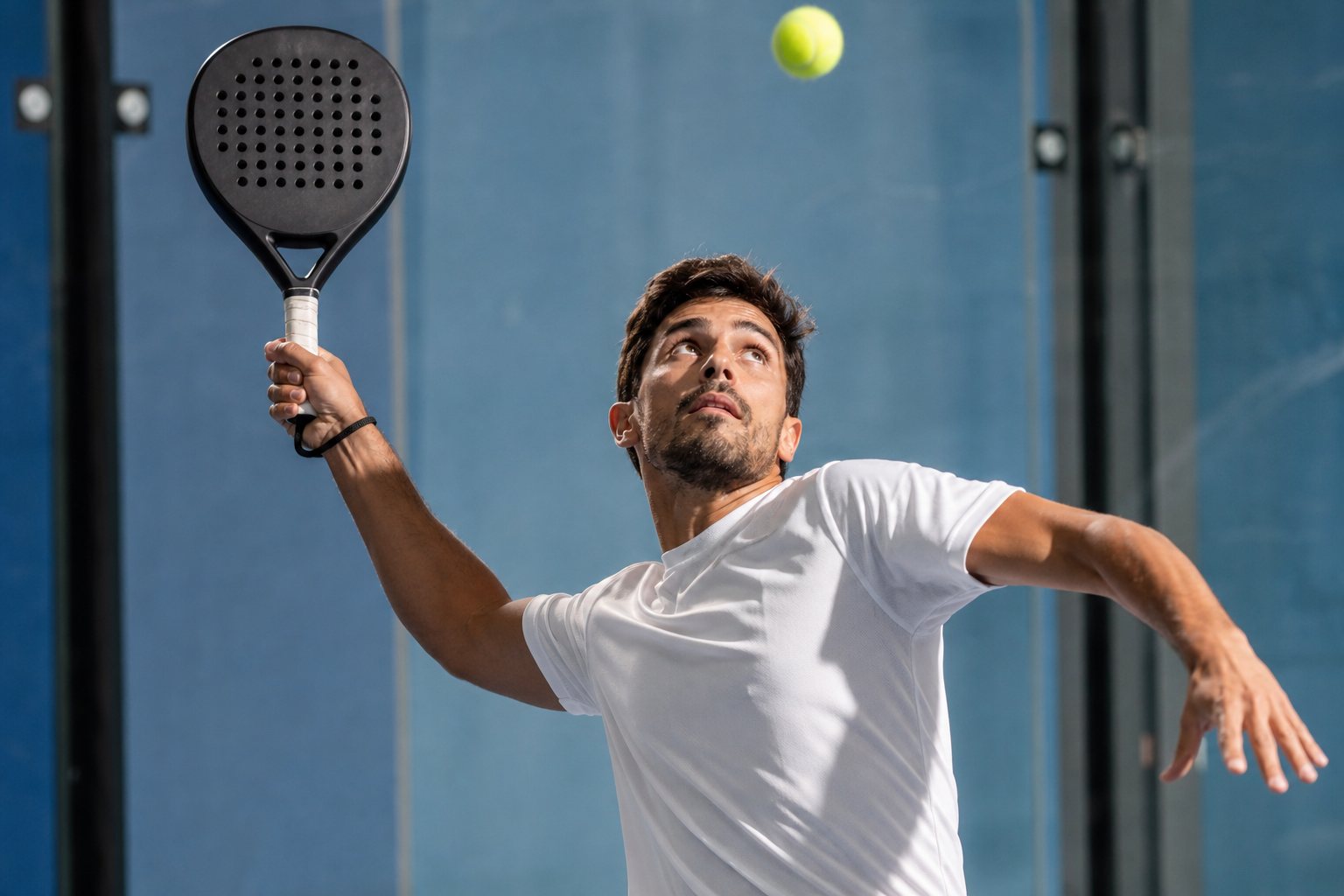
Tuesday night, 9 p.m., last set of the league match: you are 5-5, you have been moving side to side for an hour, and the ball keeps dropping off the back glass just beyond your reach. Padel training is the work you do on and off the court so that moment feels like a rally you can handle, not a sprint you cannot finish. Research on padel is young and mostly small, so this page sticks to numbers that studies actually report and says plainly where the evidence stops.
Quick answer: Padel is intermittent: short, repeated bursts of movement with brief rests. Studies of match play describe moderate-to-high heart rates, many changes of direction and, in a 135-minute match, a measurable drop in knee-extensor strength. A sensible week mixes a few court sessions, one or two short strength sessions and some easy aerobic work, built up gradually. See a sports medicine doctor, physical therapist or athletic trainer if you have a medical condition, a past injury or pain that persists.
What the game demands
- Match length and pace. In a study of 52 amateur players across 13 matches (PMID 40942670), the average match lasted 57.2 minutes with about 152 points. Physiological load rose through the match, especially in the last sets, but jump height and handgrip did not drop.
- Longer play. In 16 trained players who played a 135-minute match (PMID 42831286), maximal voluntary knee-extensor torque fell about 10% by the end, while explosive force and jumping were maintained.
- Padel versus tennis doubles. Eight national-level male players did both (PMID 40606278). Tennis involved more distance, speed and sprints; padel had more rallies and more volleys and ground strokes, and the average heart rate and lactate were comparable.
- Rally length. The youth scoping review (PMID 40137799) reports rallies of 7 to 9 seconds in beginners and 9 to 12 seconds in national-level players.
- Elite load. In 121 professional women in 34 official matches (PMID 42644041), players covered a mean of about 3,648 m with a median of 491 accelerations and 441 decelerations per match. These are professional numbers; most readers will play less.
A sensible weekly shape
No published study tests one weekly plan for padel players, so what follows is a common-sense pattern built around what the studies describe. It is a starting idea, not a prescription; a coach or physical therapist can tailor it.
| Day type | What it can look like |
|---|---|
| Court session 1 | Skills and wall play with a coach or a patient partner; easy to moderate effort. |
| Court session 2 | Match play or a clinic; this is where the hardest efforts happen. |
| Strength session | 30 to 45 minutes: legs, trunk, shoulders and forearms (see below). |
| Easy aerobic day | Walking, cycling or easy jogging at a pace where you can talk, as the CDC adult guidelines describe moderate activity. |
| Rest day | At least one day with no hard play, more if you feel flat. |
The CDC recommends that adults get at least 150 minutes of moderate-intensity activity a week and two days of muscle-strengthening. Padel counts toward the first number, and the strength sessions cover the second.
Strength and conditioning
Padel asks the legs to start, stop and push off thousands of times, the trunk to rotate, and the shoulder and forearm to swing a racket and absorb the shock of the ball. A few findings help set priorities:
- Legs and landing. In 30 amateur padel players (PMID 42931604), force-plate jumps showed the dominant leg produced more force than the other, and women showed greater landing asymmetry. The authors suggest jump testing could show imbalances; it is a small study and does not show that fixing asymmetry prevents injury.
- Elite fitness reference. Fourteen high-level male players averaged an estimated VO2max of about 51 mL/kg/min on the Yo-Yo test (PMID 41900518). It is a snapshot of one group, not a target.
- Shoulder and elbow. A small pilot study (PMID 42646895) found padel players with lateral elbow pain had less shoulder internal rotation on the sore side and thicker elbow tendon on ultrasound, which supports looking at the whole arm, not only the elbow.
- Balance and strengthening. Among 187 amateur players with ankle sprains (PMID 42577126), balance and strengthening exercises were associated with better ankle function scores, though not with fewer sprains.
Typical gym work for racket-sport players includes squats or leg press, lunges and step-ups, calf raises, hip hinges, rows, rotator-cuff external rotations, wrist and grip work and trunk anti-rotation exercises. That list is general racket-sport practice rather than a padel trial; start light and learn the technique with a qualified trainer.
Position, level and age
Padel pairs usually split into left-side and right-side players. In 34 top-60 male professionals (PMID 42422388), training heart rates were about 72% to 74% of maximum on average; left-side players spent more time in continuous efforts, right-side players in more intermittent, higher-intensity efforts. In 14 high-level men, left-side players scored higher on the Yo-Yo test. These are small group differences, so train for the role you actually play and do not copy a professional’s load.
Older players can train too. A study of 12 male players aged about 70 (PMID 39458506) found they trained at about 73% of maximum heart rate in a 90-minute session, which the authors called challenging but safe, and recommended slightly more fluids.
Periodisation basics
Periodisation just means planning harder and easier weeks. The IOC consensus on load and injury (Soligard et al., Br J Sports Med 2016) says to monitor training load and avoid large, sudden jumps. For padel, a simple version is: raise weekly court hours and strength load slowly, take an easier week every third or fourth week, and ease off before an important tournament. The ankle study above found playing two or more sessions a week and more than a year of experience were linked with sprains, which is a reminder that exposure matters. For the full injury picture see our padel injuries page.
Padel training FAQs
How many times a week should I play padel?
No study gives a right number. Surveys link more weekly play with more injuries (ankle sprains, upper-body injuries), so build up gradually and include rest days. A coach can help you set a level that matches your fitness.
Is padel enough exercise?
It can contribute. A typical amateur match lasts about an hour at moderate-to-high heart rates, which counts toward the CDC’s 150 weekly minutes, but the CDC also asks for two days of muscle-strengthening.
Do I need cardio training as well?
Padel itself is intermittent, so many players add easy aerobic sessions for general fitness. That is common practice, not a padel-specific finding.
Which side should I play, left or right?
It depends on your strengths and your partner. Studies describe small physical differences between sides at professional level, but nothing says one side is better for amateurs.
Can older players or beginners follow this?
Yes, with a lower starting point. Check with a doctor if you have a medical condition, and begin with shorter sessions.
Sources
- Evolution of physiological responses and fatigue in padel matches, Sensors 2025, PMID 40942670 (PubMed)
- Neuromuscular alterations of knee extensors during padel match play, Eur J Sport Sci 2026, PMID 42831286 (PubMed)
- Padel vs. tennis doubles: performance demands, Front Sports Act Living 2025, PMID 40606278 (PubMed)
- Topics of study in under-18 padel categories: scoping review, Sports 2025, PMID 40137799 (PubMed)
- Competition load in elite women’s padel, Biol Sport 2026, PMID 42644041 (PubMed)
- Lower-body force asymmetry in South African amateur padel athletes, Sports 2026, PMID 42931604 (PubMed)
- Playing site and weekly training frequency in elite padel players, J Funct Morphol Kinesiol 2026, PMID 41900518 (PubMed)
- Shoulder-elbow complex in padel players with lateral elbow tendinopathy, Sports 2026, PMID 42646895 (PubMed)
- Ankle sprain in amateur padel players in Saudi Arabia, Front Med 2026, PMID 42577126 (PubMed)
- Internal and external load in men’s professional padel, Biol Sport 2026, PMID 42422388 (PubMed)
- Hydration habits in male padel athletes over 65, Nutrients 2024, PMID 39458506 (PubMed)
- Soligard T et al., IOC consensus statement on load in sport and risk of injury, Br J Sports Med 2016, PMID 27535989 (PubMed)
- CDC, Physical Activity Guidelines for Adults (cdc.gov)
General information for education only, not medical advice. It does not replace a visit with a doctor, physical therapist or athletic trainer. See how we write and check our pages in our editorial policy.