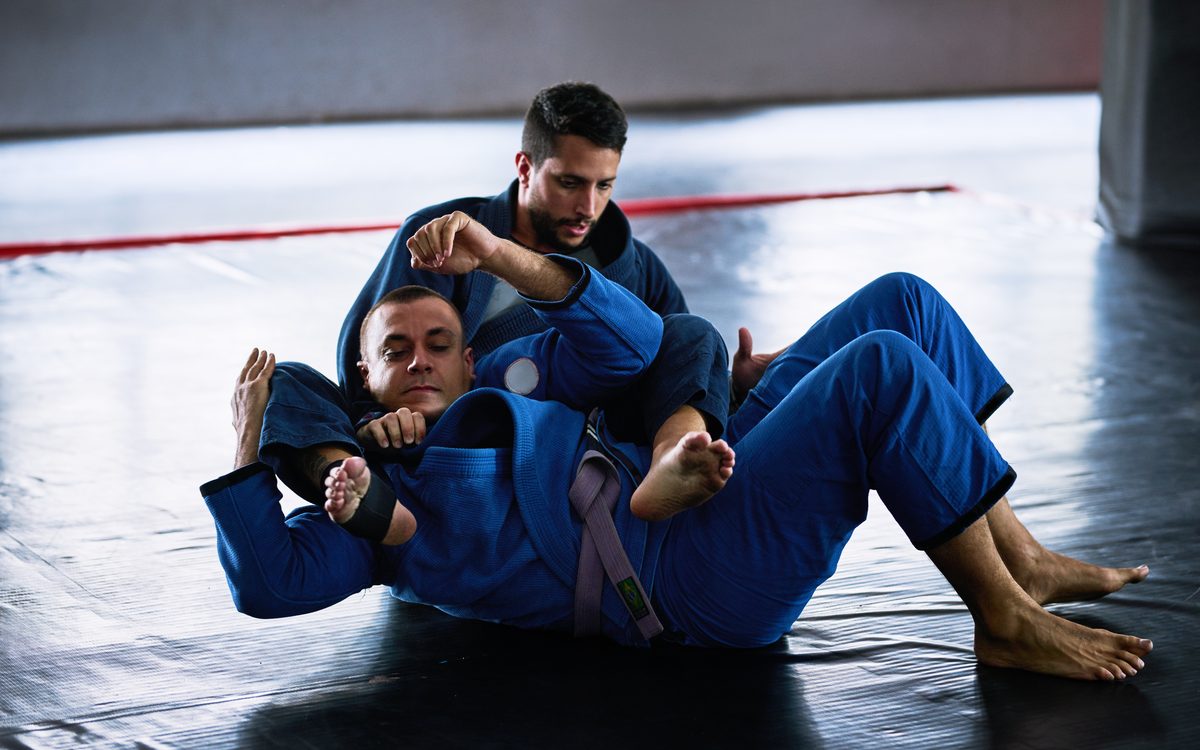
The new white belt stands at the edge of the mat in a borrowed gi, sleeves a little long, watching two people roll. Nothing looks like it is happening, and then one of them taps. That quiet moment is the whole sport in miniature. Brazilian jiu-jitsu (BJJ) is a grappling sport where you win by forcing a submission or by leading on points, and where most of the action happens on the ground.
Quick answer: A BJJ match ends when someone taps out, or when time runs out and the higher score wins (points, then advantages, then penalties, then a referee decision, per the IBJJF rule book). A beginner starts with a trial class at a local academy, often in a borrowed gi, and moves up the belts at the pace the professor decides. See a doctor first if you have a health condition or past injury.
How a match is scored
Under the IBJJF rule book (v6.1, 2024), the most widely used competition rules, points are: 2 for a takedown, 2 for a sweep, 2 for knee on belly, 3 for passing the guard, and 4 each for mount and back control. A position has to be held for three seconds before it counts. If the points are tied, advantages are counted, then penalties, and then the referee decides.
A submission ends the match at once, whatever the score. That is why a smaller athlete who is behind on points can still win: a sweep from the bottom, a pass, a choke. Penalties build in steps, according to the rule book: the first is only marked, the second gives the opponent an advantage, the third gives 2 points, and the fourth is a disqualification. Severe fouls can disqualify at once.
Basic skills a beginner learns first
Most academies teach a technique, drill it with a partner, then let students roll (live sparring at a controlled pace). Classes usually start with the same building blocks.
- Positions: the guard (you are on your back with your legs between you and your partner), side control, mount and back control. These are the same positions the scoring list rewards.
- Escapes and sweeps: getting out from under someone, and reversing the position from the bottom.
- Submissions: chokes and joint locks such as the armbar, taught slowly with a partner who taps early.
- Takedowns: ways to bring the match to the ground, often borrowed from judo and wrestling.
- Tapping: a tap on the partner or the mat means stop immediately. Both people are expected to tap early and release at once.
We cannot source a universal syllabus or a fixed number of weeks before sparring begins, because academies differ. Ask yours how new students are introduced to rolling.
Gi, no-gi and match lengths
BJJ is trained in a gi (jacket, trousers and belt) or no-gi (shorts and a fitted rash guard). The IBJJF holds separate championships for each. The gi rules in the rule book say it must be cotton, pearl weave for juvenile, adult and master divisions, and white, royal blue or black. Fingernails must be short and long hair tied back. Read the gear details on our gear page.
Adult match length depends on belt: 5 minutes for white, 6 for blue, 7 for purple, 8 for brown and 10 for black. Kids’ matches are 2 minutes at ages 4 to 6, 3 minutes at 7 to 9 and 4 minutes at 10 to 15. Jumping to closed guard is a foul under age 15 and for all white belts.
Belts and levels
Adults move from white to blue, purple, brown and black. According to the IBJJF General System of Graduation (June 2026), the professor decides promotions, and there are minimum ages: blue and purple from age 16, brown from 18. Kids use grey (ages 4 to 15), yellow (7 to 15), orange (10 to 15) and green (13 to 15) belts, with a conversion to adult belts at 16, and no minimum time for ages 4 to 15.
Competition groups people by age division, belt and weight. IBJJF divisions begin at age 4 (Mighty Mite), include Juvenile at 16 and 17, Adult from 18, and masters from 30 up to Master 7 at 61 and older. Athletes are weighed before their first match, in their uniform. For the weigh-in itself, see our nutrition page.
How a beginner starts
- Search for an academy near you and ask for a trial class. Many lend a gi for the first visits.
- Watch a class first. Look for tapping and rolling at a controlled pace, a professor who explains the rules, and a partner who lets go when you tap.
- Tell the coach about injuries, a health condition or if you are pregnant. If you have any concern, ask a doctor before you begin.
- For children, ask how the academy matches partners by age and size and how it handles contact. The American Academy of Pediatrics recommends qualified instructors and contact matched to age and maturity.
- Wait on competing. Tournaments are open to every belt, but nothing requires you to enter one.
We did not find an official federation directory of clubs that we could check, so we do not list one. The IBJJF site lists its events, rules and graduation system, and your local academy can tell you which organizations hold tournaments nearby.
Olympic status
We cannot confirm BJJ on the Olympic or Paralympic program as of 2026. The Olympic grappling sports are judo and wrestling. Check the official programme for the current Games.
FAQs
Do I need to be flexible or fit to start?
No. Classes can be taken slowly, and many people start out of shape. If you have a health condition or past injury, ask a doctor first and tell your coach.
What does tapping mean?
Tapping on your partner or the mat is the signal to stop. In training you tap early and release at once when your partner taps. It is the main safety habit of the sport.
What is the difference between gi and no-gi?
In gi you grip the jacket and trousers and use them for chokes. In no-gi you wear shorts and a rash guard, and the pace is often faster because there is nothing to hold.
How are points scored?
Per the IBJJF: 2 for a takedown, sweep or knee on belly, 3 for a guard pass, 4 for mount or back control, each held three seconds. Submissions end the match.
Is BJJ in the Olympics?
We cannot confirm it. Judo and wrestling are the Olympic grappling sports. Check the official programme for the current Games.
Sources
- IBJJF: rule book and illegal techniques chart
- IBJJF: General System of Graduation
- American Academy of Pediatrics: Youth Participation and Injury Risk in Martial Arts
General information for education only, not medical advice. It does not replace a sports medicine doctor, physical therapist or athletic trainer who knows you. Read how we work in our editorial policy. Back to the Brazilian jiu-jitsu hub or the sports hub.