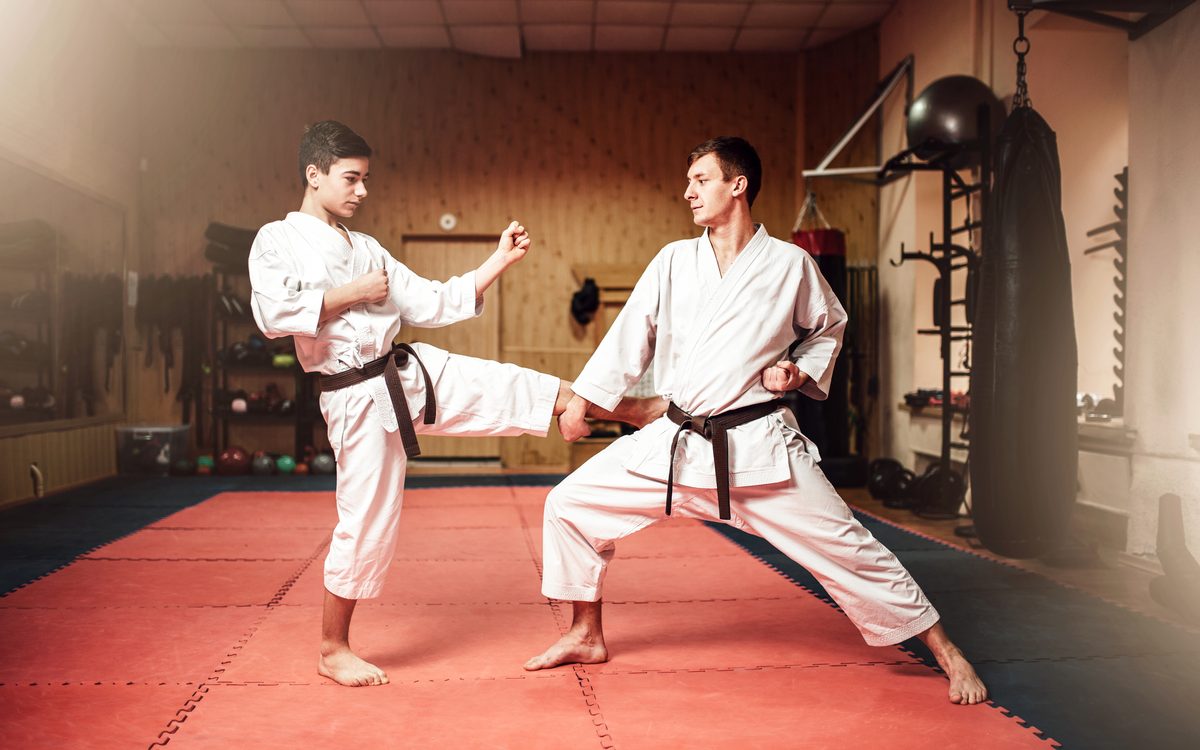
A new student stands at the back of a dojo in a stiff white uniform, copying the class as it bows, steps into a low stance and snaps a punch on the instructor’s count. Nobody is fighting yet. This first month is about posture, balance and listening. Karate (“empty hand”) is a striking martial art from Okinawa, practiced as basics (kihon), forms (kata) and partner work, with sparring (kumite) added later. This page covers how it is scored, the skills a beginner learns, how to start and where the rulebooks are.
Quick answer: Karate has two competition events. In kata, one athlete or a team performs a set sequence and judges score it. In kumite, two athletes spar and score with controlled strikes: 1 point for a punch, 2 for a kick to the body, 3 for a kick to the head. Beginners start with basics and forms in a dojo, not with sparring. Ask any school about its style, its contact rules for your age and its safety policy before you sign up.
How a bout and a performance are scored
Kumite. The World Karate Federation (WKF) describes three scores: yuko (1 point) for a punch to the head or body, waza-ari (2 points) for a kick to the midsection, and ippon (3 points) for a kick to the head or for any scoring technique on a thrown or fallen opponent. A bout is won by an eight-point lead or by the most points at the end. If points are tied, the athlete who scored first (senshu) wins; if nobody scored, the judges decide by flag signal (hantei). The WKF kumite article lists three weight categories each for men and women in Olympic-style events and a bout time of 3 minutes for seniors. In the WKF 2026 rules the time is shorter for younger groups: 2 minutes for cadets and juniors and 1.5 minutes for under-14s (as recorded from the 2026 rules; see the sources file).
Kata. The WKF explains that kata is judged, not fought: the athlete performs a recognised form against imaginary opponents. The federation says 102 kata are approved for competition, that seven judges score, and that 70% of the mark is for technical performance and 30% for athletic performance.
Penalties and control
Karate rewards control, not damage. The WKF groups penalties into two categories: category 1 covers excessive contact and dangerous or forbidden throws; category 2 covers things like feigning injury, leaving the area, avoiding combat, passivity or discourtesy. Warnings go up through chukoku, keikoku and hansoku-chui; a further penalty, hansoku, ends the bout as a disqualification. Rules about contact to the head differ by age group and by edition of the rulebook, so read the one your event uses.
Basic skills you will learn
- Stances (dachi). Front, back and horse stances build leg strength and balance. Expect to hold them longer than you think.
- Basics (kihon). Blocks, punches, and kicks practiced in lines, first slowly and then with speed, in the same rhythm as the class.
- Kata. Beginners learn short forms first. Repetition is the point: the sequence becomes automatic so attention can go to timing and breathing.
- Partner drills. Set exercises with an agreed attack and response, at a pace that both people can control.
- Sparring. Usually introduced after basic control is shown. The American Academy of Pediatrics (AAP) advises that contact and competition for children wait until they have the maturity and skill, and that qualified instructors lead the class.
- Etiquette. Bowing, punctuality, a clean uniform and respect for the instructor and partners. These matter in every style.
Belts, styles and levels
Students progress through kyu (colored belt) grades and then dan (black belt) grades. Because the belt system belongs to each school or organization, the same color can mean different things in different dojos, so ask how grading works and how often tests are held. Many schools teach a traditional style such as Shotokan or Goju-ryu, and some organizations run their own sparring rules, so a dojo’s style and the WKF Olympic-style format are not always the same. Treat “which style and which rules” as the first question for any club.
How a beginner starts
- Visit two or three dojos. Watch a class, then try a free or introductory lesson if one is offered.
- Ask about safety. Is the instructor qualified? What contact is allowed for your age? Is there a concussion plan and a mouthguard rule? Does the club follow a safe-sport policy?
- Start in street clothes or a plain uniform. Most schools sell a karategi and belt; you do not need competition gear to begin.
- Plan on two or three classes a week at first. Our training page covers how much is sensible and what the AAP says about training volume for children.
- Compete later, if you want to. Many students never do.
In the United States, USA Karate is the national body for WKF-style competition. Its site has a club finder, individual and club membership pages, a SafeSport program page, a competition calendar and parent resources. A club listed there is a good starting point, though a listing is not an endorsement of any single school’s teaching. Outside the US, look for the national federation that is a member of the WKF.
Competition levels
The WKF says karate is practiced under national federations worldwide, with continental and world championships at the top. Athletes usually move from local tournaments to regional and national events, then, for a few, to international selection. Karate was on the Olympic program at Tokyo 2020 with kata and kumite. As of 2026 we have confirmed from USA Karate (relaying a WKF notice) that it was not selected for LA28, and Olympics.com lists it as a Tokyo 2020 sport; we could not confirm a place for later Games, so check the official programme. We could not confirm karate as a Paralympic sport. See the karate hub for the full guide and its martial arts parent.
Where to read the official rules
The WKF publishes its kumite and kata competition rules and explainers on wkf.net, and the 2026 kumite rules are a PDF there. Rules are revised every few years, and details such as head-contact limits and equipment have changed between editions, so always use the edition that your tournament names. Local and style-based events often use their own rulebooks; the organizer will tell you which.
Karate rules and starting FAQs
What is the difference between kata and kumite? Kata is a set sequence performed alone or with a team and scored by judges on technique and athletic performance. Kumite is sparring against an opponent and scored on controlled strikes.
How long does it take to get a black belt? It depends entirely on the school or organization and its grading rules, so we do not give a number. Ask a dojo how grading works, how often tests happen and what each level requires.
Do beginners spar right away? Not usually. Many classes start with basics and forms and add controlled partner work, then sparring, as control improves. The AAP advises that children wait for contact until they have the maturity and skill.
What age can a child start karate? Many dojos run classes for young children. The right age depends on the child and the class. Visit and watch, and ask how the instructor handles age-appropriate contact.
Is karate an Olympic sport? It was at Tokyo 2020 only, was not on the Paris 2024 program and is not on LA28. We could not confirm a decision for later Games, so check the official programme for the current Games.
Do I need to buy equipment before the first class? No. Most schools say what to wear, and many sell a uniform. Sparring gear, such as mitts and a mouthguard, comes later. Our karate gear page explains what matters.
Sources
- World Karate Federation: what is kumite
- World Karate Federation: what is kata
- WKF Kumite Competition Rules 2026 (PDF)
- USA Karate (club finder, membership, SafeSport, calendar)
- USA Karate: Update on 2028 (7 October 2023)
- Olympics.com: Karate
- AAP: Youth Participation and Injury Risk in Martial Arts (2016)
General information for education only, not medical advice. It does not replace a visit with a doctor, physical therapist or athletic trainer. See how we write and check our pages in our editorial policy.