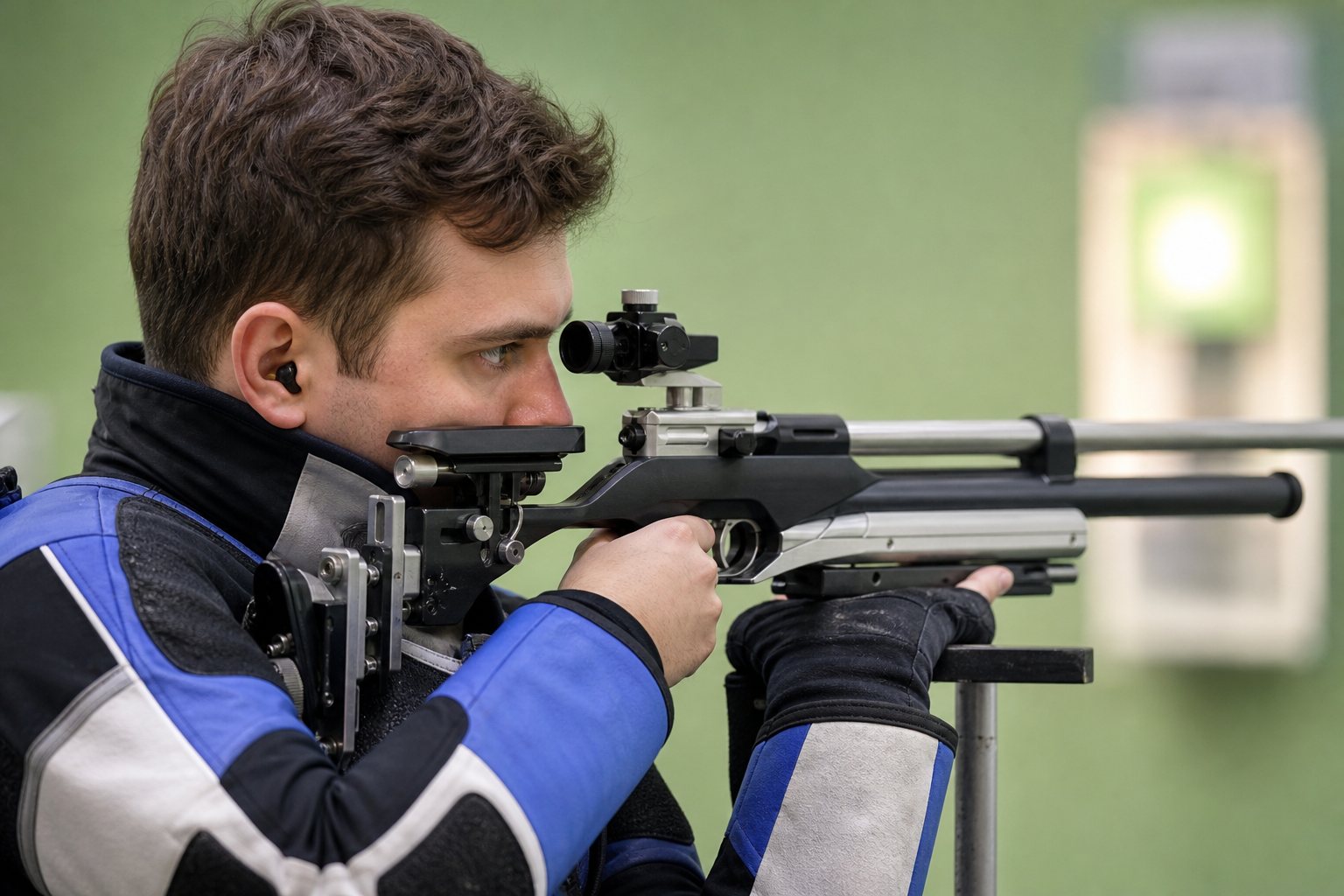
The range at Châteauroux goes quiet. Eight shooters are left in a Paralympic final, every shot is scored to a tenth of a point, and the lowest scorer leaves after each round until two remain for the duel. Para shooting rules look technical from outside, but the idea is simple: put every shot in the centre of the target, calmly, again and again, in a position you can hold. This page covers the skills, how scoring and classes work, and how a beginner can get started. For the wider picture, see the para shooting hub.
Quick answer: Para shooting (shooting Para sport) is precision target shooting with air or small-bore rifles and pistols, adapted for athletes with a physical or vision impairment. Finals use decimal scoring, where a centre shot can score up to 10.9. Athletes compete in sport classes such as SH1, SH2 and SH-VI. Beginners should start with a local adaptive sports organization or a shooting club that runs supervised sessions. The rulebook always overrides a summary like this one.
How a match works
Para shooting uses rifles and pistols at the distances you see in the event names (10 m air events, 25 m and 50 m small-bore). According to Paralympic.org’s Paris 2024 introduction, scores are split into decimals, the best single shot is worth 10.9, the top eight from qualification reach the final, and the lowest scorer is eliminated after each round until two shooters remain for a duel for gold and silver. Pistol events are shot with one hand, seated or standing. Rifle events can be shot standing, kneeling or prone (lying down), and each position can be adapted, including from a wheelchair.
At Paris 2024 there were 13 medal events: three for men, three for women and seven mixed. The IPC says LA28 keeps 13 medal events with 150 athlete places, announced in June 2025. As of 2026, check the official programme for the current Games before relying on any event list; we do not list events here beyond what those two official pages say.
The core skills
Shooting skill is built from a few repeatable parts. The list below is general coaching practice, not a ruling from any rulebook, and a coach who knows your class should adapt it.
- Position and support: a stable, comfortable setup (chair, stool, stand, sling or wheelchair position where the rules allow) that you can repeat. Most beginners spend their first sessions here.
- Aiming: holding the sights or aiming system steadily on the centre. Vision-impaired shooters use an adapted system described in the WSPS technical specifications.
- Breathing: settling the body between shots so the hold is quiet at the moment of release.
- Trigger control: pressing without disturbing the aim.
- Follow-through: keeping the position for a moment after the shot, then calling where the shot went before looking at the target.
- Routine: doing the same steps for each shot. Our mental training page goes deeper on this.
What the classes are for
Classification groups athletes so that results are decided by shooting skill rather than by the effects of an impairment. It is specific to the sport. Paralympic.org’s classification page describes these classes:
- SH1: pistol athletes with an upper and/or lower limb impairment; rifle athletes with a lower limb impairment.
- SH2: rifle athletes with an upper limb impairment who need a shooting stand to support the rifle, with or without a lower limb impairment.
- SH-VI: rifle athletes with a vision impairment, competing in 10 m rifle events.
- Para trap: the page also lists clay-target classes.
An athlete needs an eligible impairment (the page lists impaired muscle power, limb deficiency, hypertonia, ataxia, athetosis, impaired passive range of movement, leg length difference and vision impairment) and must also meet the minimum impairment criteria in the sport’s rules. The forms involved include a medical diagnostics form, and there are separate forms for a medical review request and for a classification protest. The page does not describe who classifies or how class status is granted; the WSPS classification rules do, and they take precedence over any summary. USA Shooting’s 2026 National Para Team qualification document says Para athletes must follow IPC, World Shooting Para Sport and USOPC eligibility rules.
How a beginner starts
The Team USA shooting overview recommends connecting with a local adaptive sports organization that offers shooting, and then a local shooting club to find matches. Ask any program the same practical questions before your first visit:
- Is there a trained range officer or instructor on every session, and do they have experience with adaptive setups?
- Is the firing line accessible (entrance, benches, space for a wheelchair or a stand)?
- Is equipment provided, and who checks it before you shoot?
- Are there trial days, air-rifle or air-pistol sessions, or youth sessions? Availability varies by club and state, so ask rather than assume.
Many programs begin with air rifle or air pistol sessions; the instructor and your range decide what is right for you.
Levels and where to find a program
Club matches and adaptive leagues come first, then national selection. USA Shooting’s 2026 National Para Team qualification document lists junior routes (for example, finishing first in Paralympic events at the Junior Olympics or the USA Shooting National Championships) as well as international selection and a petition process. Internationally, World Shooting Para Sport runs World Cups and World Championships. In April 2026 the ISSF and IPC signed an agreement to move governance of the sport to the ISSF; it depends on ISSF member approval in December 2026, so check which body publishes the current rulebook.
Official rulebooks
The WSPS Technical Rules and Regulations (the 2026 rulebook, in effect from January 2026) and its appendices are on the WSPS rules page, along with an equipment control sheet and VI technical specifications. For safe handling at any range, read the NSSF’s rules of safe gun handling and follow the range officer’s commands. Related sports: sport shooting and para archery.
Frequently asked questions
Do I need a classification to try para shooting?
No. Trying it at a club or adaptive program does not require classification. Classification matters for sanctioned competition; ask the organizer which level of classification the match requires.
What do SH1 and SH2 mean?
They are sport classes. SH1 shooters support their own firearm; SH2 rifle shooters have an upper limb impairment and use a stand to support the rifle.
How is a final scored?
Per Paralympic.org, finals use decimal scoring with 10.9 as the best single shot, and the lowest scorer is eliminated after each round until a gold and silver duel.
Can athletes with vision impairment compete?
Yes. The SH-VI class competes in 10 m rifle events under WSPS vision-impaired technical specifications.
Where can I read the official rules?
On the WSPS rules page on Paralympic.org. The English version prevails over translations.
Sources
- Paralympic.org: Paris 2024 introduction to shooting Para sport
- Paralympic.org: classification in shooting Para sport
- World Shooting Para Sport: rules and regulations
- IPC: LA28 medal event programme and athlete quotas
- ISSF: agreement with the IPC on shooting Para sport
- USA Shooting: 2026 National Para Team qualification
- Team USA: shooting sport overview
- NSSF: rules of safe gun handling
General information for education only, not medical advice. It does not replace care from a sports medicine doctor, physical therapist, athletic trainer or dietitian who knows you and your impairment. See how we work in our editorial policy.