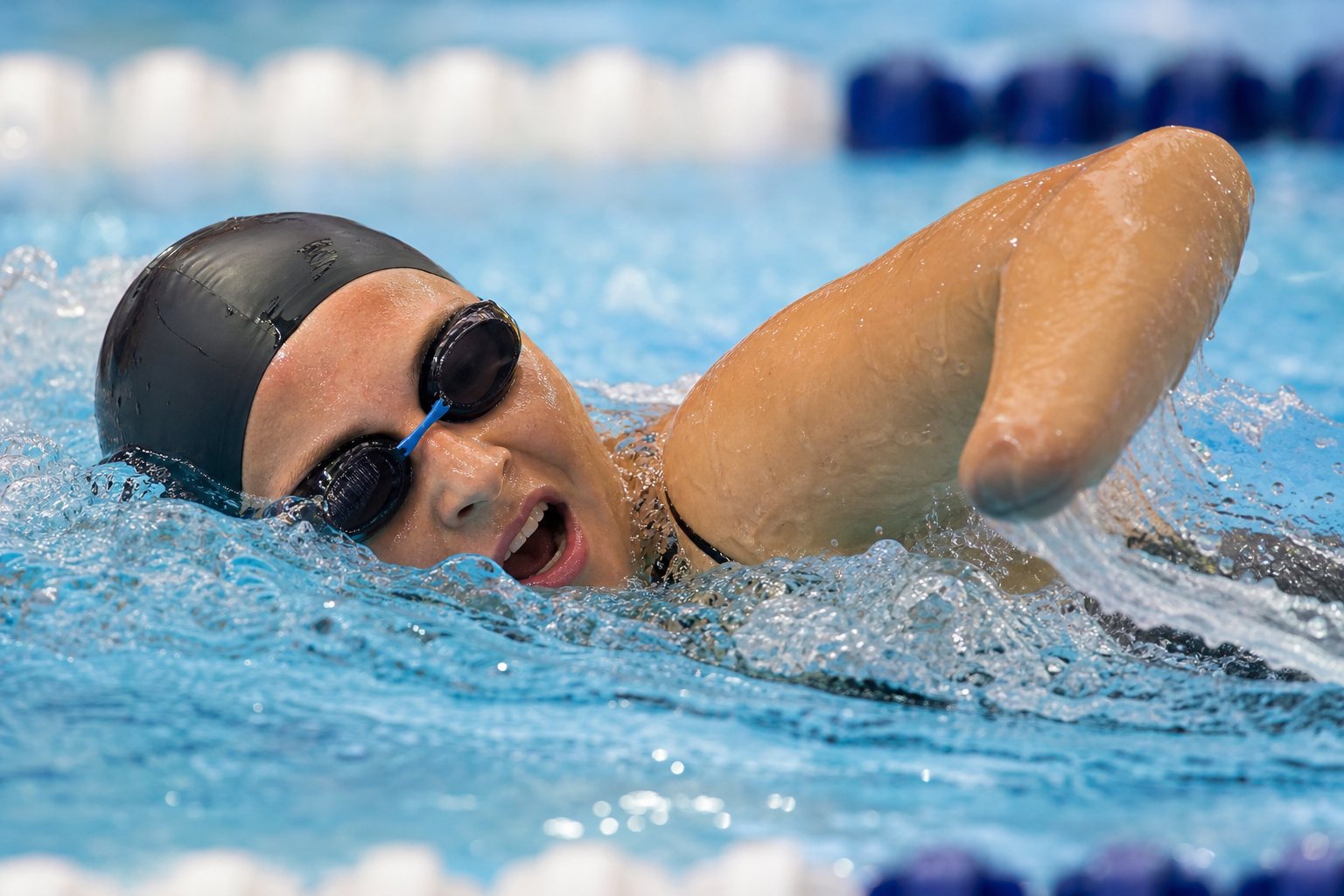
The announcer calls lane six, and a swimmer settles on the edge of the starting block, sitting, one hand on the front. Next to her a swimmer with a vision impairment turns his head to the sound of the whistle, and in lane two a swimmer slides into the water and grips the wall. Para swimming skills, rules and getting started covers how a race works, how the classes are written, which starts are allowed, and how a beginner finds a pool and, later, a classification. For the big picture, start at the Para swimming hub; for the strokes themselves, see the swimming rules page.
Quick answer: Para swimming uses the same four strokes, distances and 50 m pools as other competitive swimming, with an extra code on each event: S (freestyle, backstroke, butterfly), SB (breaststroke) and SM (medley), followed by a sport class number. World Para Swimming’s 2024 rulebook allows adapted starts and a tapper for swimmers with a vision impairment, and bans prostheses and orthoses during a race. A beginner can start at any local pool or adaptive program; classification is only needed for sanctioned competition. See a doctor before starting a new sport if your health condition calls for it.
How a Para swimming race works
The pool, the strokes and the stopwatch are the same as in other swimming: the fastest time in each event and class wins. Paralympic.org says Paris 2024 used a 10-lane Olympic-sized pool with eight lanes in use, and US Paralympics says Para swimming is held in 50 m pools. The World Para Swimming (WPS) rulebook also lists 1.5 km, 3 km and 5 km open water events among those it may select.
Relays are mixed by class. In the April 2024 rulebook, the relay tables set a maximum number of sport-class points for a team: 20 points for 4 x 50 m events and 34 points for 4 x 100 m events in classes 1 to 10.
Sport classes: what S, SB and SM mean
Paralympic.org explains that the letter shows the stroke group and the number shows the sport class: S for freestyle, backstroke and butterfly, SB for breaststroke and SM for individual medley. There are ten classes for physical impairment (1 to 10, with breaststroke written SB1 to SB9), three for vision impairment (11 to 13) and one for intellectual impairment (14). A swimmer can hold different S and SB classes, because breaststroke uses the body differently. SM is calculated from the other two with the formula (3 x S + SB) / 4.
The point of a class is to group swimmers by how an impairment affects swimming, not by diagnosis, so people with different impairments can race each other. Classification is run by the federation; we do not try to explain each class here.
Starts, turns and finishes: what is adapted
From the WPS Rules and Regulations (April 2024), the main start options are listed below. A swimmer’s allowed start is decided in classification and recorded on the federation’s master list, so it is not a free choice on the day.
- Dive from the block. Standing with at least one foot at the front, as in any swim meet. Rule 11.1.2.3 lets a swimmer with only one fully working leg start with a hand or part of the arm at the front instead of a foot.
- Sitting or beside the block. Rules 11.1.2.4 and 11.1.2.5 permit starting beside the platform or sitting on it. A support person may help a swimmer with balance problems stay steady, but may not give momentum.
- In the water. Rule 11.1.2.6 allows a start in the water with one hand on the starting place; standing in the gutter or on the bottom is prohibited. Where a swimmer cannot grip, a support person or a cleared starting device may help (11.1.2.8). Classes 1 to 3 may have feet or limb ends held to the wall (11.1.2.7).
- Visual and sound signals. A swimmer with a vision impairment may orient on the long whistle before the start (11.1.2.1), and a starting light is provided for swimmers with a hearing impairment (11.1.6).
Turns follow the standard principle: a swimmer must make physical contact with the wall and may not step off the bottom (11.8.4). Pulling on the lane rope is not allowed (11.8.5). A swimmer with a vision impairment and a tapper who surfaces in an empty lane is not disqualified (11.8.3.1), and the referee can order a re-swim after an accidental foul (11.8.7.1).
Tappers, blackened goggles and what you may not wear
A tapper is a support person at the end of the pool who taps a swimmer with a vision impairment, with a single or double tap, as the wall approaches. For classes S11, SB11 and SM11 the rulebook makes tappers mandatory at every turn and finish (rule 10.8.3.1) and requires blackened goggles, which are checked at the finish (11.8.8). For other classes tappers are optional and need not be used throughout the whole race or competition (10.8.3.3). Tapping devices must be approved in advance by WPS.
Rule 11.8.9 bans devices or swimsuits that aid speed, buoyancy or endurance (such as fins, webbed gloves and power bands), and bans watches and wearable technology. Rule 11.8.9.1 says no prosthesis (except an ocular one) or orthosis may be used in the race. Cochlear implants and insulin pumps are permitted (11.8.9.2). Our gear page covers everyday pool kit.
How a beginner starts
There is no entry test to swim. The following is general starting advice, not a rule:
- Ask an aquatics center, YMCA, swim school or adaptive-sports group about lessons for swimmers with your needs; many coach swimmers with and without disabilities in the same program. See our swimming rules and youth swimming pages for the standard club route.
- Tell the instructor how you move, what you can see and hear, and agree signals for stopping and for the wall.
- Look at US Paralympics’ about Para swimming page, which links getting-started, camps and clinics and college pages; check those directly for details.
Getting classified for competition (United States)
US Paralympics Swimming says its process follows World Para Swimming rules and starts with national classification. For a physical impairment, you submit the National Medical Diagnostic Form and supporting documents to the USOPC Classification Manager, register for a meet that offers national classification, and are evaluated a day or two before competition by a medical classifier (bench tests) and a technical classifier (in-water tasks). You get a provisional class that is confirmed or changed when classifiers watch you race. For a vision impairment, your ophthalmologist completes a national form that is submitted at least four weeks before a competition. Intellectual impairment eligibility goes through Athletes Without Limits.
International classification needs an IPC license and the World Para Swimming Medical Diagnostics Form submitted at least six weeks before the date, and places are limited by nation. Ask your coach or the US page’s listed contact about the next opportunity; outside the US, ask your national federation.
Levels: where Para swimming goes
US Paralympics describes the pathway: the Paralympic Games every four years, World Championships every two years, regional championships, and the World Series launched in 2017. Paralympic.org lists 141 medal events at Paris 2024, and Para swimming is on the initial LA28 program (15 to 27 August 2028); check the official program for LA28 events.
Rulebook: World Para Swimming Rules and Regulations, April 2024. Related hubs: swimming and Para athletics. Rules change between editions, so the federation’s current rulebook is the final word.
Para swimming rules: FAQs
Do I need to be classified to start swimming?
No. Classification matters for sanctioned Para competition. Anyone can take lessons or join a club program; ask the pool or program what they offer.
What does a tapper do?
A tapper taps a swimmer with a vision impairment as the wall approaches. The 2024 WPS rulebook makes tappers mandatory for S11, SB11 and SM11 and optional for other classes.
Can a Para swimmer wear a prosthesis in a race?
Not during the race. WPS rule 11.8.9.1 says no prosthesis (except an ocular one) or orthosis may be used. Cochlear implants and insulin pumps are allowed.
How can someone with a limb difference start without a block dive?
The rulebook permits starting beside or sitting on the block, or in the water with a hand on the wall, depending on the swimmer’s recorded exceptions.
What do S, SB and SM stand for?
Paralympic.org uses S for freestyle, backstroke and butterfly, SB for breaststroke and SM for individual medley, each followed by a class number.
Sources
- World Para Swimming Rules and Regulations, April 2024
- Paralympic.org: Para swimming classification
- Paralympic.org: Paris 2024, introduction to Para swimming
- US Paralympics: classification
- US Paralympics: about Para swimming
- Paralympic.org: LA28 initial sport programme
General information for education only, not medical advice. It does not replace a visit with a sports medicine doctor, physical therapist or athletic trainer who knows you and your impairment. See how we write and check our pages in our editorial policy, and return to the Para swimming hub.