This article contains affiliate links: if you buy through them we may earn a commission, at no extra cost to you. Read our affiliate disclosure.
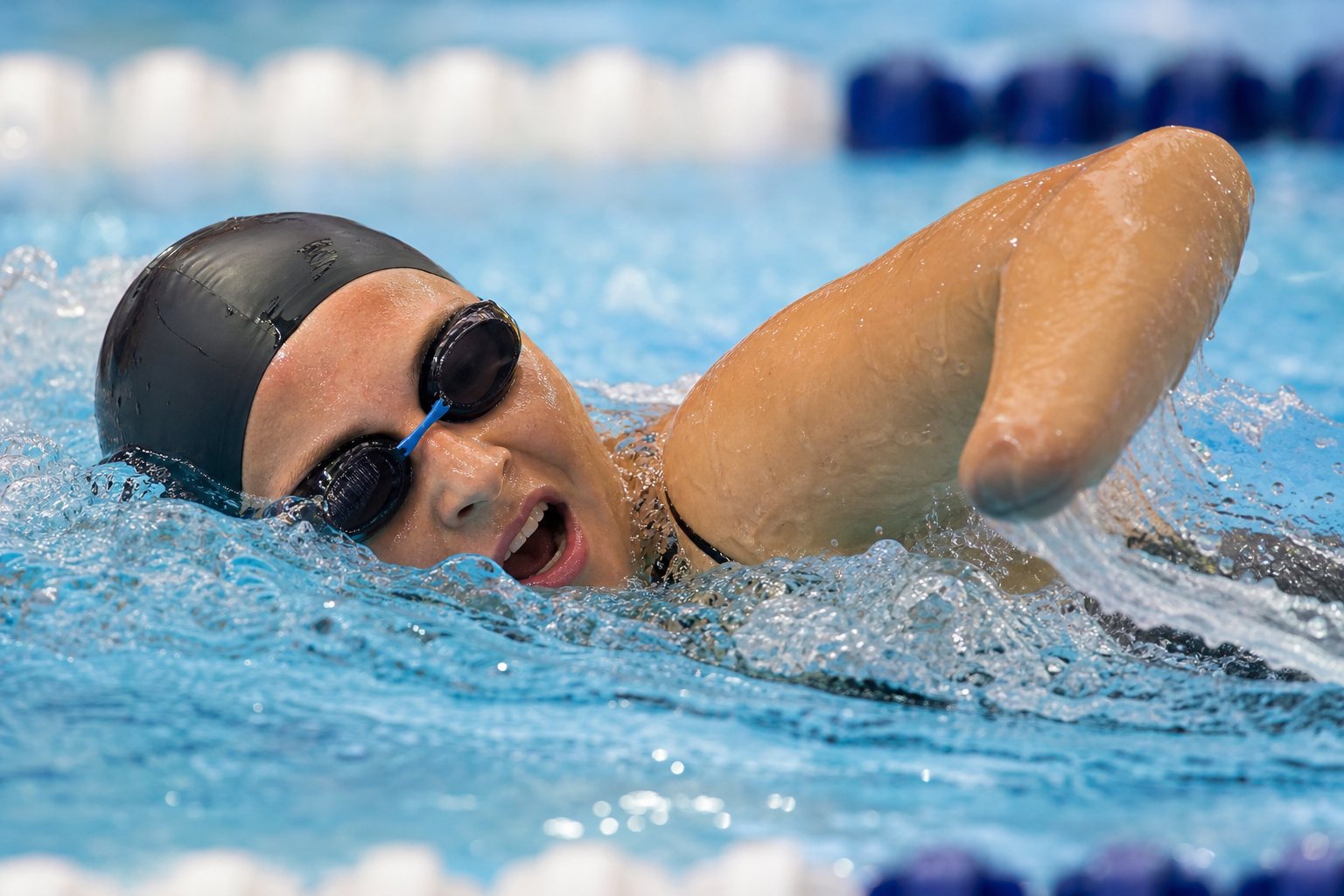
The swimmer’s kit bag is small: goggles, a cap, a towel and, for some, earplugs or a tapper’s pole. For a Para swimmer the rulebook matters as much as the shopping. Para swimming gear and equipment is the everyday pool kit, plus the adapted items some swimmers use at the wall, and the rules about what can and cannot be worn or used in a race. This page separates what the World Para Swimming rulebook actually says from what makers claim on a listing.
Quick answer: In a race, the 2024 World Para Swimming rules ban devices or swimsuits that aid speed, buoyancy or endurance, ban watches and wearable technology, and ban prostheses and orthoses (except an ocular prosthesis); classes S11, SB11 and SM11 wear blackened goggles. For training, the usual swimmer’s kit, goggles, cap and earplugs, applies, but the right choice depends on your body, so ask your coach. Ear pain or drainage, eye problems or skin irritation from kit should be seen by a doctor.
General information, not medical advice. Rules change between editions; check the current rulebook and your national federation before a meet.
What the rulebook says (April 2024 edition)
- No performance aids (11.8.9). No device or swimsuit that may aid speed, buoyancy or endurance, with fins, webbed gloves and power bands named as examples. No watches, wearable technology, communication or data-collection devices. Goggles may be worn. Taping is not permitted unless approved under Regulation 6.6.2, and strapping or improper use of swimwear that limits movement is prohibited.
- No prostheses or orthoses (11.8.9.1). Not during the race, except an ocular prosthesis. Cochlear implants and insulin pumps are permitted (11.8.9.2).
- Blackened goggles (11.8.8). Swimmers in S11, SB11 and SM11 must wear opaque goggles, which are checked at the finish. Those whose facial structure will not support goggles must cover the eyes with an opaque covering. If goggles fall off in the dive or break mid-race, there is no disqualification (11.8.8.1).
- Tapping devices (10.8.3.2). Must be approved, recorded and judged safe in construction and length by World Para Swimming before use.
- Starting devices (11.1.2.8). A device that helps a swimmer who cannot grip the wall at a water start must be cleared and deemed safe by the officials before competition. A single layer of towel on the platform may be used to prevent abrasion (11.1.2.9).
Support persons and equipment that help in daily life, such as wheelchairs or transfer aids on deck, are matters for the meet organiser and your classification record, so ask before the competition. See also Para swimming rules.
Goggles: fit and the blackened pair
Fit matters more than brand. Goggles should seal around the eye socket without pressing on the nose or temples; a leak or fog interrupts a race. Silicone gaskets and adjustable nosepieces are common features on training pairs; those are maker claims, not tested standards. For S11 swimmers, blackened goggles are a competition requirement, so practice with the opaque pair in training. If you are in the class and the goggles will not fit your face, the rulebook lets you cover the eyes another way, so talk to your coach and officials early.
Caps, earplugs and the ears
A cap keeps hair out of the face and reduces drag; silicone and latex-free options exist for swimmers with latex allergy. Earplugs are a personal choice: some swimmers use them to keep water out. If you have a cochlear implant, hearing aid or ear tubes, follow your audiologist’s advice, since the rulebook permits cochlear implants but a specialist should advise on water protection. Do not push earplugs deep or keep using them if you have ear pain or discharge; see a doctor. We did not find a published standard that tests swim earplugs for infection prevention, so the listing text below is the maker’s.
Training aids: check before you buy
Pull buoys, fins, paddles, kickboards and snorkels are coaching tools. They are banned in a race, and not every tool suits every impairment: a pull buoy assumes legs that float or are held still, and fins and paddles add load to the shoulder, which the Para injury studies identify as the joint to protect. Ask your coach or physical therapist whether a tool helps you, and add it slowly. See Para swimming training and injury prevention.
Prostheses, liners and wheelchairs near water
The rulebook bars prostheses and orthoses in the race. For training and for getting to the deck, a prosthetist can advise on water-safe options and skin care, and a wheelchair user can ask the pool about access ramps, lifts and a deck chair. These are general practice points; we found no published standard for swim-specific prosthetic equipment. Dry skin carefully and check for pressure points after sessions.
Inspect your kit
- Check goggle straps and gaskets for stretch, tears and cracks before each meet; replace if they leak.
- Look at the cap for thin spots or rips, and wash chlorine off after use.
- Wash and dry earplugs and discard worn ones.
- Test any tapping pole or starting device with your coach before race day and check that it has the required approval.
These checks are general good practice, not a standard.
Everyday pool kit: three listings
The cards below are everyday training items, taken from the makers’ listings. No listing here is tested for a Para swimmer’s needs, and we cannot say any is right for you; the best choice is the one that fits and that you can use safely.

Speedo Vanquisher 2.0 Mirrored Swim Goggles
- Panoramic lens
- Anti-fog, UV protection
- Interchangeable nosepieces


Mack's AquaBlock Swimming Earplugs
- Silicone
- Reusable
- 2 pairs
$6.99 at Amazon, as of Nov 17, 2026 02:07 UTC
Check price on AmazonMore on kit for all swimmers is on our swimming gear page, and the Para swimming hub links the rest of this series.
Para swimming gear: FAQs
Can Para swimmers use a prosthesis in a race?
No. The 2024 World Para Swimming rules say no prosthesis (except ocular) or orthosis may be used during the race. Cochlear implants and insulin pumps are permitted.
What goggles do S11 swimmers wear?
Blackened (opaque) goggles. S11, SB11 and SM11 swimmers must wear them in competition, and officials check them at the finish.
Are fins and paddles allowed in races?
No. Fins and webbed gloves are named in the rulebook as banned aids. They are used only in training.
Can I wear a watch or fitness tracker?
Not in a race: the rules ban watches and wearable technology. Training use is up to your coach and the pool.
How do I choose goggles?
Choose by fit: a good seal without pressure. Maker claims like anti-fog are not independent tests, so try them on and ask your coach.
Sources
- World Para Swimming Rules and Regulations, April 2024
- Paralympic.org: Para swimming classification
- US Paralympics: about Para swimming
- Speedo Vanquisher 2.0 goggles (Amazon listing)
- Speedo silicone swim cap (Amazon listing)
- Mack’s AquaBlock earplugs (Amazon listing)
General information for education only, not medical advice. It does not replace a visit with a sports medicine doctor, physical therapist or athletic trainer who knows you and your impairment. See how we write and check our pages in our editorial policy, and return to the Para swimming hub.