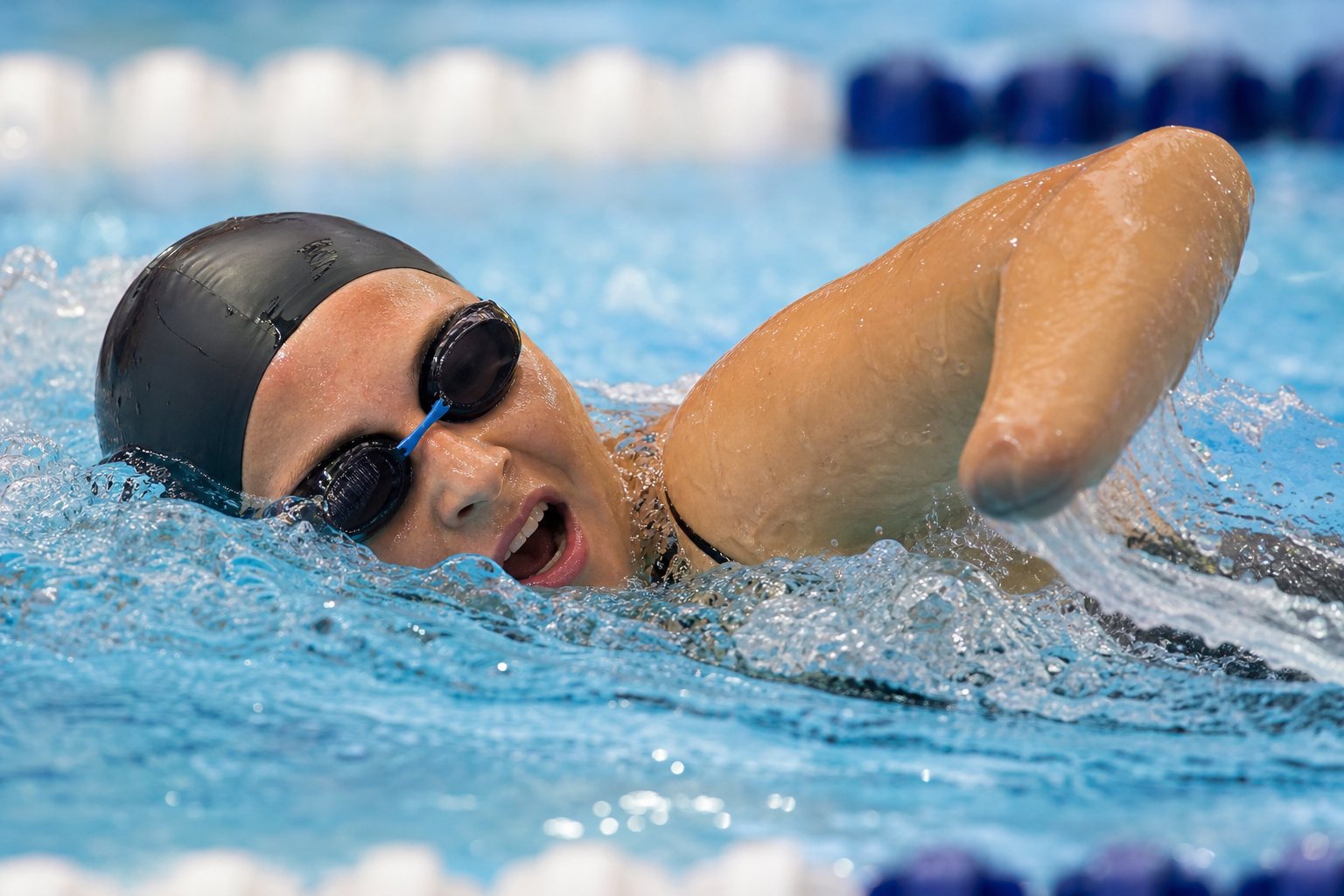
A swimmer finishes a hard set, rests an arm on the lane rope and rubs the front of her shoulder. It has ached for two weeks, a little more each session, and she has told no one because the meet is soon. Para swimming injuries are the aches, strains and accidents that keep swimmers out of the water, and the research on them is newer and smaller than for other sports. This page gives the patterns with the numbers and where they come from, general rehabilitation principles, and when to get help. It does not diagnose, clear anyone to return, or give recovery times.
Quick answer: The studies we found point to the shoulder as the most troublesome joint for Para athletes, including swimmers, and to illness (especially infections) as a separate issue at Games time. Para swimmers had lower injury odds than Para athletics athletes in one Brazilian study, which does not make the pool risk-free. Lasting pain, night pain, weakness, a head injury or any sign of infection or skin breakdown should be seen by a sports medicine doctor, physical therapist or athletic trainer who knows Para sport.
General information, not medical advice. Ways to lower risk are on our injury prevention page.
What the surveillance numbers say
At the Paris 2024 Paralympic Games, 4,450 athletes from 163 National Paralympic Committees were followed for 14 days (62,300 athlete days) in a study by Derman and colleagues (British Journal of Sports Medicine, 2026). It recorded 535 injuries, or 8.6 per 1,000 athlete days, and 19.1% of injuries led to time lost from training or competition. Taekwondo (27.3), football 5-a-side (22.3) and sitting volleyball (19.9) had higher injury incidences than other sports. It also recorded 520 illnesses (8.3 per 1,000 athlete days), with higher rates in female athletes and in triathlon. The abstract we read does not give a figure for Para swimming alone, so we do not quote one.
A 2025 systematic review and meta-analysis (Torvaldsson and colleagues, British Journal of Sports Medicine) pooled 27 Games studies and reported injury incidence of 14.3 per 1,000 athlete days at Paralympic Games, against 6.5 at Olympic Games, but rated the certainty of the Paralympic evidence as low. The IPC’s own surveillance page says Para athletes are slightly more likely to be injured than Olympic athletes and that the upper limbs carry the highest risk. The same page says illness is common, mostly infections of the airways, skin and gut, and that urinary tract infections often affect athletes with spinal cord injury.
Training-season injuries in Para swimmers
A one-year study of 102 Para athletes at two Brazilian centres (Madaleno and colleagues, Brazilian Journal of Physical Therapy, 2025) covered swimming, athletics, powerlifting and taekwondo. It logged 453 injuries and 159 illnesses. Injury prevalence averaged 31.8%, and injuries to the shoulder complex, then the ankle and knee, carried the greatest burden. In a second analysis of the same group (Resende and colleagues, BMJ Open Sport & Exercise Medicine, 2025), Para swimmers had lower odds of gradual-onset (OR 0.65) and sudden-onset injuries (OR 0.52) and less time loss than athletes in Para athletics. Both are single-country studies and the swimming group was small, so please read them as a pattern, not a forecast for any one swimmer.
The shoulder
In a 2026 ultrasound study of 43 elite Polish Para swimmers (classes S7 to S10), 22 had chronic rotator cuff tendinopathy and 21 did not, and the tendinopathy group had thicker supraspinatus tendons, a different internal tendon structure and a wider gap between the bony roof of the shoulder and the upper arm bone (acromiohumeral distance) (Pozarowszczyk-Kuczko and colleagues, Journal of Clinical Medicine). It is a cross-sectional snapshot, so it cannot say what caused what. A study of Japanese female Para swimmers (Shimura and colleagues, 2025) found reduced shoulder range of motion in swimmers with a forearm deficiency compared with swimmers with a vision impairment, a reminder that two Para swimmers can have different shoulder demands. A common sign of trouble is pain with reaching, pulling or breathing to one side, or pain at night; see a clinician rather than swimming through it.
Head injuries
Concussion can happen on a deck slip, a wall hit or a collision in an open lane. A 2024 narrative review (Teodoro and colleagues, Healthcare) calls for concussion incidence measures in Para sport for athletes with vision impairment, and notes that evidence is limited and not specific to swimming. The CDC’s HEADS UP guidance says a person with a suspected concussion should stop activity and see a healthcare provider, and that danger signs such as repeated vomiting, a seizure or growing confusion need emergency care. Return is a decision for a licensed health professional.
Pain, sleep and mood are part of the picture
In a 52-week study of 107 Swedish elite Para athletes (Fagher and colleagues, PM&R, 2023), about half reported pain in an average week (49.9%), 60.9% reported sleeping 7 hours or less and 34.1% reported anxiety or depression. In exploratory analysis, these were not linked to the next injury in that study, but they show Para athletes carry more than injuries, and that pain is common enough to ask about. A 2025 study from the same group (British Journal of Sports Medicine) found athletes with more active coping behaviour were less likely to report an injury.
General rehabilitation principles
These are general principles from sports medicine practice, not a plan: get the problem assessed; reduce the activity that provokes it rather than stopping everything; keep the rest of the body training where it is safe to do so; rebuild strength and range of motion in steps with a professional; and return to full training gradually. The American Academy of Orthopaedic Surgeons’ OrthoInfo page on swimming injury prevention says not to train through pain. For Para swimmers, a clinician who knows the swimmer’s impairment, equipment and transfers should shape any plan, and no one else can say when a swimmer is ready to race.
When to see a professional
- Emergency now: head injury with danger signs, neck pain after a fall, a swimmer with a spinal cord injury who suddenly feels very unwell with a possible autonomic dysreflexia episode, chest pain, or a joint that looks out of place.
- Soon: shoulder pain that lasts or wakes you, new numbness or weakness, a sore or skin break, signs of a urinary or chest infection, fever, or any pain that changes your stroke, start or transfer.
Links: recovery, training and the parent sport’s swimming injuries guide.
Para swimming injuries: FAQs
What is the most common injury in Para swimming?
The shoulder is the main site in the studies we found. In a one-year Brazilian study across four Para sports, shoulder-complex injuries had the greatest burden, followed by the ankle and the knee.
How many injuries happen at the Paralympics?
At Paris 2024, a surveillance study recorded 535 injuries among 4,450 athletes, 8.6 per 1,000 athlete days. The abstract we read gave no separate figure for swimming.
Is Para swimming safer than other Para sports?
In one Brazilian study, Para swimmers had lower odds of injury than Para athletics athletes. It is a small study and not a promise.
Should I swim through shoulder pain?
No. Pain that lasts, wakes you or changes your stroke should be checked by a sports medicine doctor, physical therapist or athletic trainer.
Do Para swimmers get concussions?
They can, from falls or collisions. Evidence on rates is limited. Follow CDC HEADS UP guidance and see a healthcare provider after any head injury.
Sources
- Derman et al. 2026, injury and illness at the Paris 2024 Paralympic Games, BJSM
- Torvaldsson et al. 2025, Games injury and illness meta-analysis, BJSM
- IPC injury and illness surveillance
- Madaleno et al. 2025, 102 Para athletes, Braz J Phys Ther
- Resende et al. 2025, BMJ Open Sport Exerc Med
- Pozarowszczyk-Kuczko et al. 2026, rotator cuff in Para swimmers, J Clin Med
- Shimura et al. 2025, Japanese female Para swimmers, J Phys Ther Sci
- Teodoro et al. 2024, concussion and vision impairment in Para sport, Healthcare
- Fagher et al. 2023, mental health, sleep and pain in elite Para athletes, PM&R
- Fagher et al. 2025, coping and injury in elite Para athletes, BJSM
- AAOS OrthoInfo: swimming injury prevention
- CDC HEADS UP: signs and symptoms
General information for education only, not medical advice. It does not replace a visit with a sports medicine doctor, physical therapist or athletic trainer who knows you and your impairment. See how we write and check our pages in our editorial policy, and return to the Para swimming hub.