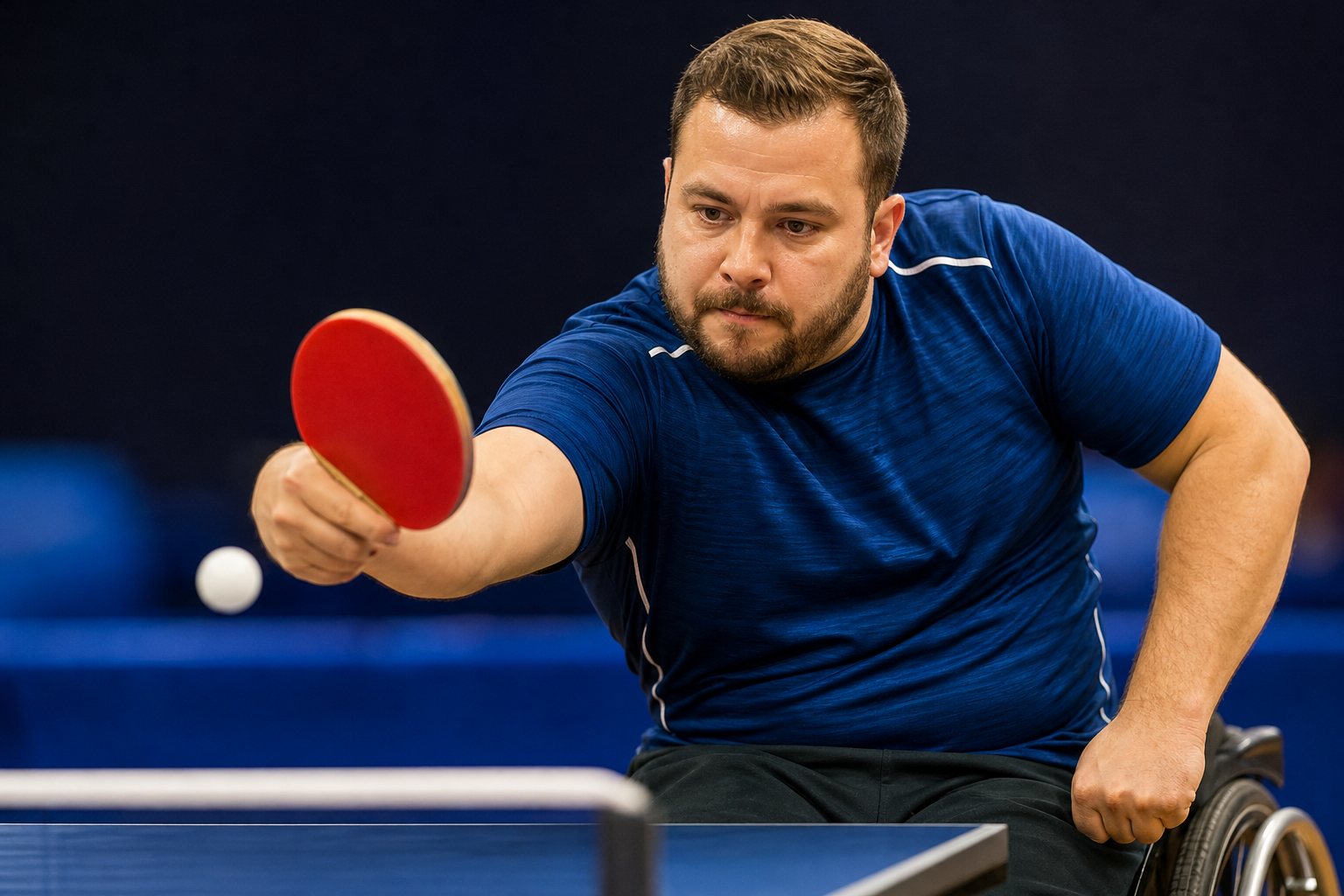
It is 9-9 in the fifth game, and the serve you have used all day suddenly feels like a new skill. Your arm tightens, the ball comes back faster than you remember, and the only way out is through. Para table tennis mental training is the practice of the mental skills that help you play your own game under pressure: focus, routines, goal setting, imagery and a plan for setbacks. It does not guarantee results. It gives you tools. For rules and match timing see our rules page.
Quick answer: The best-supported mental skills for a table tennis player are a repeatable pre-serve routine, a way to refocus after a lost point and practice under pressure. Evidence in para players is thin, so most advice is general. Anxiety, low mood, burnout or eating problems are health matters: talk to a qualified professional, and in the US call or text 988 in a crisis.
Why the mental side matters here
Table tennis leaves very little time to think. A 2026 study of top international matches (Lin and Chen, Acta Psychologica) found that under the eleven-point system players became more radical in tactics at critical points, taking more risks, and suggested more psychological training for high-pressure moments. In an experiment with 30 novices (Sekiya and Tanaka, Perceptual and Motor Skills, 2019), adding a money incentive raised anxiety and heart rate, shortened swings, and led to a “risk-aversive” hitting style. Pressure changes how people play; it is normal, not a failing.
Focus and routines
A pre-serve routine is the simplest tool: the same few seconds of breathing, bouncing the ball or looking at your target before every serve. A 2026 position statement from Exercise and Sport Science Australia on performing under pressure (Schweickle and colleagues, Sports Medicine) lists pre-performance routines among four strategies, and says pressure can help as well as hurt. Between points, many players use a cue word and a slow breath. Table tennis rules give you short breaks, such as a towel break after every 6 points; the laws allow a one-minute time-out, which you can use to reset. A study of eye movements in table tennis (Vincze and colleagues, 2023) found longer final fixations before winners than errors in 10 athletes, which fits with the coaching advice to watch the ball and the opponent’s racket calmly.
Confidence and goal setting
Confidence grows from preparation and small wins. Set goals you control, such as “my serve return stays on the table 8 times out of 10”, not “win the tournament”. Review matches by what you did, and keep a short list of what worked. There is no table-tennis-specific study on goal setting that we could find, so this is general sport psychology practice.
Imagery and visualisation
Imagery means rehearsing a serve or a rally in your head. The evidence in para table tennis is slight. A 2018 report of 3 Korean Paralympic athletes with spinal cord injury (Lim and colleagues, Journal of Exercise Rehabilitation) used 8 sessions of mental skills training covering self-talk, imagery, reframing and routines, and only one athlete used the skills fully in competition. That is a case series, not proof. If you try imagery, keep it short and specific and see whether it helps your play.
Handling pressure and setbacks
- Name it: nerves usually mean the match matters to you.
- Slow down: a 2026 study of 24 college players (Li and colleagues) found a long mentally tiring task left players slower to prepare movement and landing harder, which is a reminder to rest your brain as well as your body.
- Reset after errors: pick one cue and play the next ball, not the last.
- Use practice to simulate: play games from 8-8, with a forfeit or a small stake, so pressure is familiar. This is a coaching suggestion, not a study result.
- Mindfulness: a 2026 study of 90 college players (Qian and colleagues) followed 16 weeks of short mindfulness sessions with better attention scores and lower mental fatigue, though it was not in para players.
Tactics and doubles
Tactical thinking means reading your opponent’s serve, noticing patterns and choosing placement. Class matters: each athlete has strengths and limits, and coaches build tactics around them. We found no table tennis study on doubles communication, so any partner talk about signals, hitting order and who covers which area is general coaching advice.
Competition preparation
Plan the day before the day: when you arrive, when you warm up, what you eat and how you reach the table. Pack your chair tools or spare racket if relevant. Visualise the venue if you can. Ask your coach for a simple plan for each opponent, and for what to do if your match falls behind. The extra practice time allowed before a match is for adjusting to the table and ball, not for trying new strokes.
Mental performance is not mental health
Mental skills can help performance, but anxiety, depression, disordered eating, burnout or thoughts of self-harm are health issues, not coaching ones. The IOC consensus statement on mental health in elite athletes (2019) says mental health symptoms and disorders are common among elite athletes, can impair performance, and notes the concerns of Paralympic athletes. In a 2025 survey of 93 para-athletes (Yildiz and colleagues, PLOS ONE), exposure to bullying behaviour was linked with burnout scores. Para athletes also report real benefits: a multi-country survey of 1,208 young people (Puce and colleagues, 2023) found competing para-athletes reported higher well-being than disabled people who did not compete, though acquired disability was linked with lower well-being. If you are struggling, talk to your doctor, a sport psychologist or counsellor. In the US, the 988 Suicide and Crisis Lifeline offers free, confidential help by call, text or chat, at any time.
Para table tennis Mental Training FAQs
Does mental training work for para table tennis players?
Skills such as routines and refocusing are widely used, but para-specific evidence is thin. Treat them as tools to test, working with a coach or sport psychologist.
How do I stop choking at match point?
Pressure is normal. Many players rely on a pre-serve routine, a slow breath and a focus cue, and practise pressure situations beforehand. No technique guarantees results.
Is visualisation useful in table tennis?
Some players find it helpful. Evidence is slight; a small Paralympic case series found mixed use of mental skills in competition.
How can parents or coaches help a nervous young player?
Keep goals about effort and learning, keep the routine consistent, and watch for signs of anxiety or burnout that need professional support.
When should I seek help for stress or low mood?
If it lasts, affects sleep, eating, school or work, or you feel hopeless, speak to a doctor or mental health professional. In the US, call or text 988 in a crisis.
Sources
- Lin and Chen, Acta Psychol 2026 (PMID 42127687)
- Sekiya and Tanaka, Percept Mot Skills 2019 (PMID 30388394)
- Schweickle et al., ESSA position statement: performance under pressure, Sports Med 2026 (PMID 42271117)
- Vincze et al., Scand J Med Sci Sports 2023 (PMID 36533527)
- Lim et al., J Exerc Rehabil 2018 (PMID 30018920)
- Li et al., Front Psychol 2026 (PMID 42890198)
- Qian et al., Am J Mens Health 2026 (PMID 41721510)
- IOC consensus statement: mental health in elite athletes (2019, PMID 31097450)
- Yildiz et al., PLOS ONE 2025 (PMID 40924689)
- Puce et al., Front Psychol 2023 (PMID 37519377)
- ITTF Statutes 2026 (laws of table tennis)
- 988 Suicide and Crisis Lifeline
General information for education only, not medical advice. See our editorial policy. More: the para table tennis hub, recovery, rules and getting started, the table tennis hub and the sports hub.