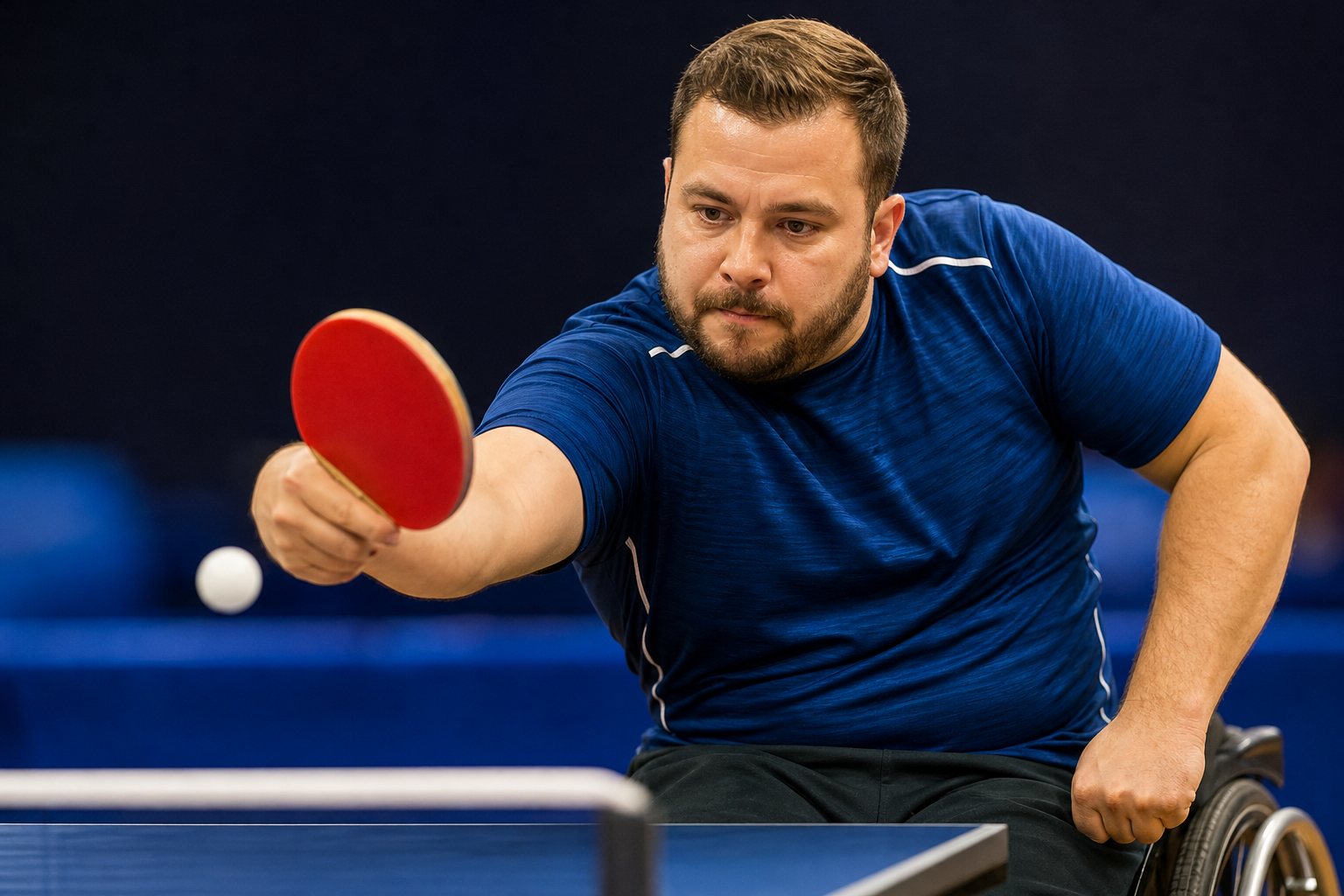
Picture a club night: the tables are lined up, the ball is pinging back and forth, and a new player rolls in unsure whether the sport is really for them. It is. Para table tennis uses the same laws, table, net and ball as the Olympic game, with a few adjustments for athletes with a physical or intellectual impairment. This page explains how a match works, what the classes mean, how classification is arranged and how a beginner finds a place to play. For the big picture see the para table tennis hub; for the strokes themselves, the parent table tennis hub applies.
Quick answer: A para match is first to 11 points (two clear), best of five games, played on a standard 2.74 m by 1.52 m table. Athletes are grouped into 11 classes: 1 to 5 seated, 6 to 10 standing, 11 for intellectual impairment. To start, contact a local table tennis club or USA Table Tennis’s para program; classification for competition is done by ITTF-certified classifiers.
How a match works
The ITTF’s laws of table tennis cover para play too. A game goes to the first player to reach 11 points, but only with a two-point lead, so a game at 10-10 continues until someone is two ahead. Matches are usually the best of five games, and the Paralympic table tennis page says games usually last no more than 30 minutes. Doubles pair players by class, and the table is the standard size, 2.74 m long by 1.52 m wide.
The main adjustments are around serving and the table. A normal serve starts with the ball resting on an open palm and being tossed upward by at least 16 cm. According to the IPC’s overview of the sport, where an athlete cannot do that, the ball may be tossed from the elbow or from the racket instead. For wheelchair play the table legs are set at least 40 cm back from the end line so chairs can roll in, and leaning on the table is allowed as long as it does not move. These are summaries; the full wording sits in the ITTF’s current handbook, so check it before a tournament.
The basic skills a beginner learns
Every table tennis player starts with the same short list, and para players adapt it to their body. Coaches usually teach in roughly this order:
- Grip and ready position: how you hold the racket and where you sit or stand so you can reach the whole table.
- Push and block: simple, controlled returns that keep the ball on the table.
- Forehand and backhand drives: the first attacking strokes.
- Serve: a legal, repeatable serve with a little spin, and then short and long placement.
- Spin and serve return: reading how the ball is spinning and choosing a safe return.
What works for one class may not work for another. A 2021 study with inertial sensors (Yam and colleagues, Sensors) compared 9 able-bodied players with 10 wheelchair players in classes 1 to 3 and found clear differences in elbow and wrist movement, even between classes, and concluded that programs built for able-bodied players are unsuitable for para players. A 2022 case study of an international Class 7 player reached the same conclusion about shoulder movement. The takeaway for beginners is to find a coach who will adapt technique to you rather than copy a textbook model.
The 11 classes in plain words
Classes exist so that results depend on skill and tactics rather than on the size of an impairment. Following the IPC’s classification description, the seated classes are 1 to 5: classes 1 to 3 have little or no sitting balance (class 1 with the playing arm most affected, class 3 with the least arm impairment), class 4 has fair sitting balance and fully functional arms, and class 5 has normal sitting balance. Standing classes are 6 to 10, from severe impairment in both arms and legs (class 6, where some players hold the racket in the mouth) to minimal impairment such as a stiff ankle or wrist of the playing arm or short stature (class 10). Class 11 is for athletes with an intellectual impairment who also meet sport-specific criteria. The IPC page we used for the details dates from 2012, so check the ITTF’s current classification rules for anything that matters for eligibility.
How classification works
Classification only matters once you want to enter classified competition. You can play in a club, in a social league or on a home table without it. When you do want a class, USA Table Tennis describes the steps this way: contact the para program, fill in a consent form and a medical eligibility form that your healthcare practitioner completes, and then be assessed by an ITTF-certified classifier, who issues a classification card. A player found ineligible can be seen again by a different classifier later. After surgery, an injury or a medical change, you see a doctor, repeat the forms and request a new assessment. For an international class, USATT says players must take part in a designated ITTF para tournament. Other countries have their own contacts, so start with your national table tennis federation.
Levels and where to start
The ladder looks like other sports: club and community play, regional and national events, international tournaments and World Championships, and the Paralympic Games. Paralympic status is by edition. Table tennis has been on the Paralympic programme since Rome 1960, and the IPC confirmed it for LA28 (15 to 27 August 2028). As of 2026, check the official programme for the current Games.
- Find a club: USATT keeps a club finder, and many clubs already have wheelchair-accessible tables. Phone first and ask about table height, space around the table and floor surface.
- Ask about para programs: national federations, adaptive sports organizations and rehabilitation centers often run introductory sessions.
- Bring a friend or a coach: one-to-one coaching in the first months pays off, because technique is adapted to your class.
- Rulebook: the ITTF publishes the laws and para regulations; ask a coach to explain the parts that apply to your class.
Equipment on day one
You do not need to buy anything on the first day. Many clubs lend rackets and balls; ask first. When you are ready, ask whether your sport chair or everyday chair is allowed in competition; a 2021 design study (Duvall and colleagues) found para players often use their everyday chair and listed what a chair built for the sport would need: casters that lock facing forward, a high seat that still lets the knees fit under the table and an adjustable seat angle. Our gear page covers this in more detail.
Para table tennis Rules and Getting Started FAQs
Do I need a classification to play para table tennis?
No. Classification is for classified competition. Clubs, social play and training do not require one, so you can start playing before you have a class.
Is the table different for wheelchair players?
It is the same size, 2.74 m by 1.52 m. For wheelchair play the legs are set back at least 40 cm so chairs can reach the end line.
How is a para match scored?
Games go to 11 points with a two-point margin, and matches are usually best of five games, the same as the standard game.
Can I play with only one hand?
Yes. Where a normal palm toss is not possible, the ball may be tossed from the elbow or from the racket. Ask a coach to help you build a serve that works for your body.
Where do I find a coach who understands my impairment?
Start with your national federation or a para program, and ask local clubs whether anyone has coached para players. A physical therapist can also tell a coach what movements to avoid.
Sources
- Paralympic.org: table tennis
- Paralympic.org: 10 things to know about Para table tennis
- Paralympic.org: Para table tennis classification breakdown
- IPC: LA28 medal event programme
- USA Table Tennis: para classification
- USA Table Tennis: US para national team
- USA Table Tennis: club finder
- ITTF: Para table tennis classification rules and procedures
- Yam et al., Sensors 2021 (upper limb kinematics, PMID 34960397)
- Kong and Yam, BMC Sports Sci Med Rehabil 2022 (PMID 35871683)
- Duvall et al., Disabil Rehabil Assist Technol 2021 (PMID 32951495)
General information for education only, not medical advice. See our editorial policy. More: the para table tennis hub, training, gear, the table tennis hub, para badminton and the sports hub.