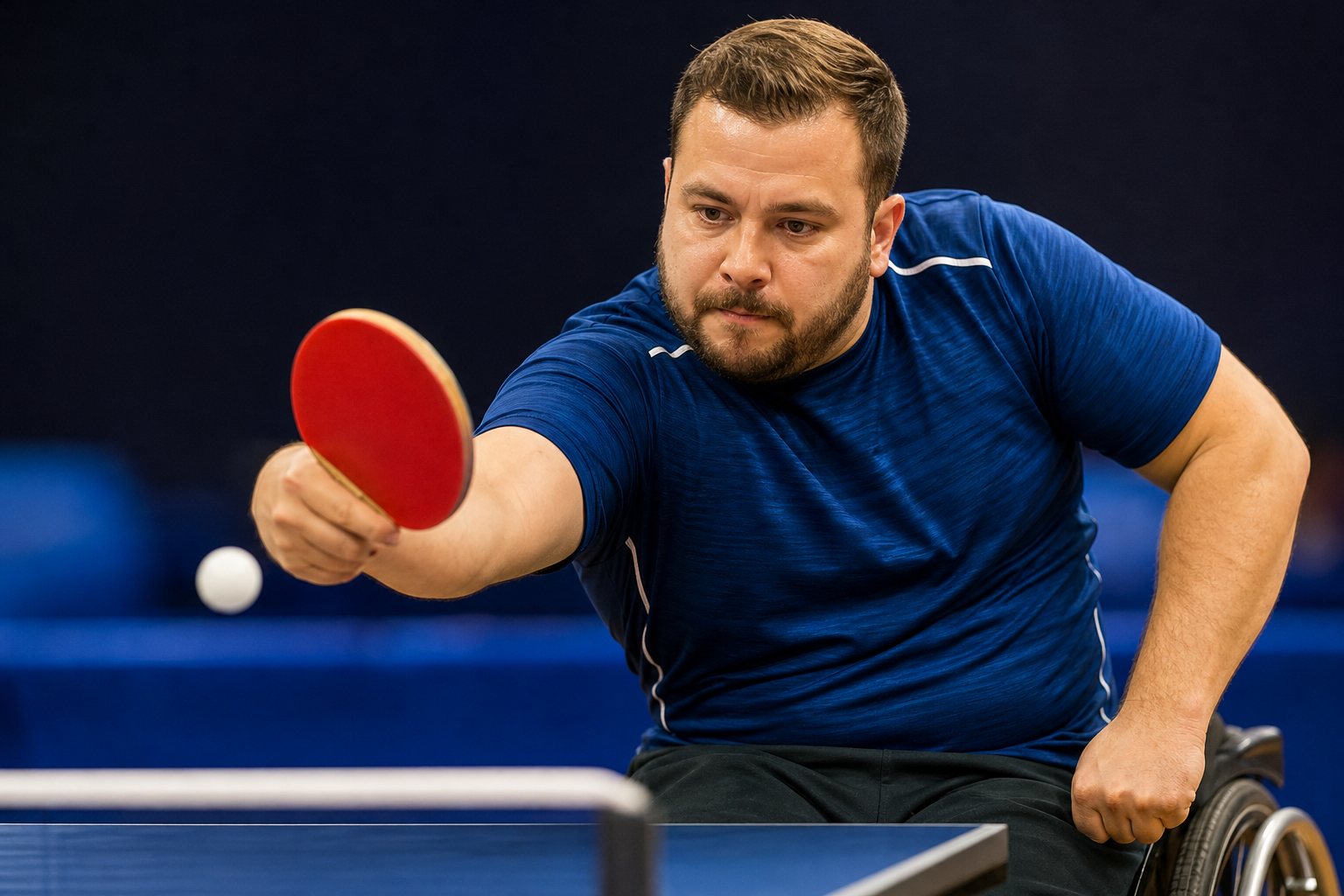
A ball leaves the opponent’s racket and you have well under a second to read the spin, choose a stroke and get there. That is table tennis, and para players do it with the whole body doing different jobs: arms and trunk in a chair, or quick short steps in a standing class. Para table tennis training is the practice, conditioning and rest that prepares an athlete for those moments, shaped around the athlete’s class and impairment. This page gives a sensible weekly shape and the evidence behind it. Rules are on our rules page, and the table tennis hub has the strokes and general drills.
Quick answer: Table tennis is a short-rally, mostly aerobic game, so training mixes technique, multiball, match play, some strength work and rest. There is little sport-specific evidence for para players, so copying an able-bodied routine is not enough: plan with a coach who knows your class and a clinician who knows your impairment.
What the sport demands
A review of table tennis physiology (Zagatto and colleagues, Journal of Sports Sciences, 2018) put the average rally at about 3.5 seconds with 8 to 20 seconds of rest, an effort-to-rest ratio of roughly 0.15 to 0.22 in official matches, and a relatively low energy demand. A 2026 mini-review of nutrition for table tennis (Wang and colleagues, Frontiers in Nutrition) estimated, from a simulation, that about 97 percent of the energy comes from the aerobic system. Both papers describe standing athletes, so treat them as a rough guide only: no source we found measures these numbers for seated or para classes.
What the para studies do show is that movement differs by class. In a 2018 study (Zemkova and colleagues, International Journal of Sports Medicine), 11 wheelchair table tennis players turned the trunk more slowly than 13 able-bodied athletes, and the authors linked that to a more limited range of trunk rotation. Sensor studies of forehand and backhand drives (Yam and colleagues 2021; Kong and Yam 2022) conclude that para players should develop movement strategies that suit their impairment rather than copy able-bodied technique.
A sensible weekly shape
There is no published weekly template for para table tennis, so the plan below is general coaching practice, not a sourced prescription. Adjust it with your coach and clinician.
- 2 to 3 table sessions: technique drills and multiball (a coach or machine feeds balls in a pattern), then match play against different styles.
- 1 to 2 conditioning sessions: shoulder and upper-back strength, trunk work suited to your balance, and for standing classes leg strength and balance.
- 1 aerobic session: something you can repeat comfortably, such as rolling, cycling or swimming, to build the stamina for long tournament days.
- At least 1 full rest day, and an easier week every few weeks.
For fitness more broadly, the CDC says adults with disabilities who are able should aim for at least 150 minutes a week of moderate aerobic activity and should talk with a doctor about the amounts and types of activity that suit their abilities. Table time counts as part of that.
Technique, multiball and match play
Most improvement comes on the table. Multiball lets a player repeat the same stroke many times, which is useful for a new serve return or a backhand. A 2024 study with 23 players from the Polish senior Para table tennis team (Galas and colleagues, Adapted Physical Activity Quarterly) showed that a battery of six stroke-accuracy and serve-precision tests was reliable across wheelchair, standing and intellectual-impairment players, which means coaches can track accuracy over time. Practice what you will face: if a rival plays with a short serve and quick returns, drill your own short-serve return.
Strength and conditioning
Para players load their shoulders in play and often outside play too, especially wheelchair users. A 2017 systematic review of shoulder complaints in wheelchair athletes (PLOS ONE) reported rates from 16 percent to 76 percent in the studies it covered, judged the quality of the studies low, and suggested that balanced strength training may help reduce risk. That fits the general advice to train the muscles that steady the shoulder blade and rotator cuff as well as the muscles that swing the racket. Ask a physical therapist for exercises that fit your impairment and any pain history, and build up gradually.
Periodisation: planning a season
Periodisation means arranging training in blocks so that effort rises toward key events and falls afterwards. The usual outline is general practice: a preparation block with more volume and basic strength, a competition block with sharper, shorter, match-like work, and a transition block with easier training. Para players may need to plan around travel, classification events, health issues such as heat or pressure areas, and chair maintenance. Put the dates of your main tournaments on a calendar first, then work backwards.
Staying motivated and measuring progress
Simple measures help: the number of serves in a target zone out of ten, how many returns in a row you can keep on the table, or match results by opponent style. A 2024 study of 39 adults with spinal cord injury (Tsou and colleagues, NeuroRehabilitation) found that a 4-week para table tennis program was associated with better self-efficacy and heart rate variability measures than in a control group, which is a reminder that the sport has benefits beyond results, though the study was small and short.
Para table tennis Training FAQs
How many days a week should a beginner train?
There is no sourced figure for para players. Many coaches suggest starting with two or three short sessions with rest days between, then adding as the body adapts. Check with a doctor or physical therapist about what suits your impairment.
Is para table tennis good aerobic exercise?
It can be. Table tennis is described as a mostly aerobic sport, and a small 2024 study found cardiovascular and self-efficacy changes after a 4-week program in adults with spinal cord injury. It does not replace your own medical advice.
Should wheelchair players lift weights?
Many do some strength training, and a 2017 review of wheelchair athletes suggested balanced strength work may help reduce shoulder risk. Choose exercises with a physical therapist who knows your impairment.
What is multiball training?
A coach or machine feeds a stream of balls so the player can repeat one stroke many times. It builds technique and consistency, and it should be mixed with real match play.
Can I copy an able-bodied training plan?
Not directly. Studies of para players found different movement patterns by class and recommended individual technique. Use able-bodied plans for ideas, and adapt them with a coach.
Sources
- Zagatto et al., J Sports Sci 2018 (PMID 28582628)
- Wang, Shen and Gao, Front Nutr 2026 (PMID 42434404)
- Zemkova et al., Int J Sports Med 2018 (PMID 30452067)
- Yam et al., Sensors 2021 (PMID 34960397)
- Kong and Yam, BMC Sports Sci Med Rehabil 2022 (PMID 35871683)
- Galas et al., Adapt Phys Activ Q 2024 (PMID 37913764)
- Tsou et al., NeuroRehabilitation 2024 (PMID 39058455)
- Shoulder complaints in wheelchair athletes: a systematic review, PLOS ONE 2017 (PMID 29161335)
- CDC: physical activity for adults with chronic conditions and disabilities
General information for education only, not medical advice. See our editorial policy. More: the para table tennis hub, rules and getting started, injuries, recovery, the table tennis hub and the sports hub.