This article contains affiliate links: if you buy through them we may earn a commission, at no extra cost to you. Read our affiliate disclosure.
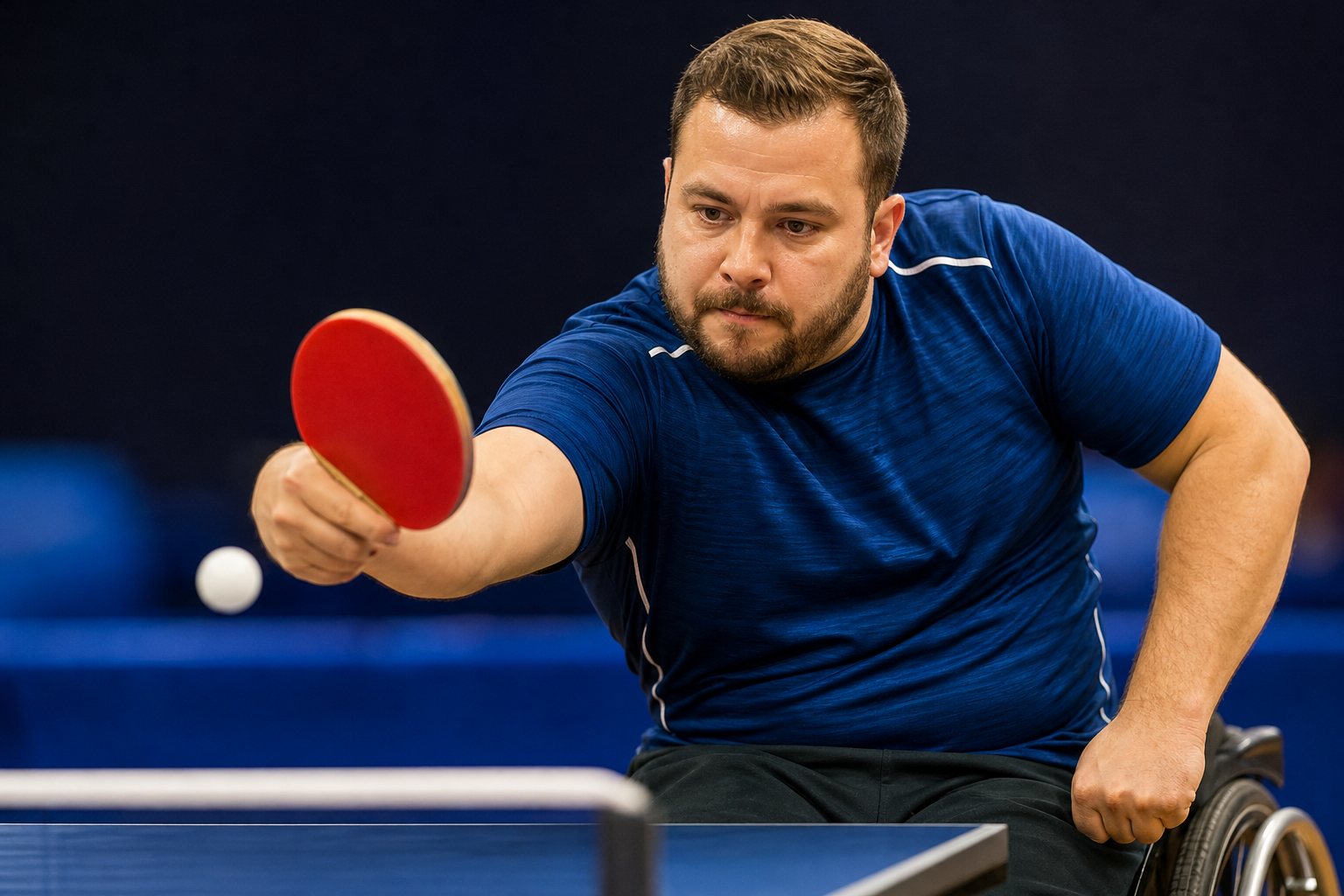
The new player rolls up to the table, hands on the edge, and looks at the racket in the club’s lending box. It is worn, but it is a racket. Good equipment in para table tennis is partly the same as in the standard game and partly personal: a racket that suits your grip, a table you can get close to and, for wheelchair players, a chair set up for the sport. Para table tennis gear has few special items, and most of the decisions are about fit. For rules see our rules page.
Quick answer: Para table tennis uses standard rackets, rubbers, balls and tables, with adjustments for chairs, grip and table clearance. Buy a simple ready-made racket first, check any competition equipment against the ITTF lists, and ask your classifier or coach before modifying a racket or chair. Product claims by makers are not ITTF rulings.
Our picks to start with

Butterfly 603 Table Tennis Racket Set
- Pre-made shakehand racket
- ITTF-approved Wakaba rubber (maker)
- Case included
$102.99 at Amazon, as of Nov 17, 2026 02:07 UTC
Check price on Amazon
Butterfly B401 Shakehand Table Tennis Racket
- Shakehand grip
- Medium speed and spin (maker)
- Racket case

JOOLA Prime 3-Star Table Tennis Balls
- 6-pack
- 40+ mm ABS plastic
- ITTF-approved (listing)
$8.95 at Amazon, as of Nov 17, 2026 02:07 UTC
Check price on Amazon
JOOLA 15mm Indoor Ping Pong Table
- Regulation size
- Quick-clamp net set
- Single-player playback mode
Cards are examples of ready-made equipment we could confirm exists, not endorsements for every class. Check specifications on the listing, and read the table section below before buying a table.
What the rules require
The ITTF’s laws, as set out in its 2026 statutes, say a racket may be any size, shape or weight, with a flat, rigid blade of which at least 85 percent is natural wood. The covering on a sandwich rubber must be under 4.05 mm thick including adhesive, a pimpled covering under 2.05 mm. One side is black and the other a bright colour. Competition coverings must be on the ITTF’s authorised list and carry the ITTF logo near the handle. Plastic balls have been standard since 2014, and the table is 2.74 m long and 1.52 m wide. Maker words such as “approved” or “tournament grade” are claims until you see the logo or list entry.
Rackets and grip adaptations
Beginners are well served by a pre-made racket with approved rubber; separate blades and rubbers come later, and a coach can guide them. Rackets are shaped for shakehand or penhold grips, and para players pick what feels natural. According to the IPC’s classification description, some Class 2 players tape the racket to the hand to compensate for weak grip, and some Class 6 players hold the racket with their mouth. Whether and how a racket may be attached depends on the rules for your class, so ask your classifier or national federation before you modify anything.
Tables, space and wheelchair clearance
The IPC says that for wheelchair play the table legs are set at least 40 cm back from the end line so chairs can roll in. Many home tables have legs near the ends and a braced frame, so check clearance before buying: a home table listed as regulation size does not mean it suits a wheelchair. Competition play needs a large clear space, and the ITTF statutes give 14 m by 7 m for the playing area. A 2026 study of 20 class C3 players (BaniSaaed and colleagues, Disability and Rehabilitation: Assistive Technology) tested a modified table with a safety line 20 cm from the net, which reduced playing depth and lengthened rallies, as an experiment, not a rule.
Sport chairs and seating
Players often use their everyday chair. A 2021 design study (Duvall and colleagues) asked what a chair made for table tennis would need and found three things: casters that lock facing forward, a seat that can be raised as high as possible while the knees still fit under the table, and an adjustable seat angle, with forward tilt letting some users raise the trunk and backward tilt giving stability to others. That is a design study, not a regulation. For competition, ask your coach and federation what the ITTF wheelchair rules allow. Cushions and straps relate to skin health and safety, so choose them with your own clinician. Check the chair before every session (see injury prevention).
Shoes, clothing and extras
Standing players need shoes with a good grip and a stable base; seated players need clothing that moves with the arm and does not catch in wheels. Keep a towel, a spare racket and water in your bag. A ball machine or robot can multiply practice, but check that the table and floor suit it and that you can safely reach the balls.
How to choose
- Start with a simple racket and approved ball, and a club table.
- Check table clearance and floor space before buying anything big.
- Ask your classifier or coach before changing a racket or chair for competition.
- Treat maker speed and spin ratings as marketing; look for ITTF logos and lists.
- Keep equipment in good condition: replace worn rubber, wipe balls and racket after play.
Para table tennis Gear FAQs
What racket should a beginner para player buy?
A ready-made shakehand or penhold racket with approved rubber is a sensible first buy. Try a few at a club first, and ask a coach about grip.
Can I use my everyday wheelchair for table tennis?
Many players do. A design study suggests sport-specific chairs could be better, but check the ITTF rules and ask your coach before changing a chair for competition.
Do wheelchair players need a special table?
It is the standard size, but for wheelchair play the legs are set at least 40 cm back from the end line so chairs fit. Check clearance on any table you buy.
Can the racket be attached to the hand?
Some players with limited grip tape the racket to the hand. Check the rules for your class with your classifier or national federation first.
Are ITTF-approved balls and rubbers required?
For ITTF competitions, equipment comes from the ITTF lists. For club and home play, any good ball and racket will do.
Sources
- ITTF Statutes 2026 (laws and equipment regulations)
- ITTF: List of Authorised Racket Coverings
- Paralympic.org: 10 things to know about Para table tennis
- Paralympic.org: Para table tennis classification breakdown
- Duvall et al., Disabil Rehabil Assist Technol 2021 (PMID 32951495)
- BaniSaaed et al., Disabil Rehabil Assist Technol 2026 (PMID 41902656)
- Amazon listing: Butterfly 603 racket set
- Amazon listing: Butterfly B401 racket
- Amazon listing: JOOLA Prime 3-Star balls
- Amazon listing: JOOLA 15mm indoor table
General information for education only, not medical advice. See our editorial policy. More: the para table tennis hub, injury prevention, the table tennis hub, para badminton and the sports hub.