This article contains affiliate links: if you buy through them we may earn a commission, at no extra cost to you. Read our affiliate disclosure.
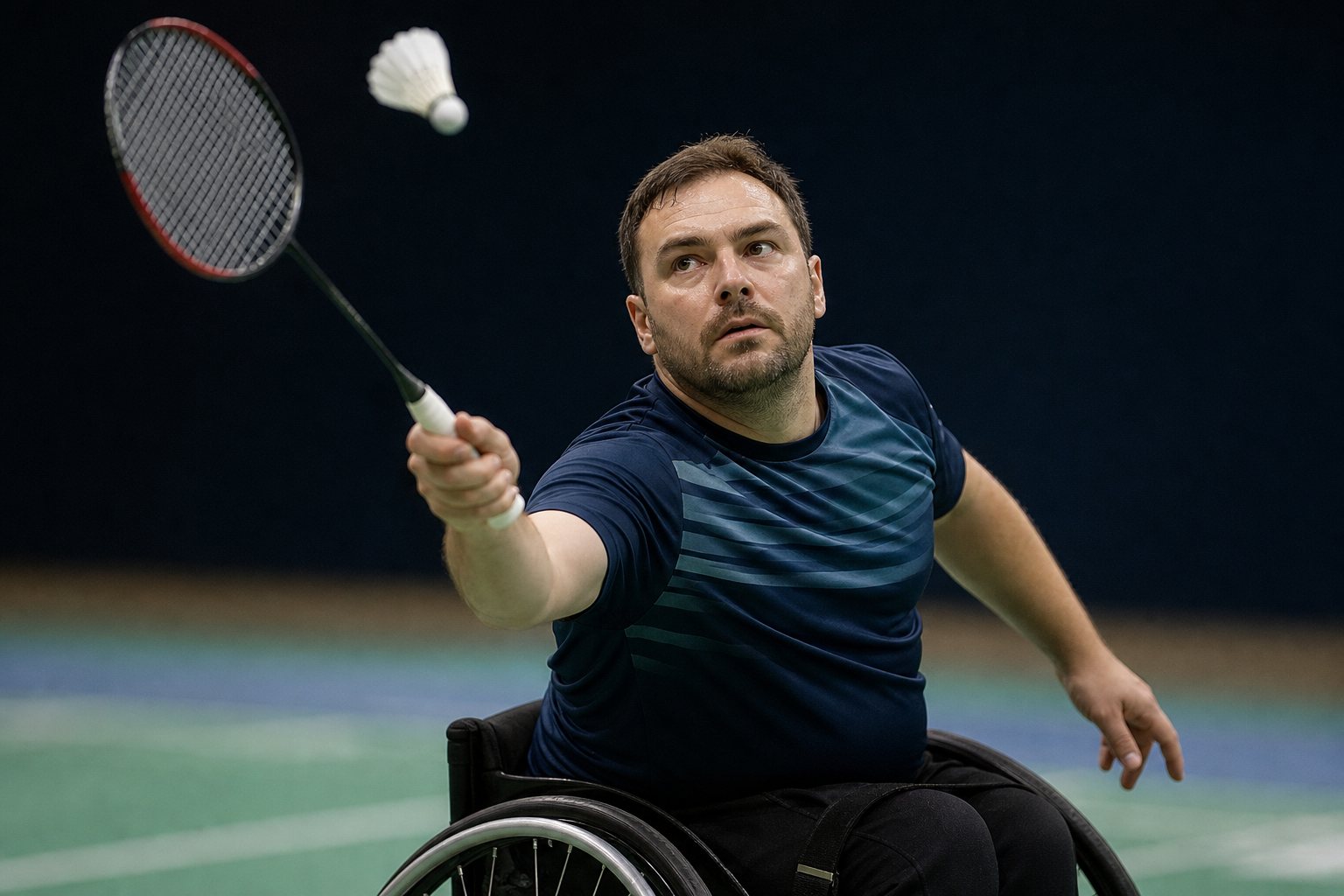
A wheelchair player stretches wide to meet a clear, spins the chair on its back wheels and drives a smash that lands inside the line. In the next court a standing player with a prosthetic leg is racing the shuttle to the net. Both are playing the same fast game, and both are in the Paralympic Games, where badminton made its debut at Tokyo 2020. Para badminton (also written parabadminton, or called adaptive badminton) is badminton for athletes with a physical impairment, played on a standard court with the same rackets and shuttles, in six sport classes.
Para Badminton guides: what do you need?
New to para badminton? Start with the first card. Everything here is general education, not medical advice.
History & Origins of Para Badminton
Para badminton grew out of the Stoke Mandeville tradition of sport for disabled athletes. Its first governing body, IBAD, was founded there in 1995, and the first World Championships followed in the Netherlands in 1998. In 2011 the Badminton World Federation took over the sport, and it made its Paralympic debut at Tokyo 2020. At Paris 2024 there were 16 medal events with 120 athletes from 31 nations. Classes cover wheelchair players (WH1, WH2) and standing players with different impairments (SL3, SL4, SU5, SH6) (Paralympic.org).
- 1995: IBAD, the first governing body of the sport, is founded in Stoke Mandeville, England.
- 1998: First Para badminton World Championships, in the Netherlands.
- 2011: The Badminton World Federation (BWF) takes over governance of the sport.
- 2020: Para badminton debuts at the Tokyo Paralympics (held in 2021).
- 2024: Paris: 16 medal events, 120 athletes from 31 nations.
Notable Athletes of Para Badminton
These athletes are listed alphabetically by surname, not ranked, and none of them endorses AthleteRx. Medal facts come from each athlete’s page on Paralympic.org.
- Daisuke Fujihara (JPN) SL3 player who won the bronze-medal matches in both men’s singles SL3 and mixed doubles SL3-SU5 at Tokyo 2020 (Paralympic.org).
- Lucas Mazur (FRA) SL4 men’s singles player, the Tokyo 2020 Para badminton champion in his class and a reigning world and European champion in 2019.
- Leani Ratri Oktila (INA) SL4 player who won two gold medals at Tokyo 2020, the sport’s Paralympic debut, and her first world title in 2019.
Official results and records
For current champions and records, go to the official sources below. We do not copy results tables here unless we have checked them on the official page.
- Paralympic.org: Para badminton
- Badminton World Federation (BWF), for World Championships results and rankings
How we keep this current: we re-check facts after each major championship and update this page. Spot an error? See our editorial policy.
This guide explains how the game works, what the classes mean in everyday words, how to get started in the United States and how to stay healthy on court. It is general information, not medical advice. Your own clinician should guide training and return from injury.
Para badminton at a glance
| What it is | Badminton for athletes with a physical impairment, played standing or in a wheelchair, in six sport classes. |
|---|---|
| How it is won | Best of three games to 21 points; at 19-all a side must lead by two (IPC). The BWF has approved a new 3×15 system for the sport from January 2027 (see below). |
| Events | Men’s and women’s singles and doubles, and mixed doubles. At Paris 2024: 16 medal events, 120 athletes from 31 nations (IPC). |
| The court | 13.4 m long and 6.1 m wide, net 1.55 m high for all classes. Wheelchair singles and class SL3 use half the court. |
| Governing body | Badminton World Federation (BWF), which took over from the International Badminton Association for Disabled in 2011. USA Badminton in the United States. |
| Season | International circuit year-round, with Para World Championships; the Paralympic Games every four years. |
How para badminton works
The rally rules are those of badminton: serve diagonally, keep the shuttle in the air, win the rally when it lands in the opponent’s court. According to the IPC, a game goes to 21 points, and at 19-all a side needs a two-point lead to win. What changes is the court. Wheelchair singles and standing class SL3 are played on half the court. Doubles use the full court except the area near the net. The net is the same height for every class.
In 2026 the BWF membership approved a new scoring system of three games to 15 points, in force from 4 January 2027 for badminton. We could not confirm from an official source whether and when the same system applies to Para badminton, so check the BWF Para regulations for the current rules.
The six sport classes in plain words
Players compete only against others in their own class, or in doubles in combinations the rules allow. Descriptions below are the IPC’s and Paralympic Canada’s general descriptions, not the full eligibility rules.
- WH1: wheelchair players with significant impairment in both legs and the trunk, for example after a spinal injury.
- WH2: wheelchair players with impairment in one or both legs and little or no trunk impairment.
- SL3: standing players with leg impairment and reduced balance when moving, for example a single above-knee amputation, both lower legs amputated or cerebral palsy.
- SL4: standing players with a milder leg impairment, such as a single below-knee amputation or a leg-length difference of at least 7 cm.
- SU5: standing players with an impairment in one or both arms, for example an upper-limb amputation.
- SH6 (written SS6 by some sources): players of short stature, for example due to achondroplasia.
Classification is how an athlete gets a class: USA Badminton says a new Para player must be a USA Badminton member and be assessed by a Para National classifier. That means submitting a medical diagnosis form to the USA Badminton Classification Manager and attending an evaluation, often at an international event with a classification panel. Dates and steps change, so confirm them with USA Badminton before you plan.
Who plays it and at what level
Beginner and club. USA Badminton suggests starting by connecting with a local adaptive sports organization that offers badminton or a local badminton club. Para players train with the same rackets and shuttles as everyone, and club sessions give you court time and coaching. For those aiming at competition, USA Badminton recommends training at least five days a week with a coach or training group.
International. Para badminton has been played internationally since the 1990s; the first world championships were held in the Netherlands in 1998, according to the IPC. The BWF now runs the international circuit, including a Para World Championships scheduled for Brazil in February 2028.
Paralympic Games. Para badminton debuted at Tokyo 2020. At Paris 2024 it had 16 medal events and 120 athletes from 31 nations. Para badminton is one of the 22 sports confirmed for the LA28 Paralympic Games, held 15 to 27 August 2028; the IPC’s June 2025 quota announcement lists 16 medal events (seven men’s, seven women’s, two mixed) and 120 athlete places. The schedule is subject to change, so check the official programme for the current Games. We did not find school or college Para badminton programs in the sources we used; ask your local club or adaptive sports organization what exists near you.
Physical demands
Badminton is a game of short bursts: repeated sprints or chair pushes, quick changes of direction, and explosive overhead strokes. A 2026 study that recorded muscle activity in nine elite Para badminton players found the wrist and elbow muscles worked hardest during the forward swing of a smash, and that the lats and abdominals also switched on to support the swing. The authors suggested that wrist stability and good control through the trunk and shoulder should be a focus of injury prevention. For wheelchair players, the chair handling, trunk control and shoulders are the engine; for standing players, balance and the strength of the stronger limbs matter. The details change with the class, so a coach who knows your impairment is worth gold.
Health and safety for para badminton
Research on injuries in Para badminton specifically is limited. We found no surveillance figure for Para badminton alone, so the numbers below are for para sport in general.
- Overall injury picture: the Paris 2024 Paralympic surveillance study followed 4,450 athletes over 14 days and recorded an injury incidence of 8.6 per 1,000 athlete days, with taekwondo, 5-a-side football and sitting volleyball higher than other sports. A 2024 systematic review of para sport found injury rates ranging from 0 to 91 per 1,000 athlete days depending on the sport and the impairment, and little evidence yet on which prevention steps work.
- Shoulders: in a one-year Brazilian study of 102 para athletes in four sports (not badminton), the shoulder complex carried the greatest injury burden, followed by the ankle and knee. Overhead sport and wheelchair use both load the shoulder, so build in rest, technique work and strength with a professional’s help.
- Eyes: a shuttle or racket can reach the eye in any racket sport. The American Academy of Ophthalmology publishes a clinical statement on protective eyewear for young athletes, and sports eyewear for racket sports is typically tested to ASTM F803; look for that marking (the product below states it, which is a maker claim).
- Falls and chair tips: a head knock needs the CDC HEADS UP steps: stop, watch for headache, dizziness, confusion or balance trouble, and have a healthcare provider decide when you can return. Call 911 for danger signs such as repeated vomiting, a seizure or one pupil larger than the other.
- Heat and skin: hot gyms and long sessions are tiring, and some impairments change how the body handles heat or pressure. Drink water, take breaks, and ask your clinician what applies to you.
If something hurts for more than a day or two, swells, or feels unstable, see a sports medicine doctor, physical therapist or athletic trainer.
Training, recovery and nutrition pointers
Our parent pages cover the basics: badminton training, badminton recovery and badminton nutrition and supplements. Adapt them to your class with a coach: wheelchair players usually train shoulders, trunk and chair skills; standing players add balance and footwork for their impairment. USA Badminton says it will distribute warm-ups and routines for each classification. Sleep matters too: the CDC recommends at least 7 hours for adults and 8 to 10 hours for teens.
Gear
Rackets and shuttles are the same as in standard badminton. Wheelchair players use a sports chair set up for the game, which is individual and best chosen with a coach or clinician. For standing players, shoe fit and a prosthesis check matter more than any accessory. Start simple.
- Racket: a head-light, medium-flex racket is forgiving for beginners.
- Shuttles: nylon shuttles last longer for practice; feather shuttles are used in competition.
- Eye protection: racket-sport goggles are worth considering, especially for juniors and doubles players near the net.
- After the match: soft recovery footwear for tired feet; see our recovery shoes guide.

Yonex NanoFlare 1000 Play
- 4U, G5 grip
- Head-light, medium flex
- Pre-strung, cover included

Yonex Mavis 350 Nylon Shuttles (6)
- Nylon skirt, cork base
- Tube of 6
- Speed by temperature

Tourna Clear Eye Protection
- Polycarbonate wrap lens
- Meets ASTM F803 (maker)
- Anti-fog coating
$16.99 at Amazon, as of Nov 17, 2026 01:07 UTC
Check price on Amazon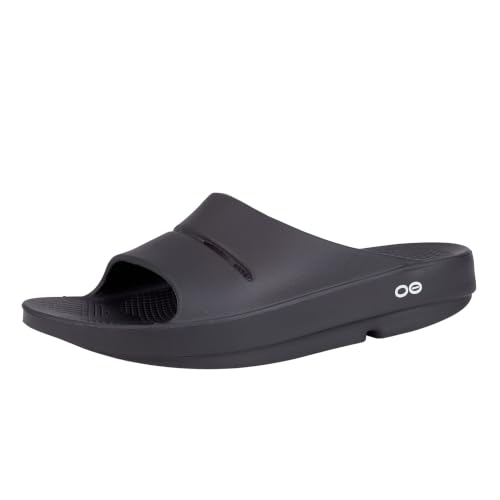
OOFOS OOahh Slide
- OOfoam slide
- APMA Seal of Acceptance
- Machine washable
$59.95 at Amazon, as of Nov 17, 2026 01:07 UTC
Check price on AmazonRelated sports and disciplines
Para badminton is the adaptive form of badminton. If you like racket sports, also see Para table tennis, squash and pickleball. More adaptive sports: Para archery, Para canoe and Para taekwondo.
Para badminton FAQs
Is badminton in the Paralympics?
Yes. Para badminton debuted at Tokyo 2020, had 16 medal events at Paris 2024, and is on the confirmed LA28 programme for August 2028.
Do wheelchair players use the full court?
In singles, no: wheelchair singles are played on half the court, as is class SL3. In doubles, the full court is used except the area near the net, per the IPC.
What do the class names mean?
W means wheelchair, S means standing. WH1 and WH2 are the wheelchair classes; SL3 and SL4 are standing with leg impairments; SU5 is standing with an arm impairment; SH6 is short stature. Within the wheelchair pair and within the SL pair, the lower number is the more impaired class (WH1 and SL3).
How do I get classified in the United States?
Join USA Badminton, send the national medical diagnosis form to the Classification Manager, and attend an evaluation, which may be held a day or two before an event with a classification panel. Confirm the current process with USA Badminton.
Do I need a special racket?
No. Para badminton uses standard rackets and shuttles. A coach can help with grip, string tension and, for wheelchair players, chair setup.
Sources
- IPC: Para badminton
- IPC: Classification in Para badminton
- Paralympic Canada: Para badminton
- IPC: LA28 medal event programme and athlete quotas
- IPC: LA28 initial sport programme
- USA Badminton: Para athletes overview
- BWF: members approve 3×15 scoring system
- Muscle activation in the para-badminton smash, PubMed
- Sports-related health problems in para sports: systematic review, PubMed
- Injuries and illnesses in Para athletes: one-year study, PubMed
- Injury and illness at the Paris 2024 Paralympic Games, British Journal of Sports Medicine (Europe PMC)
- American Academy of Ophthalmology: protective eyewear for young athletes
- CDC HEADS UP: signs and symptoms
- CDC: sleep
Keep exploring: the badminton hub, badminton injuries, badminton gear, our recovery tools guide and the sports hub.