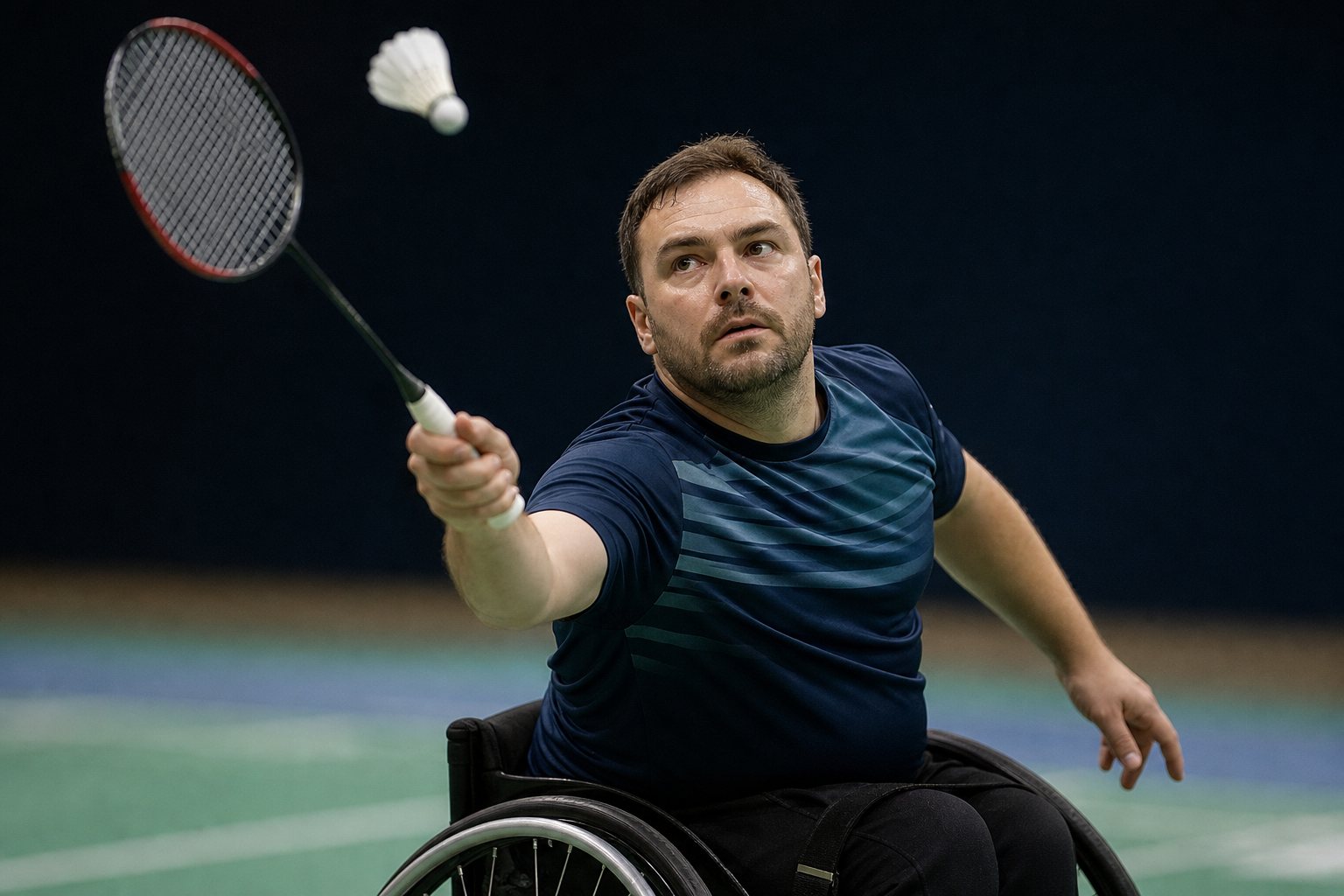
A wheelchair player lands a hard smash, and a few minutes later the shoulder starts to feel hot and stiff. A standing player with a prosthesis stumbles on a lunge and twists a knee. Neither of these is a diagnosis. They are the kind of moments that make people ask what injuries are common in Para badminton. The honest answer is that nobody has published a surveillance study of Para badminton alone, so this page uses the closest evidence available and says so each time.
Quick answer: We found no injury figure for Para badminton specifically. At the Paris 2024 Paralympic Games, 4,450 athletes were followed for 14 days and the injury incidence was 8.6 per 1,000 athlete days (British Journal of Sports Medicine). In a one-year study of 102 Para athletes in four other sports, the shoulder complex carried the greatest burden, followed by the ankle and knee. See a sports medicine doctor, physical therapist or athletic trainer for any injury that lingers, and call 911 after a head injury with danger signs.
General information, not medical advice and not a diagnosis. Ways to lower risk are on the injury prevention page; for the sport itself start at the Para badminton hub.
What the numbers show for Para sport
- Paris 2024 Paralympic Games. Researchers followed 4,450 athletes from 163 National Paralympic Committees over 14 days (62,300 athlete days) and recorded 535 injuries, an incidence of 8.6 per 1,000 athlete days. Taekwondo (27.3), 5-a-side football (22.3) and sitting volleyball (19.9) had higher incidences than other sports, and 19.1 percent of injuries caused time away from training or competition. We did not find a separate figure for badminton in the abstract.
- Tokyo 2020, Team USA. A comparison of 701 Olympic and 245 Paralympic Team USA athletes found no difference in injury incidence between the two groups (incidence rate ratio 1.18, 95 percent confidence interval 0.84 to 1.68).
- A 2024 systematic review of 64 Para sport studies reported injury incidence ranging from 0 to 91 per 1,000 athlete days across sports, and from 1 to 50 across impairment groups. Only three studies tested prevention measures, and 84 percent included elite athletes.
- One-year Brazilian study (2025). Of 102 Para athletes in swimming, athletics, powerlifting and taekwondo, 31.8 percent had an injury at any point in the surveillance weeks, and the shoulder complex, then the ankle and knee, carried the greatest burden. Badminton was not among the sports.
Because the figures come from other sports and games, they describe Para sport generally, not Para badminton, and one number cannot be applied to every class.
Where Para badminton players may feel it
Para badminton is repeated overhead hitting, quick changes of direction or chair turns, and sometimes awkward reach positions. A 2026 electromyography study of nine elite Para players found the wrist, elbow, lat and abdominal muscles all working in the forward swing of a smash, and the authors suggested that wrist stability and control through the trunk and shoulder be a focus of prevention. A review of standard badminton shoulder programs describes the shoulder as vulnerable in overhead athletes. Our best reading, therefore, is that the shoulder, wrist and elbow are places to watch, along with the knees and ankles for standing players. That is an inference from those sources, not a measured pattern in Para badminton.
Head injuries and falls
Chair tips and floor falls can cause a head knock. The CDC HEADS UP guidance says to take the player out of play, watch for signs such as headache, dizziness, confusion or balance problems, and have a healthcare provider decide when it is safe to return. Call 911 for danger signs such as repeated vomiting, a seizure, one pupil larger than the other, or a headache that gets worse. A coach cannot clear a return, and neither can this page.
Injuries from equipment and skin
Where a strap, seat or socket presses on skin, sores can develop, and a poorly fitted chair or prosthesis can load joints in an unusual way. We did not find a published rate for these in Para badminton, so they are listed as a general caution. Check the fit with your clinician or prosthetist and see our gear page.
General rehabilitation principles
The sources we use do not give a Para badminton rehabilitation protocol, and we do not give one here. These principles are what sports medicine professionals generally describe:
- Get it assessed. A sports medicine doctor, physical therapist or athletic trainer can tell a muscle strain from a tendon problem or a fracture, and can adapt the plan to your impairment.
- Relative rest, not total rest. Reduce what hurts, keep what does not, and keep moving other body parts.
- Rebuild gradually. Return to hitting through easier shots, lower volume and strength work. The 2026 narrative review of the Advanced Throwers Ten program in badminton suggests such programs may help the step from rehabilitation back to competition, but it is a review of a program for overhead athletes, not a Para trial.
- Stay within your plan. Return to sport is decided with your clinician, not by a calendar. We do not give recovery times because they vary widely.
When to see a professional
See a sports medicine doctor, physical therapist or athletic trainer if pain lasts beyond a day or two, if there is swelling, a pop, instability, numbness, a skin sore, or if pain changes how you swing or push. Urgent care is for head injury danger signs, severe pain after a fall or a deformed limb. For athletes with a spinal cord injury at or above T6, a sudden pounding headache and a sharp rise in blood pressure can be autonomic dysreflexia, a potentially life-threatening condition (2022 review): use your own emergency plan and call for help.
Para badminton injury FAQs
What injuries are most common in Para badminton?
We found no surveillance figures for Para badminton alone. In a one-year study of other Para sports, shoulder complex injuries carried the greatest burden.
How common are injuries at the Paralympic Games?
At Paris 2024 the incidence was 8.6 per 1,000 athlete days, and 19.1 percent of injuries led to time loss from training or competition.
Is Para badminton more dangerous than other sports?
We cannot say. Paris 2024 data put taekwondo, 5-a-side football and sitting volleyball at higher incidences than other sports, and the abstract does not single out badminton.
Can I play through shoulder pain?
Pain that lasts, grows or changes your stroke should be checked by a sports medicine doctor, physical therapist or athletic trainer before more hard hitting.
When can I return after an injury?
That is decided with your clinician and depends on the injury and your impairment. After a head knock, a healthcare provider decides under CDC HEADS UP guidance.
Sources
- Injury and illness at the Paris 2024 Paralympic Games, BJSM 2025 (Europe PMC)
- Injury and illness among Team USA athletes at Tokyo 2020, 2025 (PubMed)
- Sports-related health problems in Para sports: systematic review, 2024 (PubMed)
- Madaleno et al., one-year study of 102 Para athletes, 2025 (PubMed)
- Electromyographic analysis of the para-badminton smash, 2026 (PubMed)
- Advanced Throwers Ten program in badminton, narrative review 2026 (PubMed)
- CDC HEADS UP: signs and symptoms
- Autonomic dysreflexia following spinal cord injury, 2022 (PubMed)
General information for education only, not medical advice. It does not replace a visit with a doctor, physical therapist or athletic trainer. See how we write and check our pages in our editorial policy. Back to the sports hub and badminton.