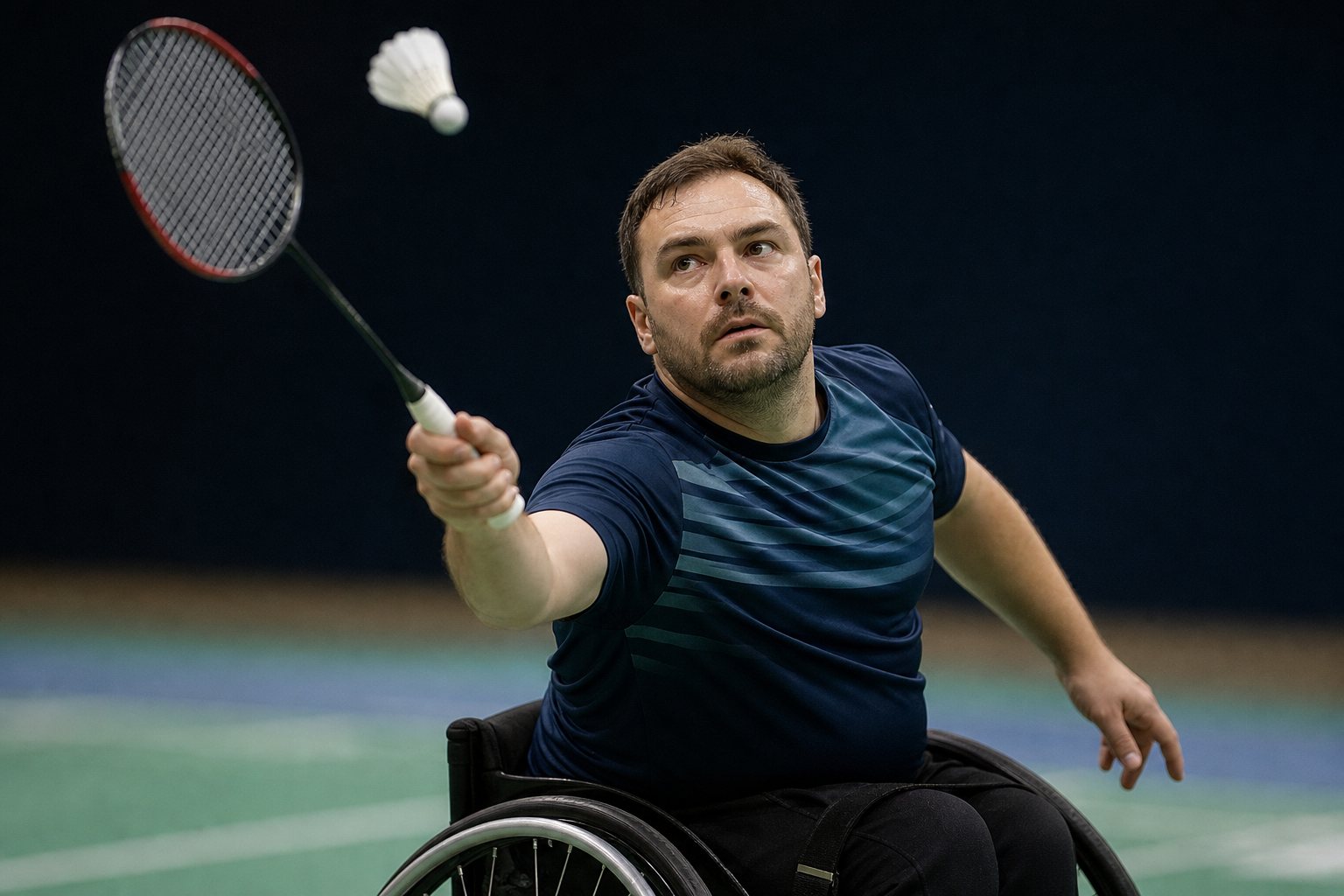
Late in a long rally, the shuttle is still in the air, a wheelchair player is hauling the chair backward on its rear wheel, and the next shot will be an overhead clear from a position that is anything but comfortable. Para badminton training is about being ready for that moment: fast pushes or steps, quick turns, and a swing that stays controlled when the arm is tired. This page covers what the sport demands, how a training week can be arranged, and what to ask a coach who knows your class.
Quick answer: Badminton is made of short bursts with little rest. Research on the standard game finds about 60 to 70 percent of the energy comes from the aerobic system and about 30 percent from the anaerobic system, and a 2026 study of nine elite Para players found wrist, elbow, lat and abdominal muscles all working in the forward swing of a smash. USA Badminton says players aiming to compete should train at least five days a week with a coach or group. Training is individual to your impairment, so work with a coach and your clinician.
General information, not medical advice. Rules and classes are on our rules page; injury questions are on the injuries page.
What the sport asks of the body
A widely cited review of standard badminton (Phomsoupha and Laffaye, Sports Medicine, 2015) describes a game played at a heart rate above 90 percent of maximum, with an energy supply of roughly 60 to 70 percent aerobic and 30 percent anaerobic. We did not find an equivalent study of Para badminton, so treat those numbers as a guide to the sport rather than a measurement of your class.
What we do have for Para play is a 2026 electromyography study (Frontiers in Bioengineering and Biotechnology) of nine elite Para badminton players. It recorded eight muscles during a smash. The wrist muscles (flexor and extensor carpi ulnaris) and the elbow muscles (biceps and triceps) were significantly more active in the forward swing. The latissimus dorsi, the big back muscle, was recruited in the forward swing, and so was the rectus abdominis at the front of the trunk, while the infraspinatus (a rotator cuff muscle) stayed steadily active. The authors describe their work as exploratory, but it fits what coaches teach: a smash is powered by a connected chain from trunk to hand.
Skills first: chair work, footwork and strokes
Para badminton is a skill sport, and the first training priority is usually the skill that is most limiting. Our sources do not rank skills, so these are common coaching practices:
- Wheelchair players: pushing, braking and turning drills, split-second starts, holding a position while swinging, and shuttle-to-racket timing from the chair.
- Standing players: footwork patterns matched to your balance and impairment, recovery to a ready position after each shot, and stroke technique.
- All classes: serves, clears, drops, smashes and net shots, practised first slowly and accurately, then at pace with a feeder or partner.
Strength and conditioning
The EMG study’s authors suggest that wrist stability and good control through the trunk and shoulder should be a focus for injury prevention, and the Brazilian one-year study of 102 Para athletes (see our injuries page) found the shoulder complex carried the greatest injury burden. Both point to the same training targets:
- Shoulder and upper back: rotator cuff and shoulder blade strength, pulling as well as pushing.
- Trunk: control through the trunk is what links the legs or chair to the racket. For WH1 players with trunk impairment, the work is adapted to what the trunk can do.
- Forearm and wrist: grip and wrist stability for the forward swing.
- Legs for standing players, and the stronger side’s endurance: single-leg strength, ankle and hip control, depending on the impairment and any prosthesis.
- Aerobic base: the repeated efforts of a long match need some aerobic fitness, which wheelchair players can build with arm-based work.
Starting weights, sets and repetitions are not given here because we found no sourced prescription for Para badminton. A coach or physical therapist who knows your impairment should set them.
A sensible weekly shape
USA Badminton says players aiming for competition should train at least five days a week and that training requires planning. It has not yet published the class-specific routines it plans to share. This is an example of how a coach might lay a week out, not a prescription from any source:
- Two or three court sessions: skills, footwork or chair drills, then rallies and matches.
- Two strength sessions: shoulder, trunk, forearm and leg or chair-propulsion work.
- One lighter conditioning or mobility session and at least one full rest day.
Beginners and club players can do far less. Three short sessions a week with a coach is a fair place to start, and the number can grow slowly.
Periodisation basics
Periodisation means planning the year so that hard blocks are followed by easier ones and a peak lands on the competition that matters. For a Para player it often looks like a build period (more volume and strength), a sharpening period (match pace, less volume) and a rest or transition period. The details depend on the calendar, which for international players follows the BWF Para circuit. We did not find a published periodisation study in Para badminton, so this is general coaching practice.
A note on unusual methods
A 2026 case report described adding breath-hold running and badminton drills to the Paris 2024 preparation of one elite SH6 player. It was a single athlete, over five weeks and nine sessions, and the authors report only on feasibility and on oxygen saturation and heart rate responses, not on whether it improved results. Oxygen saturation dropped markedly in the sessions. This is not advice to try it, and it is a reminder to ask a clinician before using any method that deliberately stresses the body.
Adapting training for your impairment
Some conditions change how the body handles training. For wheelchair athletes with a spinal cord injury at or above T6, autonomic dysreflexia, a sudden rise in blood pressure, can be life-threatening (a 2022 review in a spine journal), and it is banned in sport when brought on deliberately, a practice called boosting. Heat can also be a problem because sweat response is impaired in many athletes with spinal cord injury (a 2024 study of 15 elite athletes). Tell your coach what applies to you and agree a plan with your doctor.
Para badminton training FAQs
How many days a week should I train?
USA Badminton says a minimum of five days a week for players aiming at competition. Beginners and recreational players can start with fewer.
Is badminton good for fitness?
The standard game is played at a high heart rate with a large aerobic share, according to the 2015 review above. For a Para player, how much fitness you get depends on your class and how hard you play.
Do wheelchair players need different training from standing players?
Yes. The skills (chair control versus footwork) and the limiting body parts differ. A coach who knows your class matters more than any generic plan.
Should I train my shoulders even if they do not hurt?
Shoulder and trunk work is a common focus because the shoulder carries a large injury burden in Para athletes, but ask a physical therapist what suits your body.
How do I find a Para coach?
USA Badminton says coaching locations are to be listed on the Para-Badminton website. Meanwhile ask your local adaptive sports organization or badminton club.
Sources
- Electromyographic analysis of muscle activation across smash phases in para-badminton, 2026 (PubMed)
- Phomsoupha and Laffaye, The science of badminton, Sports Medicine 2015 (PubMed)
- USA Badminton: Para athletes overview
- Madaleno et al., one-year study of 102 Para athletes, 2025 (PubMed)
- Voluntary hypoventilation training in a para-badminton athlete, case report 2026 (PubMed)
- Autonomic dysreflexia following spinal cord injury, 2022 review (PubMed)
- How elite athletes with a spinal cord injury sweat during exercise, 2024 (PubMed)
- Electroceuticals for Paralympic athletes: a fair play and classification concern, 2026 (PubMed)
General information for education only, not medical advice. It does not replace a visit with a doctor, physical therapist or athletic trainer. See how we write and check our pages in our editorial policy. Back to the para badminton hub and the sports hub.