This article contains affiliate links: if you buy through them we may earn a commission, at no extra cost to you. Read our affiliate disclosure.
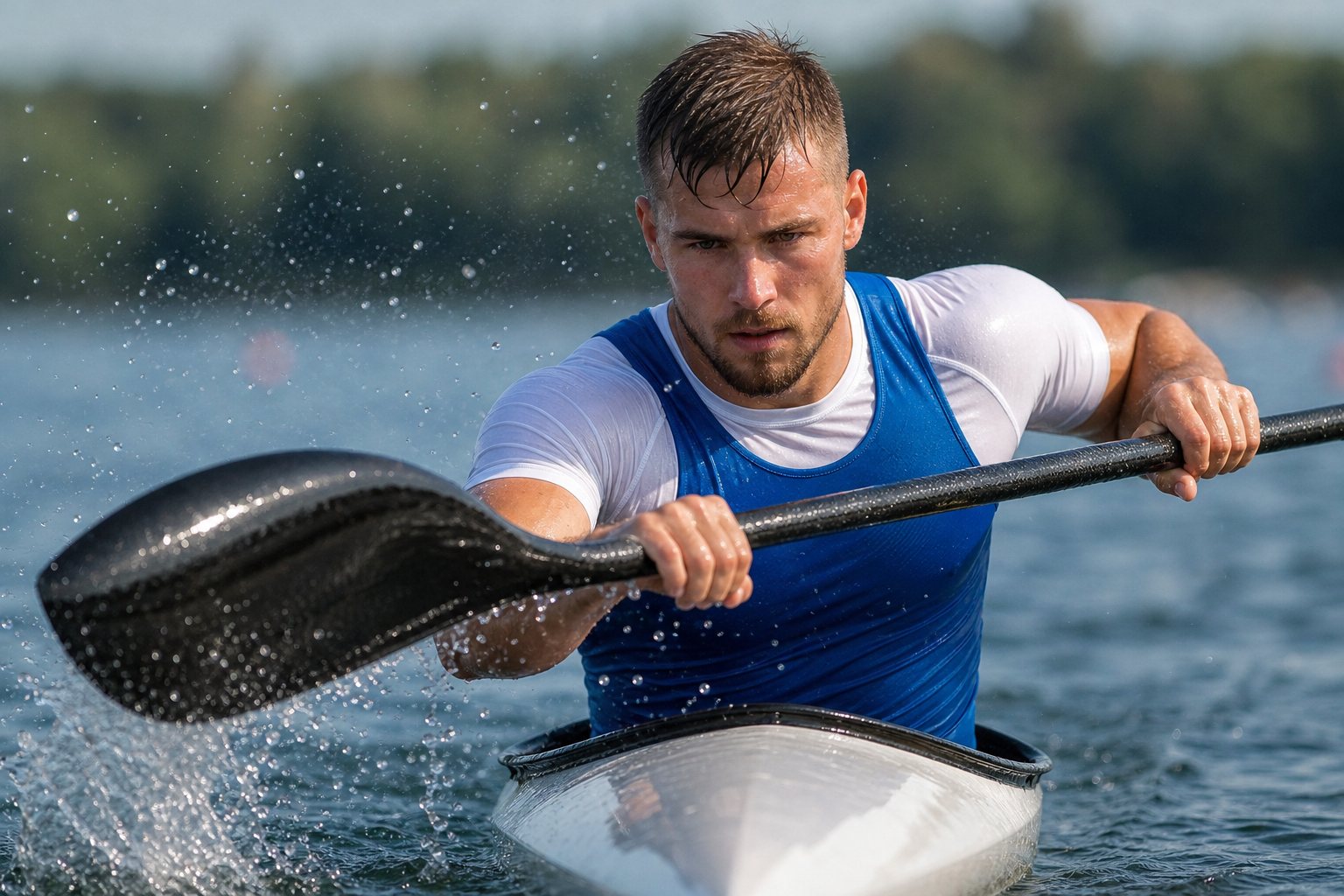
It is 200 meters of open water and a short, all-out effort. A paddler in a narrow kayak leans into the first strokes, the boat lifting and settling, and the finish line comes up before the arms stop burning. Next to her, an athlete in an outrigger canoe digs a single-blade paddle in on one side and holds the line with the boat’s float. Para canoe (also written paracanoe or Para canoe sprint) is flat-water sprint racing for athletes with a physical impairment, in kayaks and in va’a outrigger canoes, and it has been in the Paralympic Games since Rio 2016.
Para Canoe guides: what do you need?
New to para canoe? Start with the first card. Everything here is general education, not medical advice.
History & Origins of Para Canoe
Para canoe started as an exhibition called Paddleability at the 2009 Canoe Sprint World Championships. It was recognised as Para canoe in 2010, when the first Para canoe World Championships were held. It reached the Paralympic Games at Rio 2016 with kayak racing, and va\x27a, a canoe with an outrigger, joined at Tokyo 2020. Racing is over 200 m, in five classes: KL1, KL2, KL3 for kayak and VL2, VL3 for va\x27a (Paralympic.org).
- 2009: Para canoe, then called Paddleability, appears as an exhibition at the Canoe Sprint World Championships.
- 2010: Recognised as Para canoe; first Para canoe World Championships.
- 2016: Paralympic debut at Rio, kayak only.
- 2020: Va’a (outrigger canoe) added at Tokyo (held in 2021).
Notable Athletes of Para Canoe
These athletes are listed alphabetically by surname, not ranked, and none of them endorses AthleteRx. Medal facts come from each athlete’s page on Paralympic.org.
- Curtis McGrath (AUS) four Paralympic golds: KL2 kayak at Rio 2016, Tokyo 2020 and Paris 2024, plus VL3 va’a at Tokyo 2020.
- Susan Seipel (AUS) three Paralympic medals: KL2 kayak bronze at Rio 2016, VL2 va’a silver at Tokyo 2020 and VL2 va’a bronze at Paris 2024.
Official results and records
For current champions and records, go to the official sources below. We do not copy results tables here unless we have checked them on the official page.
- Paralympic.org: Para canoe
- International Canoe Federation, for World Championships results
How we keep this current: we re-check facts after each major championship and update this page. Spot an error? See our editorial policy.
This guide explains the boats, the classes, how to get started in the United States and how to stay safe on the water. It is general information, not medical advice; a sports medicine doctor, physical therapist or athletic trainer who knows your situation should guide your training.
Para canoe at a glance
| What it is | Flat-water sprint racing in kayaks (double-blade paddle) and va’a outrigger canoes (single-blade paddle) for athletes with an impairment. |
|---|---|
| How it is won | Fastest time over 200 meters. At international level all races are individual. |
| Classes | Kayak KL1, KL2, KL3; va’a VL1, VL2, VL3. At Paris 2024 the Paralympic classes were KL1, KL2, KL3, VL2 and VL3 (IPC). |
| Paralympic events | Ten medal events at Paris 2024 and on the LA28 programme: five men’s, five women’s (IPC). |
| Where it is played | Lakes, rowing and paddling basins and sheltered flat water, from local clubs to World Championships. |
| Governing body | Paddle Worldwide (formerly the International Canoe Federation) for canoe; the International Va’a Federation for va’a. The American Canoe Association runs the US program. |
| Season | Mostly warm-weather, outdoor racing; the Paralympic Games every four years. |
How Para canoe works
Racing is simple to follow: paddlers line up and race 200 meters, and the best time wins. What makes the sport special is the boats and the classification. Para kayaks have a wide base for stability. Va’a boats (also called waka ama or outrigger canoes) have an ama, a float on the side, for balance. Seats, sockets and grips can be adapted to the paddler, but athletes may not be attached to the boat, for safety reasons (IPC). The Paddle Worldwide page notes that races at international level are individual.
Classes in plain words
Classes are based on how much leg and trunk function a paddler has, since those drive stability and power. The levels below follow the USOPC and Canoe Racing New Zealand descriptions; the exact eligibility rules are in the Paddle Worldwide classification rules.
- KL1: no or very limited leg function and very limited trunk function. Power comes mostly from the arms and shoulders.
- KL2: no or very limited leg function, with some trunk function kept.
- KL3: the most leg function allowed in the sport, with good hip and trunk function.
- VL2 and VL3: the va’a classes at the Paralympics. VL2 is very limited leg function and hip control with lower trunk function; VL3 is very limited function in one leg or moderate function in both.
An athlete can have a different class in each boat, because the outrigger gives extra stability. The USOPC notes that Para canoe is open only to athletes with impairments of the trunk and lower limbs; upper-limb impairments and leg-length differences are not eligible. Ask Paddle Worldwide or the American Canoe Association for the current rules before you plan.
Who plays it and at what level
Getting started. The American Canoe Association runs the US Paracanoe program. The USOPC says you can fill in the Paracanoe Athlete Interest Form and a staff member will connect you to a local club, and the ACA also has a club locator. At minimum you need a kayak or va’a (adapted if needed) and a paddle; many clubs lend equipment to beginners. National classification happens at Team Selections, where you register and complete the required forms. Check the ACA for current dates.
International. The International Canoe Federation started Paracanoe so that athletes with impairments could compete. It appeared as an exhibition (called paddleability) at the 2009 Canoe Sprint World Championships in Dartmouth, Canada, and became an official event at the 2010 World Championships in Poznan, Poland.
Paralympic Games. Para canoe debuted at Rio 2016 with six kayak medal events. Va’a joined at Tokyo 2020 with three more events, making nine. At Paris 2024 there were ten events, with equal numbers for men and women. Paracanoe is one of the 22 sports on the LA28 Paralympic programme (Games 15 to 27 August 2028), and the IPC’s June 2025 announcement lists 10 medal events (five men’s, five women’s) and 100 athlete places, the same as Paris 2024. The schedule can change, so check the official programme for the current Games. We did not find school or college Para canoe programs in the sources we used.
Physical demands
A 200-meter sprint is mostly a power event: a hard start, strokes at top rate and a finish where everything is spent. The stroke is driven by the shoulders, arms and trunk, and for paddlers with more trunk function (KL3, for example) the trunk rotation adds power and stability. KL1 paddlers rely more on arms and shoulders. A study of elite adolescent flat-water kayak and canoe athletes in China, not Para athletes, found most injuries at the shoulder and lower back, which fits what the stroke asks of the body. A coach and clinician who know your impairment should plan strength, mobility and sprint work.
Health and safety for Para canoe
We found no injury surveillance specific to Para canoe, so the figures below are general.
- Overall picture: the Paris 2024 Paralympic surveillance study (4,450 athletes over 14 days) found an overall injury incidence of 8.6 per 1,000 athlete days. A 2024 review found injury rates in para sport anywhere from 0 to 91 per 1,000 athlete days depending on sport and impairment, and few studies on prevention.
- Shoulders and back: in the adolescent flat-water study of 140 athletes, kayakers reported 0.90 injuries per 1,000 training hours, mostly lower back, shoulder, wrist and knee; canoeists reported mostly shoulder and lower back injuries. In a one-year Brazilian study of para athletes in four other sports, the shoulder complex carried the greatest burden. Rest, technique and warm-up help, and pain that does not settle should be checked by a professional.
- Capsizing and water safety: because athletes are not attached to the boat, a capsize can happen. Wear a life jacket that fits and that is approved by the US Coast Guard (see the USCG guide on choosing a life jacket), paddle with a rescue-capable partner or coach, and practice capsize recovery under supervision. Ask your club about its safety plan and adapted rescue methods.
- Cold water: the National Weather Service warns that cold water can quickly cut breathing control and strength. Dress for the water temperature, not the air temperature, and stay close to shore in cold seasons.
- Sun, heat and skin: hours on open water mean heat and UV. Use shade, hydration and sunscreen as the American Academy of Dermatology describes, and ask your clinician about any impairment that changes how you handle heat or pressure on the skin.
- Head knocks: after a hit to the head, follow CDC HEADS UP: stop, watch for headache, dizziness, confusion or balance trouble, and have a healthcare provider decide when you can go back. Call 911 for danger signs such as repeated vomiting, a seizure or one pupil larger than the other.
Training, recovery and nutrition pointers
Our parent pages cover the basics: canoeing training, canoeing recovery and canoeing nutrition and supplements. For Para canoe, plans usually mix paddling technique, shoulder and trunk strength, short sprint intervals and mobility, all adjusted to your class by a coach. Sleep supports all of it: the CDC recommends at least 7 hours for adults and 8 to 10 for teens. A foam roller or massage gun can feel good on tight shoulders and back; see our massage guns guide. Those tools are about comfort, not treatment.
Gear
Racing boats and seats are fitted to the athlete and checked against the class rules, so talk to your coach and your club before buying anything big. Many clubs lend boats and paddles to newcomers. The basics for any paddler:
- Life jacket: a US Coast Guard-approved paddling vest that fits well and sits clear of a high seat back.
- Paddle: racing paddles are fitted to the paddler; a recreational double-blade paddle is a fine way to start practicing the stroke on easy water.
- Dry bag: for keys, a phone, a change of clothes and any medication or supplies you need.

Onyx MoveVent Dynamic Paddle Vest
- USCG and Transport Canada approved
- Mesh lower back for high seats
- SOLAS reflective trim
$76.34 at Amazon, as of Nov 17, 2026 01:07 UTC
Check price on Amazon
Bending Branches Whisper Kayak Paddle
- 2-piece aluminum shaft
- Polypropylene dihedral blades
- 0 or 60 degree feathering
$79.95 at Amazon, as of Nov 17, 2026 01:07 UTC
Check price on Amazon
Earth Pak 20L Waterproof Dry Bag
- 500D PVC roll top
- Shoulder strap
- Waterproof phone case included
$23.99 at Amazon, as of Nov 17, 2026 01:07 UTC
Check price on AmazonRelated sports and disciplines
Para canoe is the adaptive form of canoe sprint, part of canoeing. Related paddle sports: kayaking, rowing and Para rowing. More adaptive sports: Para archery, Para badminton and Para taekwondo.
Para canoe FAQs
Is Para canoe a Paralympic sport?
Yes. It debuted at Rio 2016 with kayak events, va’a was added at Tokyo 2020, and it is one of the 22 sports confirmed for LA28 in August 2028.
What is the difference between a kayak and va’a?
A kayak is paddled with a double-blade paddle. A va’a is an outrigger canoe with a float (ama) on one side for balance, and it is paddled with a single-blade paddle.
How long is a Para canoe race?
All international Para canoe races are individual and 200 meters long.
Who can compete?
Athletes with an eligible impairment of the trunk and lower limbs, according to the USOPC. Upper-limb impairments and leg-length differences are not eligible, and every athlete is classified under Paddle Worldwide’s rules.
How do I try it in the United States?
Fill in the Paracanoe Athlete Interest Form from the USOPC or American Canoe Association, or find a club with the ACA club locator. Many clubs lend boats and paddles to beginners.
Sources
- IPC: Para canoe
- Paddle Worldwide: Paracanoe
- USOPC: Paracanoe
- Canoe Racing NZ: Paris 2024 paracanoe explained
- IPC: LA28 medal event programme and athlete quotas
- IPC: LA28 initial sport programme
- Injuries among elite adolescent flat-water kayak and canoe athletes, PubMed
- Sports-related health problems in para sports: systematic review, PubMed
- Injuries and illnesses in Para athletes: one-year study, PubMed
- Injury and illness at the Paris 2024 Paralympic Games, British Journal of Sports Medicine (Europe PMC)
- US Coast Guard: how to choose the right life jacket
- National Weather Service: hazards of cold water activities
- American Academy of Dermatology: how to apply sunscreen
- CDC HEADS UP: signs and symptoms
- CDC: sleep
Keep exploring: the canoeing hub, canoeing injuries, canoeing gear, our recovery tools guide and the sports hub.