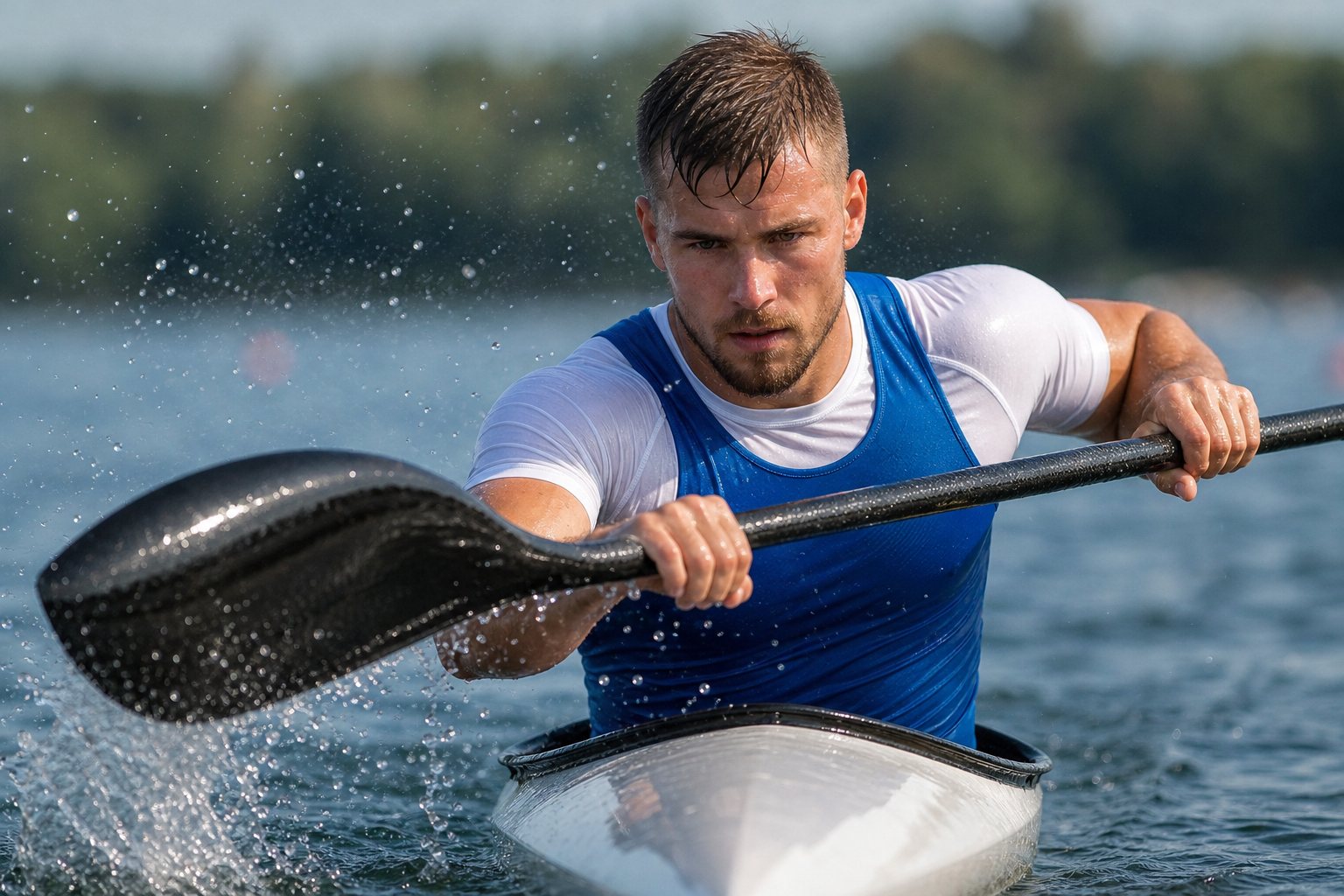
The first morning at the dock is rarely about speed. It is about how the seat feels, how steady the boat is when you lean, and whether the blade bites the water the way the coach said it would. Para canoe rules are short, and most of what a beginner needs is in three ideas: a 200-meter straight race, a boat that is fitted to your body, and a class that puts you against paddlers with a similar level of function. This page explains how a race runs, what the rulebook says about boats and safety, how classification works and how to start in the United States.
Quick answer: Para canoe is an individual 200-meter flat-water sprint in a kayak (double-blade paddle) or a va’a outrigger canoe (single-blade paddle), and the fastest time wins (IPC, Paddle Worldwide). Athletes race in sport classes, KL1 to KL3 in kayak and VL1 to VL3 in va’a, set at classification. To try it in the United States, fill in the Paracanoe Athlete Interest Form from the USOPC and American Canoe Association (ACA); most clubs lend boats and paddles to beginners. Rules below follow the 2022 edition of the ICF Paracanoe Competition Rules, so check the current edition before you race.
General information, not medical advice. See the Para canoe hub for the sport overview, and the training and gear pages.
How a race works
Every international Para canoe race is an individual 200-meter sprint, in a one-person kayak (K1) or a one-person va’a (V1) (Paddle Worldwide; ICF rules). Boats race in separate lanes. When there are more entries than lanes, athletes are split into heats by drawing lots, and a B final is only held when more than 18 boats are entered.
- The start. The command is Ready, Set, Go. At Set the boat must not move forward, and paddling before Go is a false start. The first false start brings a warning, and a second by the same athlete means disqualification.
- The course. The whole boat must stay inside the 5-meter-wide central area of the lane from start to finish. Leaving your lane means disqualification.
- The finish. A boat finishes when its bow crosses the line with the athlete in it, and the order of arrival decides the result. A capsize during the race is a did-not-finish.
- Fair racing. Kayaks use a double-blade paddle only, va’a a single-blade paddle only, and paddles must not be attached to the boat.
Boats and adapted equipment
The rulebook sets limits for the boat but leaves room for adaptation. These are the main numbers from the 2022 edition:
| Item | Kayak | Va’a |
|---|---|---|
| Maximum length | 520 cm | 730 cm |
| Minimum weight | 12 kg | 13 kg, including hull, ama and spreaders |
| Paddle | Double blade | Single blade, one side |
| Rudder | One allowed, under the hull | Not permitted |
Adaptation equipment (seat, supports, grips) is not regulated, and it counts toward the boat’s weight if it is securely attached. Two limits matter. Only the adaptations used at classification may be used in competition, changes must be reported to the ICF before competing, and a change can lead to reclassification. And no part of the boat or seat may have moving parts that propel the boat to an unfair advantage, though approved existing moving seats are accepted. Stabilizing pontoons are permitted if they make the boat slower.
Safety rules written into the rulebook
Para canoe’s rulebook builds safety into the boat and the athlete. Under the 2022 ICF rules, boats must stay buoyant when full of water, and any strapping that connects an athlete to the boat must be a quick-release type that the athlete can demonstrate. Athletes may be asked to prove capsize and self-escape by video or at the event. A personal flotation device (PFD) is required unless the athlete signs a waiver saying they swim very well, and PFDs must meet at least ISO 12402-5 (level 50). The ACA asks athletes for a strapping waiver and, if they skip a PFD, a PFD waiver. The IPC’s summary says athletes may not be attached to the boat, so ask your classifier and coach what applies to you. Water, cold and skin safety are on our injury prevention page.
Classes and classification
Para canoe is open to athletes with an eligible impairment of the trunk and lower limbs. The USOPC lists impaired muscle power (for example from spinal cord injury or spina bifida), impaired passive range of motion and limb deficiency. Upper-limb impairments and leg-length differences are not eligible. Classes describe how much leg and trunk function a paddler has:
- KL1: no or extremely limited leg function and no or very limited trunk function.
- KL2: no or very limited leg function, with some trunk function.
- KL3: the most leg function within eligibility, with strong hips and trunk.
- VL2 and VL3: VL2 is very limited leg function and hip control with lower trunk function; VL3 is very limited function in one leg or moderate function in both, with an impairment above the knee. VL1 also exists, and Paddle Worldwide lists KL1 to KL3 and VL1 to VL3.
An athlete can have a different class in each boat, for instance KL2 in kayak and VL3 in va’a (USOPC). In the US, the ACA offers national classification for new athletes alongside Team Selections. You register, ask for an appointment and bring ICF forms: a diagnosis form, a certificate of diagnosis signed by a medical doctor, an information and consent form (where you list medications and supplements), and an equipment passport with photos and measurements of your seat, footrest and adaptations.
The Paralympic classes at Paris 2024 were KL1, KL2, KL3, VL2 and VL3 (IPC), and the IPC lists ten medal events for LA28. Check the official programme for the current Games.
What a beginner practices
Beginners work on sitting securely, finding balance and learning the stroke. In a kayak you sit with legs extended and alternate sides; in a va’a you paddle on one side (USOPC). Because the rules ask for quick-release strapping and a demonstrated capsize escape, practicing a capsize under supervision is part of learning. Paddle Worldwide has four “Discover Paracanoe” videos on what the sport is, getting started, getting comfortable and what class you are.
Getting started in the United States
- Step 1: fill in the Paracanoe Athlete Interest Form (USOPC or ACA). An ACA staff member contacts you and connects you with a local club.
- Step 2: use the ACA club locator if you want to look yourself. At minimum you need a kayak or va’a (adapted if needed) and a paddle, and most ACA clubs lend equipment to beginners.
- Step 3: ask your doctor about paddling, then ask the club about safety and rescue.
- Step 4: when you are ready to race, register for national classification at Team Selections. The ACA’s two main domestic events are Team Selections and Paracanoe Nationals.
To move toward national-team level, athletes meet the Para National Team Standards in the ACA’s selection criteria. Outside the US, start with your national canoe federation. We did not find school or college Para canoe programs.
Where to read the official rules
Paddle Worldwide’s Paracanoe page and the ACA page link the ICF competition and classification rules. Rules change, so the 2022 text above is a guide. The canoe sprint and canoeing hubs cover the Olympic version, and Para rowing is a related seated water sport.
Para canoe rules FAQs
How long is a Para canoe race?
Every international Para canoe race is 200 meters and individual, according to Paddle Worldwide and the ICF rules.
What is the difference between a kayak and a va’a?
A kayak uses a double-blade paddle. A va’a is an outrigger canoe with a float (ama) and a single-blade paddle. A paddler can have a different class in each boat (USOPC).
Can I use my own seat or adapted equipment?
Adaptation equipment is not regulated in the 2022 ICF rules, but only what you used at classification may be used to race. Ask your classifier before you change anything.
Do I have to wear a life jacket?
Under the 2022 ICF rules a PFD meeting at least ISO 12402-5 (level 50) is required unless the athlete signs a waiver saying they swim very well.
Who can compete in Para canoe?
Athletes with eligible impairments of the trunk and lower limbs, per the USOPC. Upper-limb impairments and leg-length differences are not eligible, and every athlete must be classified.
Sources
- ICF Paracanoe Competition Rules 2022 (PDF)
- Paddle Worldwide: Paracanoe
- IPC: Para canoe
- USOPC: Paracanoe
- American Canoe Association: Paracanoe
- IPC: LA28 medal event programme and athlete quotas
General information for education only, not medical advice. It does not replace a sports medicine doctor, physical therapist, athletic trainer or a classifier who knows your impairment. See our editorial policy for how we research and write.