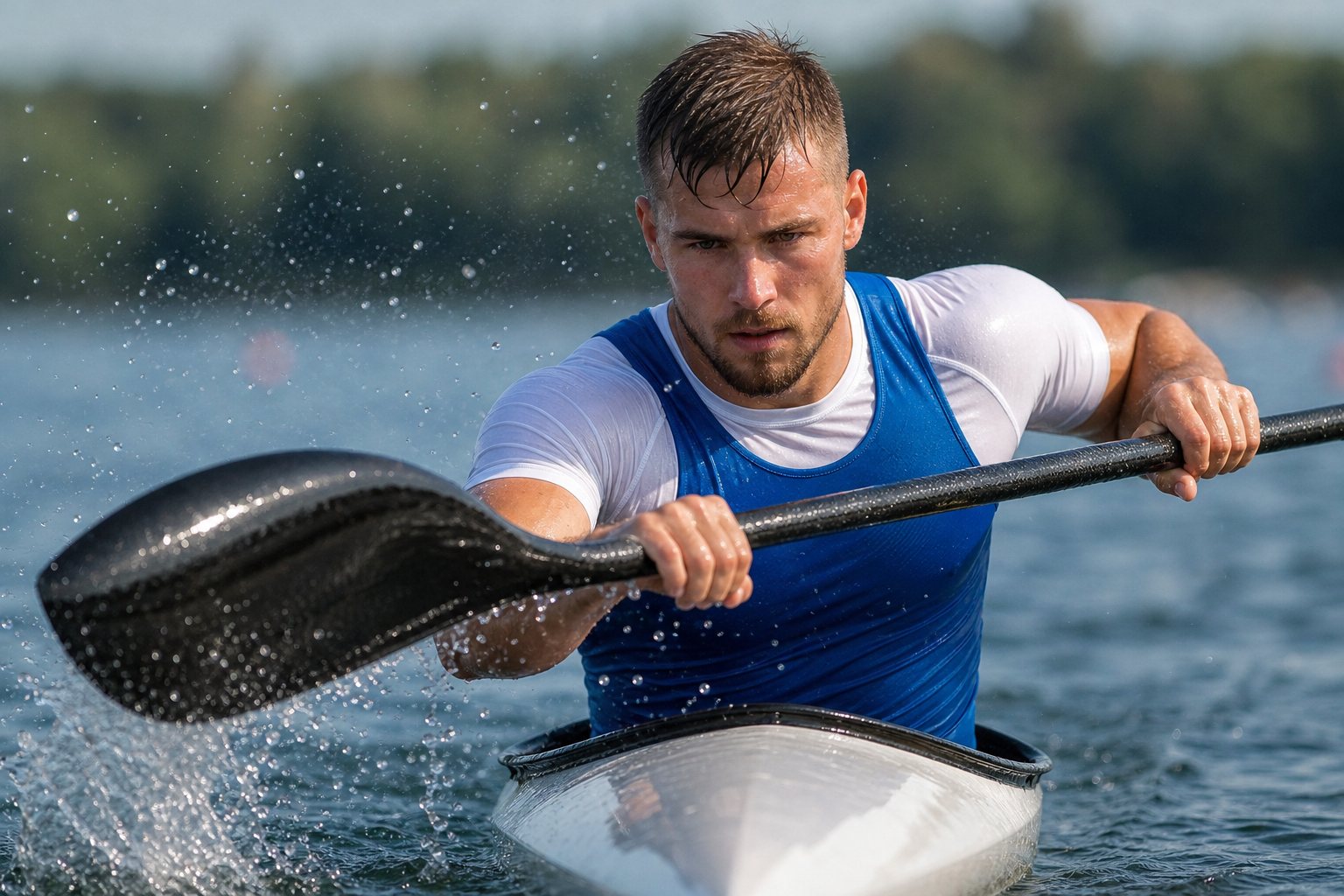
The boat is back on the rack, the shoulders feel heavy and the alarm for tomorrow’s session is already set. What an athlete does in the next 24 hours is the quiet half of training. Para canoe recovery means the sleep, easier days, mobility work, food and skin and body care that let a paddler absorb hard training and show up ready for the next session. This page covers what research supports, where evidence is weak and how to tell ordinary soreness from an injury.
Quick answer: The best-supported recovery steps are boring ones: enough sleep (the CDC says adults need at least 7 hours and teens 8 to 10), easier days between hard ones, enough food and fluid, and paying attention to stress and fatigue. A 2026 network meta-analysis of 16 trials in endurance athletes found no recovery gadget or technique beat plain rest. Soreness that fades in a few days is common; pain that is sharp, one-sided or constant is a reason to see a sports medicine doctor, physical therapist or athletic trainer.
General information, not medical advice. Training is on our training page, fuel and heat on nutrition and injuries on injuries.
Sleep first
The CDC recommends 7 or more hours of sleep for adults aged 18 to 60 and 8 to 10 hours for teens aged 13 to 17, and suggests a consistent schedule, a cool and quiet bedroom, no screens for at least 30 minutes before bed and limiting caffeine and alcohol late in the day. In a 50-week study of 61 Para athletes in Brazil (Madaleno and colleagues 2026, BMJ Open Sport and Exercise Medicine), high weekly stress went with higher odds of gradual-onset injury the next week, and high fatigue with higher odds of a substantial gradual-onset injury. Results for sleep quality were mixed: moderate sleep quality went with more injury-related time loss than other levels (odds ratio 1.50), so sleep alone is not a simple signal. Talk to your doctor if you regularly have trouble sleeping, which the CDC also advises.
Load management is recovery
The two IOC consensus statements on load (Soligard and colleagues 2016 on injury; Schwellnus and colleagues 2016 on illness, British Journal of Sports Medicine) describe poor load management, including rapid changes in training and competition load, as a risk for injury, illness and overtraining, and recommend monitoring training, well-being and psychological load. For a paddler, that means hard days balanced by easier days, a gradual build, and a written note of how you feel. A short check of sleep, stress, fatigue and soreness each day, the same four items used in the Brazilian Para study, makes patterns easier to see. Share them with your coach.
Mobility and flexibility
Mobility work for the shoulders, upper back and trunk is a common part of a paddler’s routine. Evidence in Para canoe is lacking. A 2019 randomized trial of a six-month trunk program in 103 young kayak-canoe athletes (Kiss and colleagues, Journal of Back and Musculoskeletal Rehabilitation) found better flexibility of the knee extensors and chest muscles, along with strength and posture, in the program group, though the participants were not Para athletes. Because impairment changes what is safe, ask a physical therapist which stretches and positions suit you, especially if you have limited range of motion, spasticity or reduced sensation.
What the evidence says about recovery methods
Athletes try foam rollers, massage guns, cold or hot immersion, compression and electrical stimulation. A 2026 systematic review and network meta-analysis in competitive and elite endurance athletes (Jin and colleagues, Frontiers in Sports and Active Living) pooled 16 randomized trials with 273 participants. It found no modality outperformed passive recovery for muscle soreness, creatine kinase or sport-specific performance, and a sham treatment ranked at or above every active one, which suggests expectation can matter as much as the method. Certainty was very low for 31 of 47 comparisons. The one moderate-certainty finding was that compression garments did not improve performance (standardised mean difference 0.04). None of the trials were in Para athletes, and the evidence is weak, not proof that nothing works. If a roller or a warm shower feels good and does no harm, that comfort is a legitimate reason to use it, as long as it is not replacing sleep, food or a clinician visit.
Soreness or injury
- Usually soreness: a general muscle ache after unfamiliar or hard work, felt on both sides, that eases over a few days with gentle movement.
- Get it checked: pain that is sharp, one-sided or persistent, pain at rest or at night, swelling, a joint that feels unstable, numbness or tingling, or pain that changes your stroke.
- Skin and heat: a red patch that does not fade, an open sore or signs of overheating need attention from a doctor, not more training.
This split is general guidance, not a diagnosis. The injuries page covers patterns reported in research.
Body care after a long day
After long hours seated, check skin where you sit and where straps touch, as a doctor or occupational therapist advises. A 2026 scoping review of pressure injury in disability sport (Parker and colleagues, Australian Occupational Therapy Journal) found only ten sources, so advice is mostly individual. In hot conditions, Paralympic reviews describe cooling and acclimatisation strategies for athletes who are more vulnerable to heat strain (Griggs and colleagues 2020, Temperature). After cold-water sessions, getting dry and warm quickly matters; the National Weather Service warns about losing muscle control in cold water.
Para canoe recovery FAQs
How much sleep does a Para canoe athlete need?
The CDC says adults need at least 7 hours and teens 8 to 10. Your own need may differ, so ask a doctor if you are often tired.
Do massage guns and foam rollers speed recovery?
A 2026 network meta-analysis found no recovery modality beat passive recovery in endurance athletes, and evidence is weak. They may feel good. They are not a substitute for sleep, food and rest days.
Should I stretch after paddling?
There is no Para canoe study on this. Mobility work can be part of a routine, but ask a physical therapist which movements are safe for your impairment.
Is soreness after a hard session normal?
Muscle soreness that eases over a few days is common. Sharp, one-sided or constant pain, numbness or loss of motion should be checked.
How many rest days do I need?
There is no sourced number for Para canoe. The IOC load guidance suggests planning load and recovery with monitoring. Your coach and clinician can set a number for you.
Sources
- CDC: sleep
- Madaleno F et al. 2026, stress, sleep, fatigue and soreness in Para athletes (DOI)
- IOC consensus statement on load in sport and risk of injury, 2016 (PubMed); and illness, 2016 (PubMed)
- Kiss RM et al. 2019, trunk program in kayak-canoe athletes, randomized trial (PubMed)
- Jin Y et al. 2026, recovery modalities in endurance athletes, network meta-analysis (DOI)
- Parker C et al. 2026, pressure injury prevention in disability sport (DOI)
- Griggs KE et al. 2020, heat-related issues for Paralympic athletes (PubMed)
- National Weather Service: cold water hazards
General information for education only, not medical advice. It does not replace a sports medicine doctor, physical therapist, athletic trainer or a classifier who knows your impairment. See our editorial policy for how we research and write.