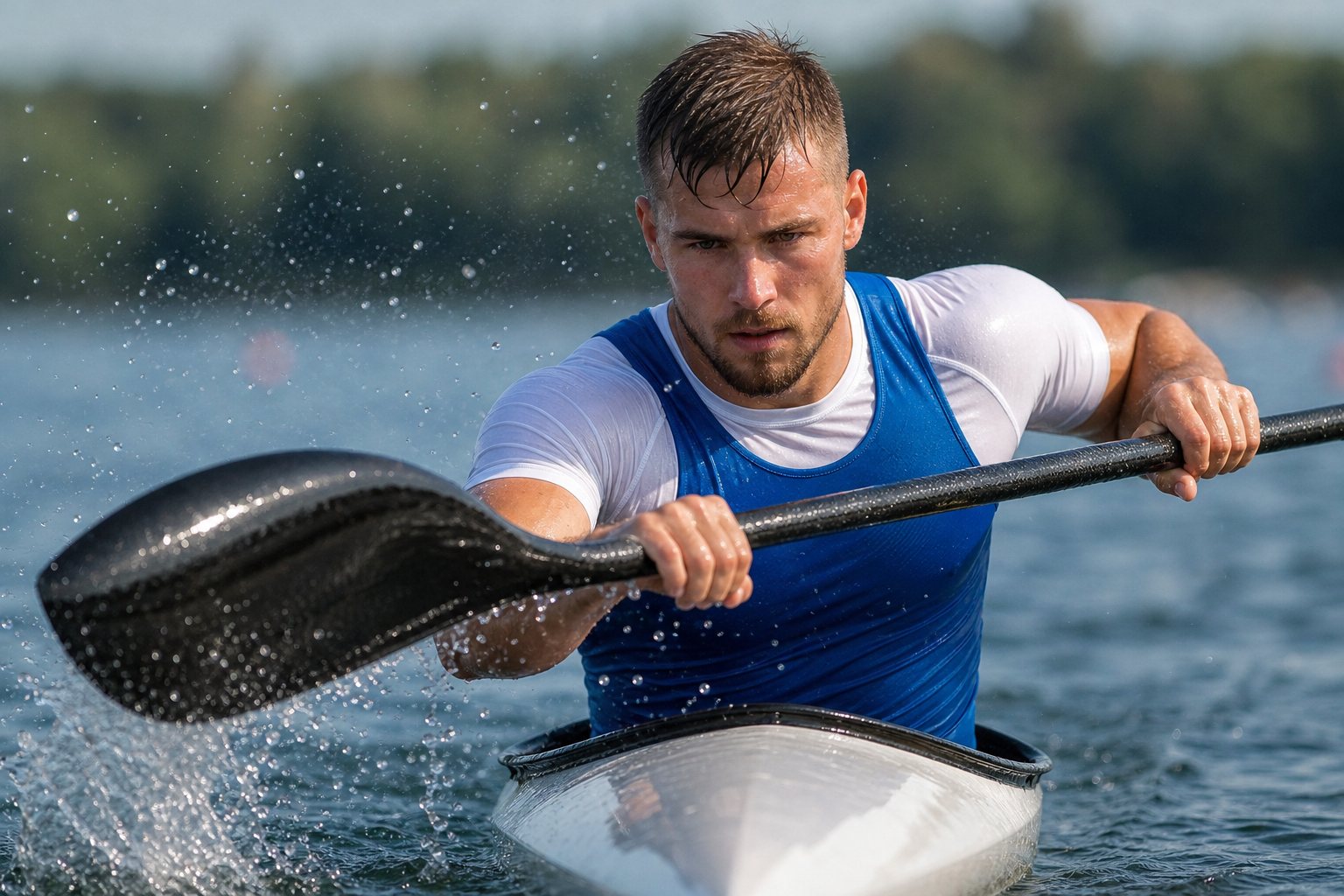
A capsize at the end of a hard session, a shoulder that has ached since last month, a patch of skin that stays red after a long day in the seat: injuries in Para canoe do not look like those in a contact sport. Para canoe injuries are mostly about the upper body and the skin, and about what the body can and cannot feel. This page describes the patterns researchers have found, the general principles of rehabilitation and when to see a professional. It does not diagnose, clear anyone to return to sport or promise recovery times.
Quick answer: We found no injury surveillance specific to Para canoe, so numbers come from related groups. Paddlers most often injure the shoulder and lower back (adolescent flat-water study, Gao and colleagues 2025), and many paddling injuries are overuse (Cassel and colleagues 2025). Skin pressure injuries, heat illness and capsize injuries matter in Para sport. After a head injury, follow CDC HEADS UP: stop, watch for danger signs and have a healthcare provider decide when you return. See a sports medicine doctor, physical therapist or athletic trainer for any pain that does not settle.
General information, not medical advice. To lower the risk of injury, see our injury prevention page. For the sport’s overview, see the Para canoe hub.
What the numbers say
The Paris 2024 Paralympic surveillance study (Derman and colleagues 2026, British Journal of Sports Medicine) followed 4,450 athletes for 14 days (62,300 athlete days) and recorded 535 injuries, an incidence of 8.6 per 1,000 athlete days. Injury prevalence was 10.9%, and 19.1% of injuries meant time lost from training or competition. Taekwondo (27.3 per 1,000 athlete days), football 5-a-side and sitting volleyball had higher incidence than other sports. The abstract reports illness at 8.3 per 1,000 athlete days, higher in female athletes (10.6) than in male athletes (6.6). We did not find the Para canoe figure within the abstract, so we do not state it.
A 2024 systematic review of 64 studies of health problems in Para sports (Sports Health) found injury incidence ranging from 0 to 91 per 1,000 athlete days depending on sport, with rates also varying with impairment category, and said evidence on severity and risk factors is limited. In a one-year study of 102 Para athletes in swimming, athletics, powerlifting and taekwondo in Brazil (2025, Brazilian Journal of Physical Therapy), injuries to the shoulder complex carried the greatest burden, followed by the ankle and knee. Those sports differ from paddling, so read these numbers as context.
Shoulder and back: the paddling pattern
In a 2025 study of 140 elite adolescent flat-water paddlers in China (Gao and colleagues, Frontiers in Public Health), kayakers had 0.90 injuries per 1,000 training hours, mostly to the lower back, shoulder, wrist and knee, and canoeists were hurt most often at the shoulder and lower back. A 2025 study of 112 adolescent canoe sprint athletes among 348 elite athletes seen at a sports medicine centre (Cassel and colleagues, Sportverletz Sportschaden) found canoe sprint had 1.6 injuries per 1,000 hours, the lowest of the three sports, with overuse injuries far outnumbering traumatic ones.
Para-specific data on shoulders come from wheelchair users. A 2026 survey of 61 US wheelchair rugby athletes (Rider and colleagues, Assistive Technology) found high shoulder pain scores, with lower scores in athletes who warmed up more and did more shoulder strength training. Those are correlations in another sport. Paddlers share a heavy reliance on the arms and shoulders, so many Para paddlers may face similar loads, but that is our inference, not a finding.
Capsizes and acute shoulder injuries
A UK case series of 57 shoulder injuries in paddlers (Holland and colleagues 2018, Clinical Journal of Sport Medicine) found the most common mechanism was a capsize (26% of injuries), and that ten of the capsize injuries were labral tears that needed surgery. Outcome scores improved after treatment, and some paddlers returned to high-level paddling. The authors suggested the arm position at the time of a capsize or roll, abducted and rotated outward, is one of the most common causes of serious shoulder injury. A shoulder that looks out of place or cannot move is an emergency: the American Academy of Orthopaedic Surgeons says a dislocated shoulder needs a doctor to put it back, not a friend.
Skin and pressure injuries
Pressure injuries are a major health concern for people with mobility impairments, and sport adds equipment and environment challenges (Parker and colleagues 2026, Australian Occupational Therapy Journal). The authors’ scoping review found only ten sources on preventing and managing them in disability sport, so evidence is thin. Practical points from clinicians are individual: ask a doctor or occupational therapist how to check your skin, what to do about red marks and when a sore needs care. Do not paddle on an open sore without medical advice.
Heat and cold illness
The Paralympic version of exertional heat stroke care (Hosokawa and colleagues 2022, British Journal of Sports Medicine) keeps the IOC principles of early recognition, rapid cooling and advanced clinical care, with changes for autonomic dysfunction and moving a collapsed athlete. Cold water can also be dangerous: the National Weather Service says muscle control can be lost within 10 minutes in water at 70 degrees Fahrenheit or lower. Both are emergencies.
Head injuries
A fall, a collision or a hit from a boat or paddle can cause a concussion. CDC HEADS UP lists symptoms such as headache, dizziness, balance problems, nausea, trouble thinking, light or noise sensitivity and mood changes. Call 911 or go to an emergency department for danger signs such as seizures, repeated vomiting, a worsening headache, increasing confusion or drowsiness, slurred speech, weakness or numbness, or one pupil larger than the other. A healthcare provider decides when an athlete can return, not a coach or the athlete.
Rehabilitation principles
Rehabilitation is individual, and a sports medicine doctor or physical therapist who knows your impairment should lead it. A few general ideas come from the research. In the wheelchair rugby survey, athletes used physical therapy (54.1%), occupational therapy (44.3%) and primary care (41%) for shoulder pain, which shows rehabilitation is often a team effort. Team USA Paralympic athletes interviewed in a 2026 qualitative study (Kossman and colleagues, BMJ Open) named chronic injury management and healthcare access among the challenges of the sport. A rehabilitation plan usually includes protecting the injured area, restoring movement, rebuilding strength and returning to paddling gradually, in steps agreed with your clinician. We give no recovery times because they vary widely.
When to see a professional
- Pain that persists, grows, wakes you at night or alters your stroke.
- A shoulder that feels unstable or locked, or any numbness, tingling or new weakness.
- Red or broken skin that does not fade, or a sore.
- Heat illness signs or any concussion symptoms.
Para canoe injuries FAQs
What is the most common injury in Para canoe?
We did not find Para canoe surveillance. In adolescent paddlers, the shoulder and lower back were the most common sites (Gao 2025).
How do I know if it is an injury or just soreness?
Soreness that is even on both sides and eases over a few days is common after hard training. Sharp, one-sided or night pain, numbness or loss of motion are reasons to see a professional. See our recovery page.
When can I paddle again after an injury?
A clinician who has examined you decides. We do not give return-to-play times.
Are capsizes dangerous?
They can be. A UK case series found 26% of paddler shoulder injuries happened in capsizes, and cold water adds risk. Practice capsize recovery under supervision.
What about concussion?
Stop, watch for symptoms and get a healthcare provider’s decision on returning. CDC HEADS UP lists danger signs that need emergency care.
Sources
- Derman W et al. 2026, injury and illness at the Paris 2024 Paralympic Games, Br J Sports Med (Europe PMC)
- Sports-related health problems in para-sports, systematic review, Sports Health 2024 (PubMed)
- Injuries and illnesses in Para athletes: one-year study, Braz J Phys Ther 2025 (PubMed)
- Gao et al. 2025, injuries in adolescent flat-water kayak and canoe athletes (PubMed)
- Cassel et al. 2025, canoe sprint, handball and triathlon injuries (PubMed)
- Rider JV et al. 2026, shoulder pain in wheelchair rugby athletes (DOI)
- Holland et al. 2018, shoulder injuries in canoeing and kayaking (PubMed)
- AAOS OrthoInfo: dislocated shoulder
- Parker C et al. 2026, pressure injury prevention in disability sport, scoping review (DOI)
- Hosokawa et al. 2022, exertional heat stroke, Paralympic athletes (PubMed)
- National Weather Service: cold water hazards
- CDC HEADS UP: signs and symptoms
- Kossman MK et al. 2026, Team USA Paralympic athletes, qualitative study, BMJ Open (DOI)
General information for education only, not medical advice. It does not replace a sports medicine doctor, physical therapist, athletic trainer or a classifier who knows your impairment. See our editorial policy for how we research and write.