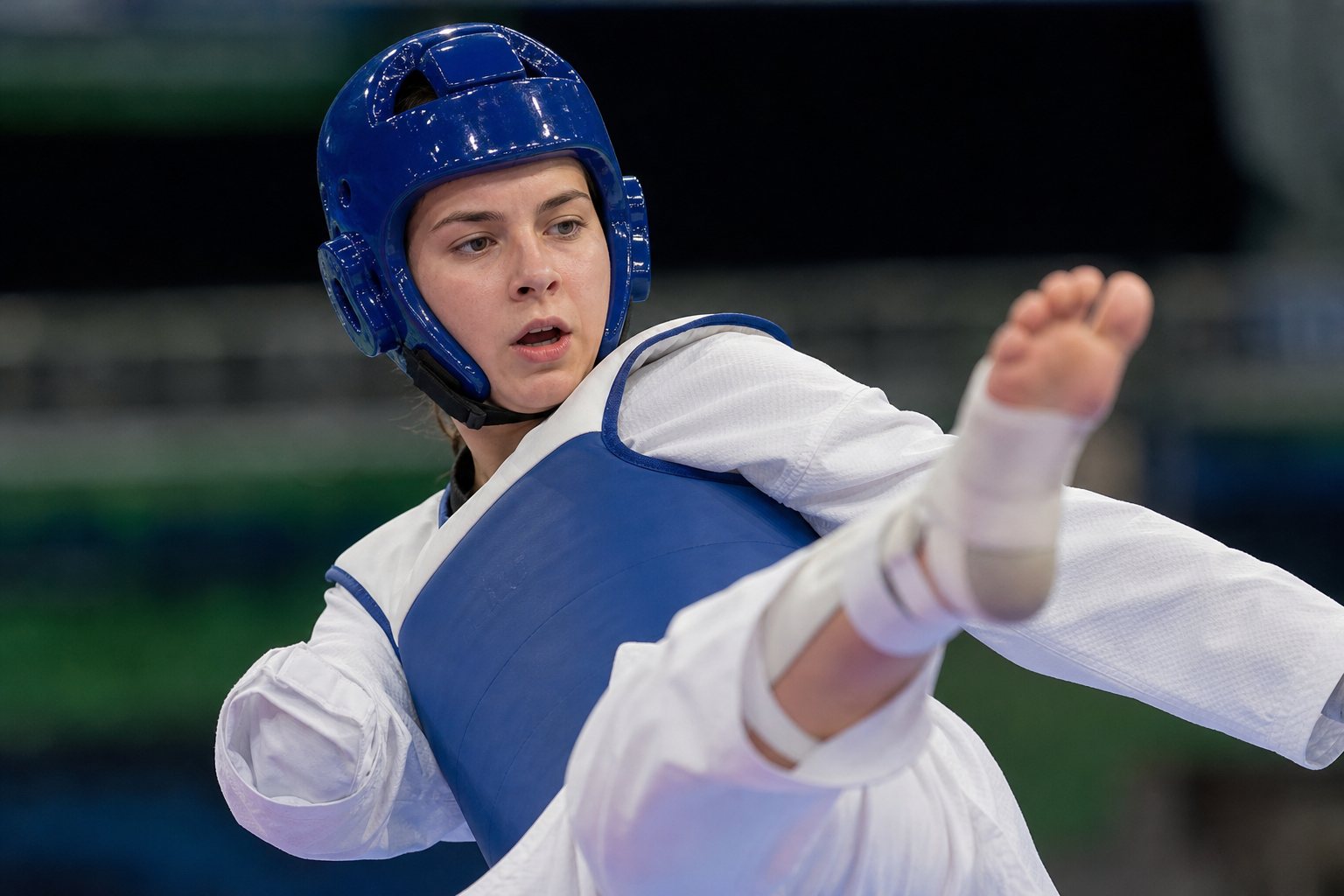
Ten seconds before the first round. The fighters face each other on the mat, the referee is about to start the bout, and in that quiet moment a mind can go two ways: toward “what if I lose?” or toward “first kick, my distance.” Mental training in Para taekwondo means practicing skills such as focus, confidence, goal setting, imagery and routines so that attention goes to the task. It is different from mental health care, and the two should not be confused.
Quick answer: Mental skills are trained like physical ones: small, regular and specific. Useful tools include a pre-bout routine, clear process goals, imagery of kicks and tactics, a plan for mistakes and a way to settle nerves. None of these guarantees results, and the evidence in Para taekwondo specifically is limited. If worry, low mood, eating problems or burnout take over, that is a health matter: talk to a qualified professional, and in the US call or text 988.
General information, not medical advice. For rules and match format see our rules and getting started page, and for the sport overview the Para taekwondo hub.
Confidence and focus
Confidence grows from evidence: kicks landed in practice, fitness work completed, rounds survived. A simple habit is to keep a short training log of what went well each session. For focus, many coaches use one-word cues (“distance,” “timing,” “breathe”) that bring the mind back when it drifts. That is general coaching practice. A 2026 survey of 346 Chinese taekwondo athletes (Liu and colleagues, Frontiers in Psychology) found that higher mindfulness was associated with lower psychological distress, partly through stress self-management and less brooding. It is a cross-sectional survey, so it shows an association, not a cause, and it was not conducted in Para athletes.
Goals and motivation
Goals work best when some are about the process (how many clean turning kicks in a sparring round) and not only about the result (a medal). A coach can help you set a ladder: this month, this season, this year. Motivation also dips. Athletes who lose a class review, change weight category or wait for the next event need small goals that fit that moment. A qualitative study of 19 Team USA Paralympic athletes (Kossman and colleagues, BMJ Open, 2026) asked about support systems and recommended better sports medicine, classification-aware support and community awareness. Seek a team, club or national federation that understands your needs.
Imagery (visualization)
Imagery means rehearsing a kick, a round or a bout in the mind with as many senses as possible. A 2026 study of 111 Turkish Paralympic national team athletes, including taekwondo athletes, measured how athletes use imagery on a standard questionnaire and found differences between men and women on one sub-scale (Topuzoglu and colleagues, BMC Sports Science, Medicine and Rehabilitation). It was descriptive and did not test whether imagery improved results. A reasonable way to use it is a few minutes a day: see yourself in your stance, feel your balance on the standing leg, then picture the kick landing on the trunk protector and a calm reset afterward.
Decision-making and tactics
Para taekwondo is a tactical game. In the Tokyo 2020 match analysis of 78 Paralympic matches (Park and colleagues, Journal of Sports Sciences, 2024), winners had higher kick-to-score ratios than non-winners, and the authors stress scoring efficiency and defensive actions. In plain terms, patience and accurate choices beat a flurry of kicks. The WT rules shape decisions too: falling, stepping out and stalling give your opponent a point, and a turning kick is worth four points against two for a straight kick. Your coach may use video review to build a game plan for each opponent.
Pre-competition routines and handling pressure
A routine is a short, repeatable sequence that you control: a warm-up, a few breaths, an imagery run-through, a cue word. It reduces the number of things left to chance. WT events add stress outside the mat, which is worth planning: international classification takes place one to two days before competition, the weigh-in is the day before, and a random weigh-in may follow on the morning of the event. Knowing the schedule ahead of time lowers surprises. Slow breathing (for example a longer exhale than inhale) is a common technique for settling nerves before a bout, and it is general practice rather than a Para-specific finding. For logistics and the rules of each stage, see our rules page.
Responding to setbacks
Setbacks in this sport are real: a bad draw, a gam-jeom you disagree with, a reclassification, an injury. Coaches often teach a “next kick” attitude: accept the point, take one breath, reset the plan. After a loss, many athletes find it useful to review with the coach after a cooling-off period, separate what they control from what they do not, and pick one thing to practice. A sports psychology professional, for example one certified by a national sport psychology association, can help build these skills.
Mental health is not the same as mental performance
The IOC consensus statement on mental health in elite athletes (Reardon and colleagues, British Journal of Sports Medicine, 2026) says that mental health symptoms and disorders are common among elite athletes, can have sport-related causes and can affect performance, and that elite Para athletes are relatively understudied and may have distinct concerns. Anxiety that will not ease, low mood, loss of interest, sleep problems, disordered eating or burnout are health matters, not weaknesses and not something a mental skills routine will fix. Talk to your doctor, a licensed mental health professional or a team physician. In the United States you can call or text 988 (the 988 Suicide and Crisis Lifeline) at any hour for free; it also helps people who are in emotional distress, not only in a suicidal crisis. Outside the US, look up your national crisis line. In an emergency, call your local emergency number.
Stress and injury can be linked. In a 50-week study of 61 Para athletes that included taekwondo, high stress was associated with higher odds of gradual-onset injury the next week (Madaleno and colleagues, 2026). Taking care of your mind is part of taking care of your body; see recovery.
Frequently asked questions
Does visualization really work for taekwondo?
Many athletes and coaches use imagery, and it is common in sports psychology. We did not find a trial in Para taekwondo showing it improves results, so treat it as a practice tool, not a guarantee.
How do I stay calm before a bout?
Build a short routine: warm up, breathe slowly, run through your cue words, and picture your first kick. Practice it in training so it is familiar on the day. If nerves feel overwhelming, talk to a professional.
What is the difference between mental training and mental health care?
Mental training builds skills like focus and routines. Mental health care treats conditions such as anxiety or depression. Anyone struggling should see a qualified professional; in the US, 988 is available by call or text.
How should I handle a bad referee call?
Under the WT rules the coach, not the athlete, may request an instant video replay for certain items, such as some penalties and technical points; points registered by the electronic trunk protector cannot be appealed. Take a breath and focus on the next kick, and leave the appeal to your coach.
Can mindfulness help taekwondo athletes?
A 2026 survey of Chinese taekwondo athletes linked higher mindfulness with lower psychological distress. That is an association in a general taekwondo group, not a proven effect for Para athletes.
Sources
- Reardon et al., Mental health in elite athletes: IOC consensus statement (2026), Br J Sports Med (Europe PMC)
- 988 Suicide and Crisis Lifeline
- Liu et al., mindfulness and psychological distress among Chinese taekwondo athletes, Front Psychol 2026 (Europe PMC)
- Kossman et al., qualitative investigation of Team USA Paralympic athletes, BMJ Open 2026 (Europe PMC)
- Topuzoglu et al., imagery: a study on Paralympic athletes, BMC Sports Sci Med Rehabil 2026 (Europe PMC)
- Park et al., tactical and technical factors in Para taekwondo at Tokyo 2020, J Sports Sci 2024 (PubMed)
- Madaleno et al., daily stress, sleep, fatigue and soreness and injury in Para athletes, BMJ Open Sport Exerc Med 2026 (Europe PMC)
- World Taekwondo, Para Taekwondo Competition Rules in force as of 23 October 2025, Art 9, 10, 13, 15
General information for education only, not medical advice. It does not replace a visit with a doctor, physical therapist or athletic trainer. See how we write and check our pages in our editorial policy.