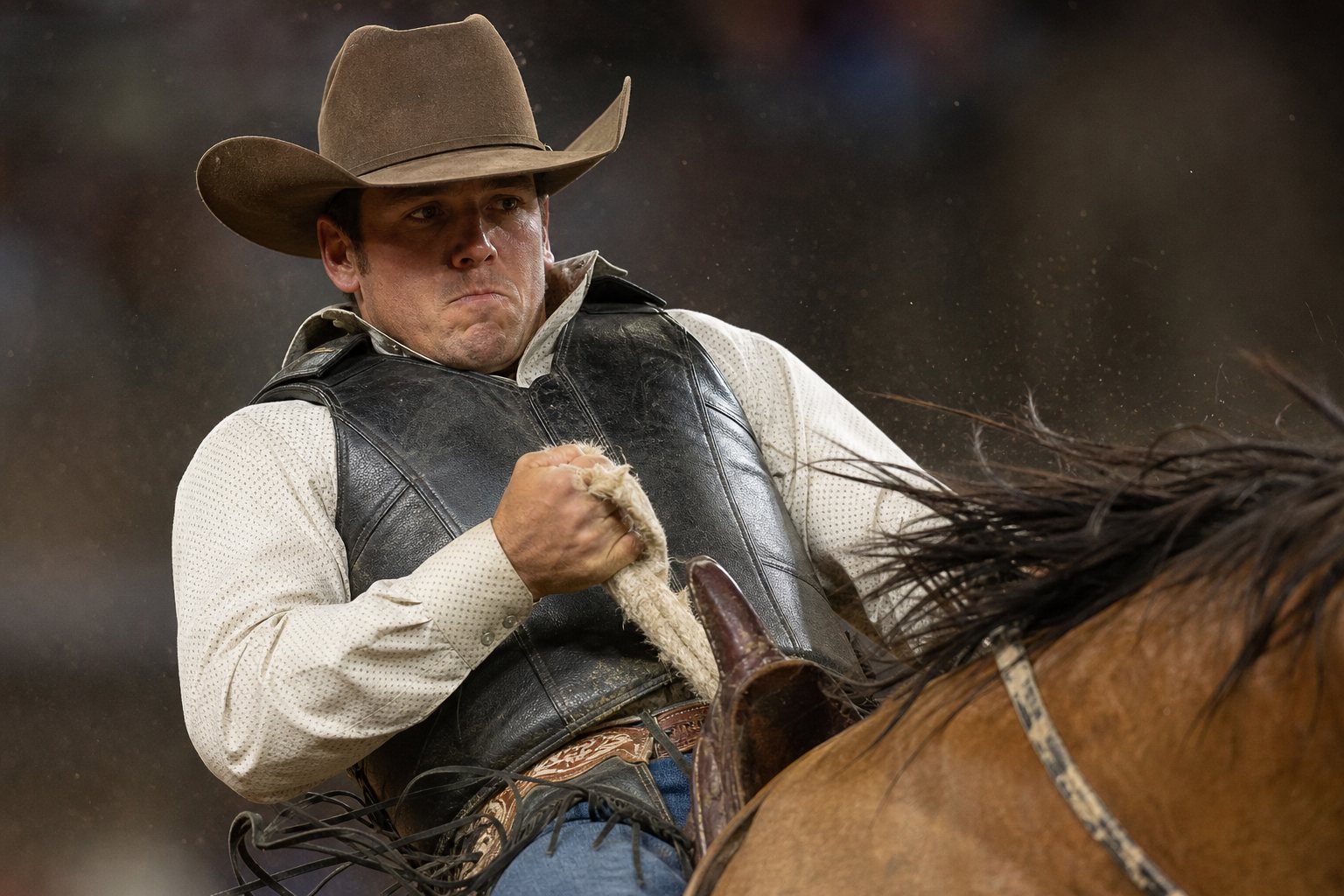
Behind the chutes, a bull rider pulls his rope, tightens his glove and goes quiet. A barrel racer two chutes down is patting her horse and breathing slowly. Nobody is talking. Mental training in rodeo is the practice of preparing attention, confidence and emotions so you can ride or rope the way you practised, when the gate opens and the crowd is loud. It is a skill, not a personality trait, and it works alongside the physical work, not instead of it.
Quick answer: A 2026 position statement from Exercise and Sports Science Australia says pressure can help or hurt performance and lists four evidence-based approaches: pre-performance routines, implicit attentional strategies, psychological skills training and mindfulness-based methods. Rodeo-specific research is limited: a 2010 review found psychology studies in rodeo mostly covered personality, sensation seeking and competitive anxiety. Techniques build skills; they do not guarantee a result. If worry, low mood or fear is affecting your life, see a qualified professional; in the US you can call or text 988.
Confidence you can back up
Meyers and Laurent (Sports Medicine, 2010) report that the psychological side of rodeo has been studied only in narrow ways: personality, sensation seeking and competitive anxiety. Their abstract adds that, set against higher levels of mainstream sport, rodeo participants closely resemble their counterparts. So we lean on general sport psychology, and we label it. A coach-friendly way to build confidence is evidence you can see: a log of good practice runs, video of clean technique and a plan for the draw you fear. Confidence that rests on preparation holds up better than hype.
Focus: the next eight seconds
In roughstock events the ride is very short. General sport psychology practice is to pick one or two cues (“chin down, eyes up,” “rock with the rhythm”) and bring attention back to them when it drifts. In timed events, the focus is on your pattern and your horse’s feel, not the clock. The ESSA statement names implicit attentional strategies, which means simple cues and external focus on the task rather than on how your body is moving, as one evidence-based option under pressure.
Motivation and goal setting
Rodeo life is long drives, entry fees and bad draws, so motivation has to survive setbacks. Common goal-setting practice, as sport psychologists teach it, is to set process goals you control (tying a consistent set-up, fixing one thing in your dismount) alongside outcome goals you do not (a buckle, a check). Write them down, review weekly and adjust. This is general practice from applied sport psychology, not a rodeo study; the Association for Applied Sport Psychology publishes plain-language resources at appliedsportpsych.org.
Imagery and visualization
Mental imagery is widely used in sport. A 2026 scoping review of imagery for stress management in athletes (Zhao and colleagues, Frontiers in Psychology) charted 39 core studies and noted that the term covers several different things that are often mixed together. In rodeo, a typical use is to rehearse a run in your head in the first person, with the feel of the horse or bull, the sound of the chute and a calm finish. Use it in addition to real practice and keep it positive. It is a skill that gets better with repetition, and it is not a promise.
Routines before you nod
The ESSA 2026 statement lists pre-performance routines first among evidence-based strategies for pressure. A routine is a short, repeatable sequence: gear check, breathing, a cue word, then go. Try it in practice, not just at the big rodeo. Keep it short enough to complete when the schedule runs late. If your routine includes a checklist, put safety first: equipment, rigging and the chute before anything about mindset. Our gear page covers equipment checks.
Pressure, mistakes and bad days
The ESSA statement says pressure can have both facilitative and debilitative effects, and that training environments with some pressure built in can prepare athletes. A practice rodeo, a friendly side bet, or a run with spectators are ways to add it gradually. After a wreck or a miss, a short reset routine helps: breathe, name what happened, pick one fix, move on. Dwelling on one run can follow you into the next. Learning from a bad draw or a no-time is part of the sport.
Fear and coming back from injury
Fear in a dangerous sport is not a flaw; it is information. A 2018 Journal of Athletic Training article on concussion in rodeo (Wicklund and colleagues) describes a culture that encourages swift return to competition and notes unique barriers, including the solo nature of the sport. The safe approach is to separate the mental plan from the medical one: your return to riding is a medical decision (see rodeo injuries), and the mental work, such as graded exposure with a coach, supports it afterward. Do not use mental toughness as a reason to hide symptoms.
Decisions, partners and your animal
Timed-event partners (team ropers, header and heeler) and your horse are part of the mental game. General practice: agree on a plan and on signals before the run, accept your partner’s mistakes calmly, and recognise that a nervous rider makes a nervous horse. For horse handling, see horseback riding.
Mental performance versus mental health
Mental training is about performance skills. Anxiety that will not settle, depression, panic, disordered eating, substance use or burnout are health matters and need a qualified professional such as a doctor, psychologist or counselor, not just a better routine. In the US, you can call or text the 988 Suicide and Crisis Lifeline at any time. The IOC published a 2026 consensus on mental health in elite athletes (British Journal of Sports Medicine), and the NCAA has mental-health best practices for college athletes at ncaa.org. College rodeo athletes should also ask their school counseling office. We did not find a rodeo-specific mental-health program to recommend.
Rodeo mental training FAQs
How do bull riders handle fear?
Public interviews vary, and there is little research. General sport psychology suggests routines, breathing, focus cues and gradual exposure with a coach. Fear that blocks you from riding at all is worth discussing with a qualified professional.
Does visualization really work?
Imagery is widely used and studied, but a 2026 scoping review noted the term is used for different things and the evidence is mapped, not settled. It is a supplement to practice, not a replacement.
What is a pre-run routine?
A short, repeatable set of steps before you nod or enter the arena, such as equipment check, breathing and a cue word. A 2026 ESSA position statement lists routines as an evidence-based strategy for performing under pressure.
How do I come back mentally after an injury?
Get medical clearance first, then rebuild gradually with a coach and a clinician. Rehearsing technique and fear management help, but they do not replace healing time.
Where can I get help if I am struggling?
Talk to a doctor, counselor or psychologist. In the US, call or text 988. College athletes can use campus counseling. Rodeo has a culture of toughing things out, so ask a trusted person to help you reach out.
Sources
- Schweickle MJ et al. Performance Under Pressure in Sport: ESSA position statement. Sports Med 2026
- Zhao L et al. Mental imagery for stress management in athletes: scoping review. Front Psychol 2026
- Meyers MC, Laurent CM. Part I. Sports Med 2010
- Wicklund A et al. Concussion return to play in rodeo. J Athl Train 2018
- AASP resources
- 988 Suicide & Crisis Lifeline
- IOC consensus on mental health in elite athletes 2026 (Br J Sports Med)
- NCAA mental health best practices
General information for education only, not medical advice. It cannot replace a sports medicine doctor, physical therapist or athletic trainer who knows you. Read how we work in our editorial policy.