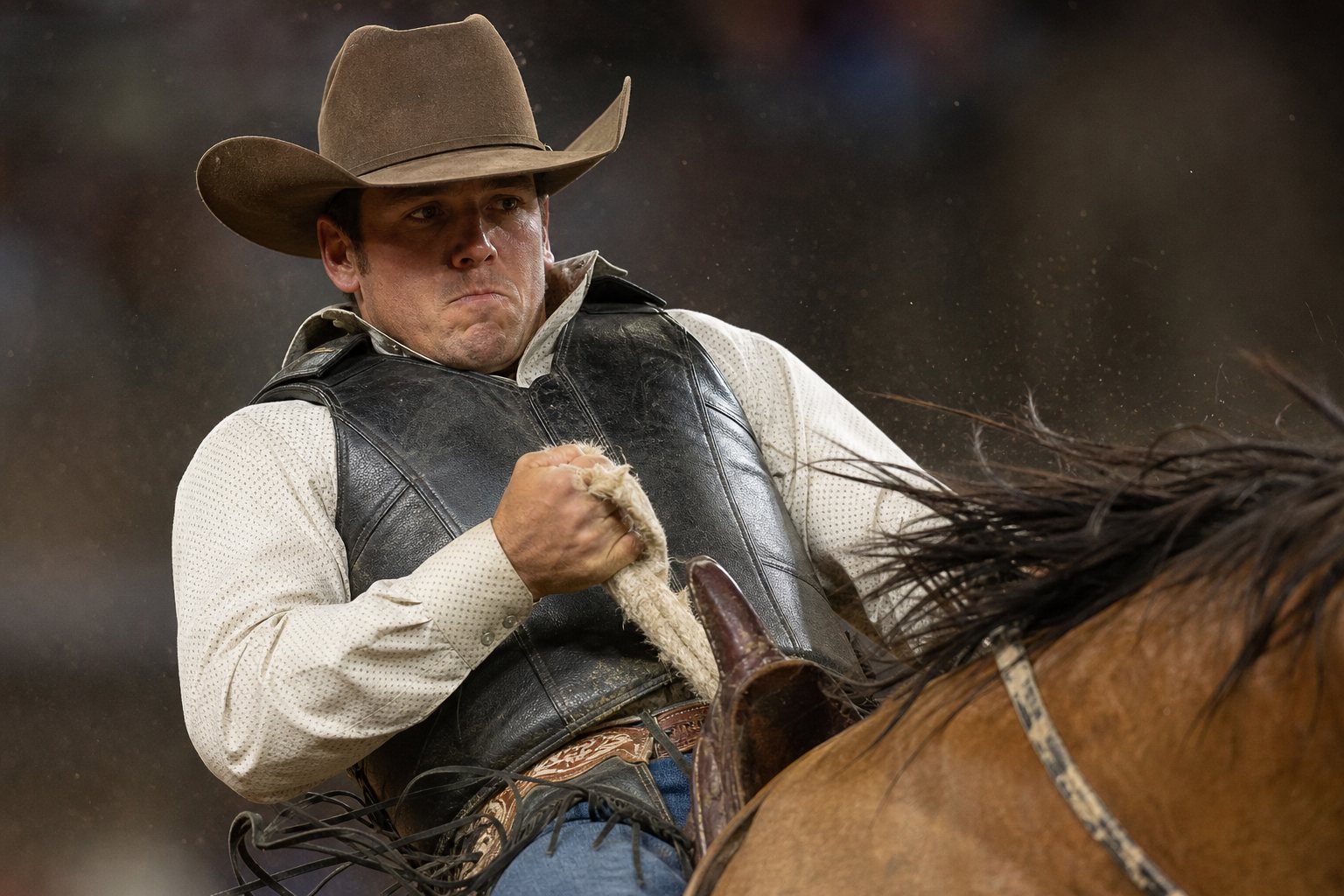
The bull turns back into the rider, the rope hand hangs up for half a second, and he comes off headfirst. Within a minute, sports medicine staff are at the fence. Rodeo injuries are what happen when a rider’s body meets a bucking animal, a hard arena floor or a rope under load. The research is limited and patchy, but it is consistent on one thing: roughstock events, bull riding most of all, produce the most injuries and the most concussions.
Quick answer: The most-studied injuries are sprains and strains, knee and shoulder problems, fractures and concussions. A 2024 review of 23 studies found 4.2 to 19.1 injuries per 1,000 competition exposures, with bull riding causing 19.4% to 58.4% of injuries. This page is general information: it cannot diagnose anything. See a sports medicine doctor, physical therapist or athletic trainer for any injury, and get emergency care for a head injury with danger signs, neck or back pain after a fall, or a deformed limb.
General information, not medical advice. To lower risk, see rodeo injury prevention.
The numbers, with their source
| Study | What it found |
|---|---|
| Box and colleagues, 2024, systematic review of 23 studies, 2,105 athletes | 4.2 to 19.1 injuries per 1,000 competition exposures; sprains and strains 15% to 34% of injuries; knee the most common location (11.1% to 17%); bull riding 19.4% to 58.4% and bareback 15.3% to 28.8% of injuries |
| Watts and colleagues, 2022, 264 college athletes at 11 NIRA schools (NCAA injury surveillance system) | 10.98 injuries per 1,000 athlete exposures in competition and 3.09 in practice; 62.2% of injuries happened in practice |
| Sinclair Elder and Tincknell, 2020, Justin Sportsmedicine Team records 2011 to 2014 | 84 hip injuries in 82 athletes; roughstock athletes had 83.3%, bull riders 50.0%; contusions 45.2%, impingement 15.5%, strains 13.1% |
| Forrester, 2021, US emergency departments, ages 13 to 19, 2000 to 2019 | About 17,363 injuries estimated; bulls involved in 58.4%; contusion or abrasion 29.5%, fracture 22.8%, strain or sprain 15.0%, concussion 8.0% |
| Seifert and colleagues, 2022, one level I trauma center, 70 patients | Head injuries 54.3%, surgery 28.6%, 98.6% discharged home, one death |
Robinson and colleagues (Journal of the American Podiatric Medical Association, 2026) pooled seven studies and report about 28% of rodeo injuries in the lower extremity, with thigh and knee ahead of the ankle. Older Canadian pro data on bull riders (Butterwick and Meeuwisse) found 36% of injuries were severe, with fractures the most common severe injury. Numbers vary because studies count injuries, exposures and levels differently, so use them for patterns, not for predicting your own risk.
Concussion and head impacts
The Box 2024 review found concussions in up to 15.3% of injuries across all events and up to 77% in roughstock events. A 2024 study of collegiate roughstock athletes wearing mouthguard sensors (Carlson and colleagues) found a high rate of head acceleration events in every roughstock event; bull riding had the highest magnitudes, mostly from the head hitting the ground or the animal during the dismount, while bareback riding had many lower-magnitude events from whiplash-like head movement. A 2026 follow-up of 13 athletes and 112 rides recorded 344 events.
The CDC HEADS UP guidance lists signs such as headache, confusion, dizziness, nausea, balance problems and sensitivity to light or noise, and says an athlete with a suspected concussion should stop playing and be seen by a health care provider. A 2018 article in the Journal of Athletic Training (Wicklund and colleagues) notes that no standard post-concussion protocols exist across rodeo organizations, that the solo nature of the sport and limited access to clinicians complicate care, and that rodeo culture encourages a quick return. We cannot clear anyone to ride; only a qualified provider can.
Other common patterns
- Knee, shoulder and hip. The Butterwick study found these the most injured joints in bull riders; the hip data above show dismount contusions are common.
- Fractures in youth. A 2026 pediatric case series (Arnold and colleagues, Journal of Children’s Orthopaedics) of 41 patients found 51.2% orthopedic injuries and that 5 of 13 operative fractures needed open reduction.
- Animal contact. Meyers and Laurent (2010) found about 80% of injuries involved animal contact.
- Overuse. The same review lists overtraining among concerns. Do not ignore pain that builds up.
General rehabilitation principles
Specific rehab depends on the injury and the person, so this is general. Standard sports medicine practice for most sprains, strains and bruises is early assessment, protecting the area, then graded movement and strengthening guided by a physical therapist or athletic trainer, with return to riding tied to function and symptoms rather than the calendar. Concussion rehab follows the staged approach in the Wicklund article: removal from activity, proper evaluation and gradual return with medical clearance. We give no recovery times; they vary widely. Daily recovery habits are on our rodeo recovery page.
Where to get care
At PRCA and WPRA events the Justin Sportsmedicine Team provides free on-site care to members, per the program’s page. Amateur and youth rodeos may have only a basic EMT or none. Know where the closest emergency department is, and tell the staff about any blow to the head.
Rodeo injuries FAQs
What is the most common rodeo injury?
Sprains and strains were the largest injury type in the 2024 review (15% to 34%), and the knee was the most common location. Contusions are common too, and in the hip data they made up 45.2% of hip injuries.
Which rodeo event is the most dangerous?
Bull riding accounted for the most injuries in the 2024 review (19.4% to 58.4%), followed by bareback riding (15.3% to 28.8%). Timed events are not injury-free; a 2026 meta-analysis found timed-event athletes had about 9% higher lower-extremity injury prevalence.
How many rodeo riders get concussions?
Concussions made up up to 15.3% of injuries across all events and up to 77% in roughstock events in the 2024 review. Rates vary a lot between studies.
When can a rider get back on after a concussion?
That depends on a medical evaluation. Guidelines call for gradual return with clearance from a qualified provider once symptom free; we cannot give a timeline.
Should I see a doctor after a fall if I feel fine?
If you hit your head, hurt your neck or back, or feel pain that is worsening, yes. Some injuries show up hours later. When in doubt, ask the sports medicine staff.
Sources
- Box MW et al. Rodeo injuries systematic review. Orthop J Sports Med 2024
- Watts M et al. Characteristics of injury in collegiate rodeo. Clin J Sport Med 2022
- Sinclair Elder AJ, Tincknell R. Hip injuries in professional rodeo 2020
- Forrester MB. Rodeo-related injuries among adolescents. J Emerg Med 2021
- Seifert CL et al. Rodeo trauma. Kans J Med 2022
- Robinson B et al. Lower extremity injuries in rodeo athletes. J Am Podiatr Med Assoc 2026
- Butterwick DJ, Meeuwisse WH. Bull riding injuries in professional rodeo
- Carlson CD et al. Head impacts in collegiate rodeo athletes. S D Med 2024
- Carlson CD et al. Head acceleration events in collegiate rodeo athletes. Ann Biomed Eng 2026
- Arnold TE et al. Irreducible extremity fractures in pediatric rodeo trauma 2026
- Wicklund A et al. Return to play in rodeo athletes after concussion. J Athl Train 2018
- Meyers MC, Laurent CM. Part II 2010
- CDC HEADS UP: signs and symptoms
- CDC HEADS UP: response
- Justin Sportsmedicine Team
General information for education only, not medical advice. It cannot replace a sports medicine doctor, physical therapist or athletic trainer who knows you. Read how we work in our editorial policy.