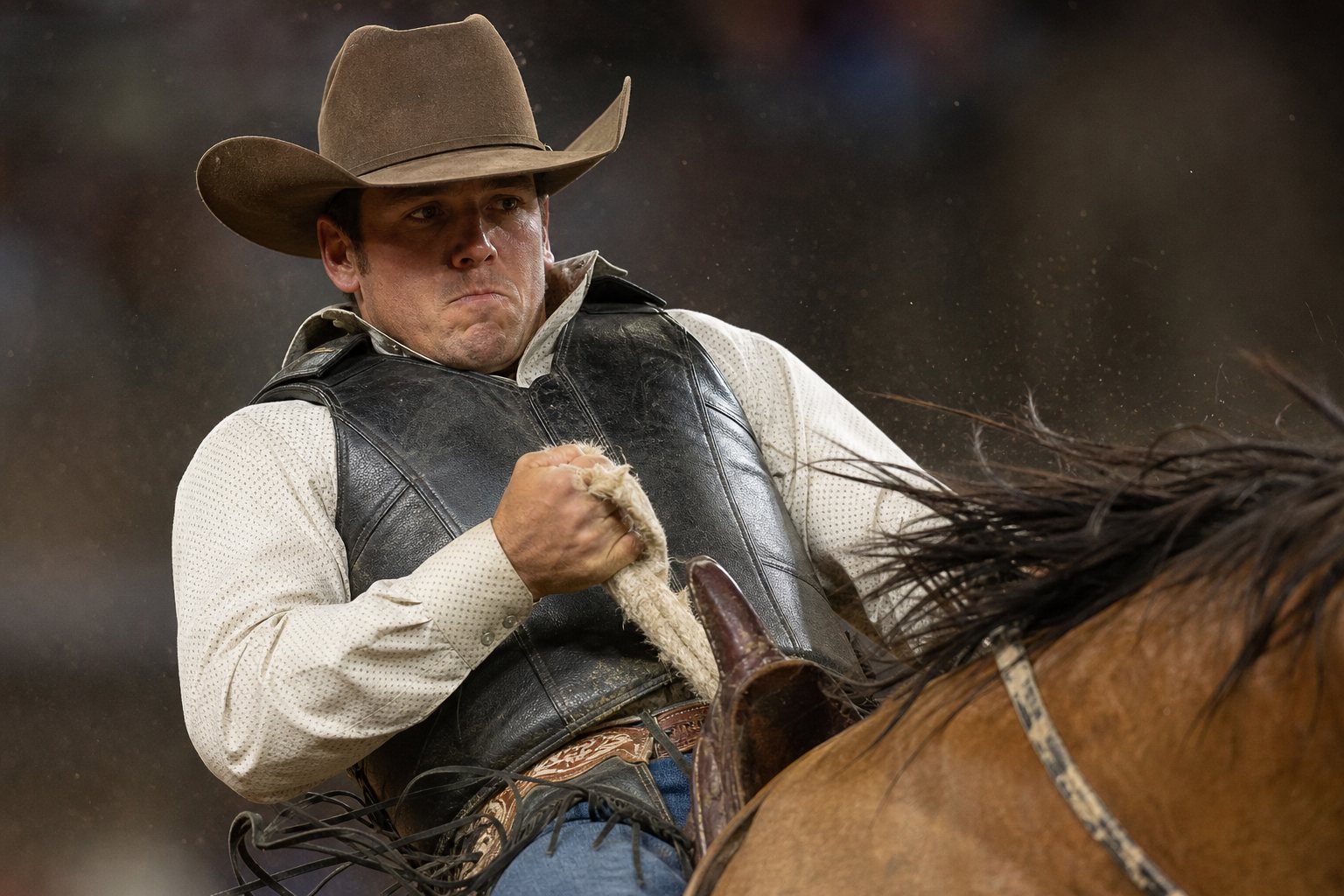
Sunday night, four hundred miles of highway behind you, a stiff neck, a swollen hand and a Monday-morning alarm. Rodeo recovery rarely looks like a spa. Rodeo recovery and mobility means the things that let your body and your riding or roping partner get ready for the next run: sleep, easy movement, enough food and water, a sane schedule, and knowing the difference between sore and hurt. This page keeps to what the sources support and says plainly where the evidence is weak.
Quick answer: The best-supported recovery tools are boring ones: enough sleep (adults 7 or more hours, per the American Academy of Sleep Medicine and Sleep Research Society), rest days, regular food and water, and gradual training. Reviews of popular recovery methods such as cold-water immersion are mixed and of low confidence, and we found no rodeo-specific recovery trials. Soreness that fades in a few days is normal; sharp, one-sided, worsening pain, swelling or any head injury symptom is not. See a sports medicine doctor, physical therapist or athletic trainer in that case.
Sleep first
The CDC says sleep affects health, mood and how well you function during the day, and the CDC and AASM/SRS recommend adults get at least 7 hours a night. For teens, the AASM consensus endorsed by the American Academy of Pediatrics is 8 to 10 hours for ages 13 to 18. Rodeo makes this hard: late performances, early drives and unfamiliar beds. General practice that coaches suggest, not rodeo research: keep a regular wake time when you can, give yourself a wind-down after a late night run, plan sleep stops on long drives, and cap caffeine late in the day. A 2026 systematic review and meta-analysis (Walsh and colleagues, Sports Medicine) notes that sleep and circadian interventions in athletes are mainly used for performance, recovery and travel, and examines their effect on mood and well-being.
Load management and rest days
Meyers and Laurent (Sports Medicine, 2010) warn that rodeo competitors should know the signs of overtraining, “exacerbated by overuse and minimal recovery.” The American Academy of Pediatrics (Brenner, 2016) advises young athletes to take 1 to 2 days off a week from their main sport and about three months a year away, in blocks of a month. For travelling pros, a simple version is to schedule at least one lighter day after every long run of competition, and a lighter week on a regular basis. Watch for repeated warning signs: heavy tired legs, poor sleep, low mood, more minor injuries, or riding badly for no reason.
Mobility and flexibility
A 2025 study of 162 college rodeo athletes (Wolfe and colleagues) used the Functional Movement Screen and concluded that movement patterns differ by event, so a bareback rider and a barrel racer will not need the same mobility work. Our practical (general-practice) list: hips and low back after long rides, shoulders and rotator cuff for ropers, neck and upper back for roughstock riders, and ankles for everyone who dismounts at speed. Ten easy minutes after a session, such as controlled hip openers, thoracic rotations and calf work, beat a long stretch routine you will skip. A physical therapist can check what your own body needs.
Recovery methods: what the evidence says
We did not find any trial of a recovery method in rodeo athletes. The general literature is mixed:
- Cold-water immersion. A 2026 umbrella review (Liang and colleagues, Sports Medicine Open) pooled 14 systematic reviews and found findings varied by outcome, comparison, timing and protocol. The same authors rated confidence as low in 2 reviews and critically low in 12, and note that the same studies appear across multiple reviews.
- Other modalities. A 2026 network meta-analysis of 35 randomized trials on soreness and muscle damage (Li and colleagues, Frontiers in Bioengineering and Biotechnology) found some methods, such as whole-body cryotherapy and light-based therapy, reduced soreness more than control at 24 and 48 hours. Those are not tools most rodeo athletes can use after each ride, and the research does not tell you the benefit in a rodeo setting.
- Massage tools and foam rollers. Popular and low-risk for most healthy people; we did not find rodeo-specific evidence. See our recovery tools guide for product comparisons.
- Food and fluids. Refuelling and rehydrating after hard work is a standard recommendation (ACSM, Academy of Nutrition and Dietetics and Dietitians of Canada 2016 position); see rodeo nutrition.
Sore or injured?
This is general guidance, not a diagnosis. Muscle soreness that builds a day or two after hard work and fades within a few days is common. Pain that is sharp, in one spot, getting worse, with swelling, a catching or giving-way joint, numbness, or pain at night should be assessed. After any head blow, stop and see CDC HEADS UP for danger signs. Pain that lingers for weeks, especially in the shin, foot or hip, can be a stress injury and needs a clinician. What injuries look like is on our rodeo injuries page.
Related: training, injury prevention, horseback riding recovery for rider-specific tips.
Rodeo recovery FAQs
How much sleep does a rodeo athlete need?
Adults need at least 7 hours a night, per AASM and SRS, and teens 8 to 10 hours per the AASM consensus endorsed by the AAP. Travel can cut that down, so plan sleep as part of your schedule.
Do ice baths help after rodeo?
The evidence is mixed. A 2026 umbrella review of 14 reviews found results varied by outcome and protocol, with low or critically low confidence in the reviews. Nothing was tested in rodeo riders.
Should I stretch after riding?
Easy mobility work after a session is reasonable and is general coaching practice. Event-specific needs differ, so ask a physical therapist what to prioritize.
How do I know if I am overtraining?
Warning signs include lingering tiredness, poor sleep, mood changes and more minor injuries. Meyers and Laurent say rodeo athletes should know the signs of overtraining and recover enough between hard efforts.
Is a foam roller worth it?
Many athletes like them and they are low risk for most people, but we found no rodeo-specific evidence. Use it as a comfort tool, not as a treatment for an injury.
Sources
- CDC: About sleep
- AASM pediatric sleep duration consensus (PDF)
- Walsh E et al. Sleep and circadian interventions and athlete mental health. Sports Med 2026
- Meyers MC, Laurent CM. Part II. Sports Med 2010
- AAP Brenner 2016
- Wolfe A et al. FMS profile of college rodeo athletes 2025
- Liang W et al. Cold-water immersion umbrella review. Sports Med Open 2026
- Li J et al. Recovery modalities network meta-analysis. Front Bioeng Biotechnol 2026
- ACSM/AND/DC joint position on nutrition and athletic performance 2016
- CDC HEADS UP: signs and symptoms
General information for education only, not medical advice. It cannot replace a sports medicine doctor, physical therapist or athletic trainer who knows you. Read how we work in our editorial policy.