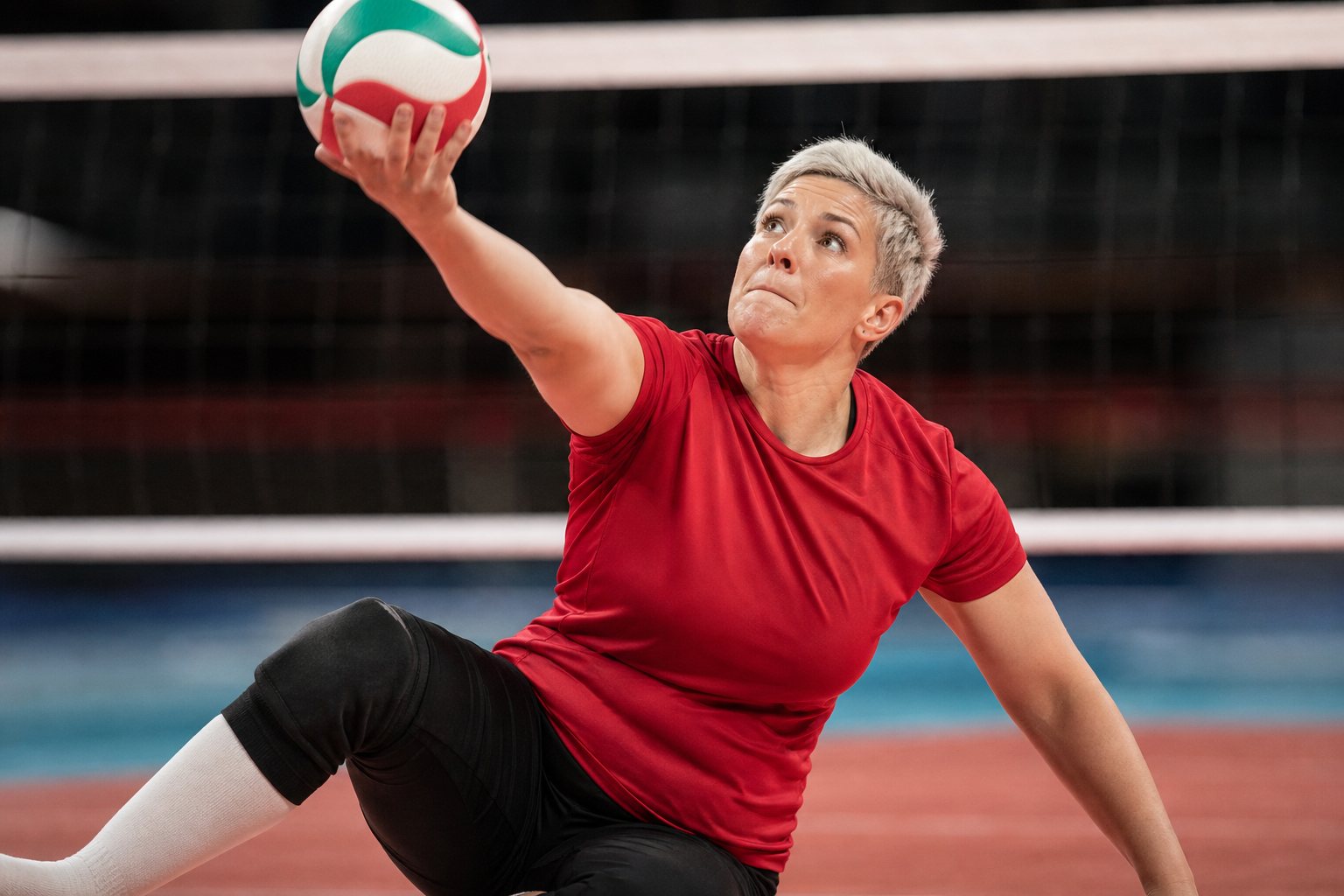
Late in a long tournament day, a defender dives for a tip over the block, lands on her hip and slides, and gets up shaking the right hand she caught the floor with. Sitting volleyball injury prevention is the set of habits that aim to lower the chance of this kind of hurt: a warm-up that wakes up the shoulders, a slow build in load, strength work for the shoulder and trunk, a safe floor, sensible protection and honest reporting of pain. They lower the odds. They cannot promise anything.
Quick answer: The injury research points mainly at the shoulder, hand and fingers, neck and lower back. We found no tested prevention program for sitting volleyball itself, so the best-supported ideas come from standing volleyball and wheelchair sports and are labelled below. See a sports medicine doctor, physical therapist or athletic trainer who works with para athletes if pain stays in one spot, wakes you at night, or changes how you swing. Call emergency services after a head injury with danger signs.
General information, not medical advice. What the injuries look like is on our injuries page, so we do not repeat it here. For the sport as a whole, start at the sitting volleyball hub.
Warm-up: what published programs include
No injury-prevention warm-up has been tested in sitting volleyball. The closest evidence is a study of eight recreational standing volleyball teams (93 players) in which teams doing a shoulder-focused routine at the start of training twice a week had fewer injuries, and less severe ones, than teams that did not (Tooth and colleagues, Physical Therapy in Sport 2023). Shoulder injuries fell too, significantly only in men, and compliance was a problem. In wheelchair basketball, a 5-minute shoulder program done three times a week for six weeks improved shoulder rotation range in seven college athletes, but not strength (Wilroy and Hibberd, Journal of Sport Rehabilitation 2018). Both are other sports, with small samples.
Practical read, as general coaching practice: start with gentle arm circles and band work for the rotator cuff and shoulder blades, add trunk rotation and wrist and finger mobility, then build through serving and passing at partial effort before full-speed attacks. Keep static stretching for after play. Strength work is on our training page.
Technique and the movement of play
A systematic review of sitting volleyball injuries (Moraes and colleagues, Motriz 2025) found most injuries affected the upper limbs, especially the shoulder, mainly through overload, and mostly in training rather than matches. That fits a game of repeated overhead contacts. The review does not test technique changes, and we found no published study showing a technique fix that lowers injury risk in this sport. What coaches can do is practise full shoulder and elbow extension and trunk use rather than arm-only hitting, which a serve-velocity study supports for performance (Cavedon and colleagues, 2023), and ask a physical therapist to check any movement that hurts.
Training load: build gradually
There is no sourced numeric rule for sitting volleyball load, so we give none. The evidence says to watch the spikes. In the Iran Sitting Volleyball Super League, injury incidence in the competition period (33.5 per 1,000 athlete days) was more than double the pre-competition period (14.5), and most injuries were re-injuries (Mahmoudkhani and colleagues, Physician and Sportsmedicine 2025). In elite volleyball players, training volume may help predict low back pain (Zwierzchowska and colleagues, Scientific Reports 2023). Sensible reading: ramp up gradually after layoffs, keep rest days and treat tournaments as a load spike.
Strength and balance of the shoulder and trunk
In 16 sitting volleyball players, an imbalanced ratio of external to internal rotation strength was associated with a history of shoulder overuse injury, and the authors recommended external rotator conditioning, particularly in fatigued conditions (Dupuy and colleagues, American Journal of Physical Medicine and Rehabilitation 2025). That is an association in a small group, not proof. For manual wheelchair users with paraplegia, a randomized trial compared groups taught shoulder exercises and mobility techniques with historical controls: shoulder pain began in 11% and 24% of exercisers at 18 and 36 months against 27% and 40% of controls (Haubert and colleagues, Topics in Spinal Cord Injury Rehabilitation 2021). A different population, but a pointer.
Floors, posts and the environment
World ParaVolley’s rules say the playing surface must be flat, horizontal and uniform, must not present a danger of injury, and that rough or slippery surfaces are forbidden (rule 1.2.1). At World ParaVolley events net posts must be padded and set 1 metre outside the side lines (rule 2.5.1). In a community gym, check for loose boards, wet patches and obstacles before play. Heat is mainly an outdoor and travel concern, but a review of heat in Paralympic athletes notes that some impairments raise heat vulnerability (Griggs and colleagues, Temperature 2020), so ask a clinician about your own thermoregulation.
Protective equipment and fit
The rules permit compression pads, described as padded injury protection devices, to be worn for protection or support, and bandages (rules 4.5.1 and 4.5.3). They also forbid sitting on thick material or wearing specially made thick shorts or pants, so padding that raises the player is out. Shoes, if worn, must be light and pliable with rubber or composite soles without heels (rule 4.3.2); players may play without shoes. There is no published standard or trial for finger tape, wrist supports or hip padding in sitting volleyball, so treat them as comfort and personal choice, not proven protection. A 2024 case report described custom 3D-printed hand orthoses that allowed one athlete with scleroderma to play (Cutti and colleagues, Medical Engineering and Physics). Check hands, hips and any residual limb for friction sores after sessions.
Head injuries
Concussion is less studied in sitting volleyball than in contact sports. The first Concussion in Para Sport position statement (Weiler and colleagues, British Journal of Sports Medicine 2021) says return to sport after concussion in para athletes needs case-by-case decisions. The CDC HEADS UP guidance says to seek emergency care for danger signs such as repeated vomiting, a headache that gets worse, seizures, increasing confusion or one pupil larger than the other. Remove the player from play and let a health professional decide.
What prevention cannot do
Nothing here removes the risk. Sitting volleyball had one of the higher injury rates at Paris 2024: 19.9 per 1,000 athlete days against 8.6 for the Games overall (Derman and colleagues, British Journal of Sports Medicine 2026). Much of the research is small or retrospective. We found no youth-specific sitting volleyball injury data, so we say nothing special about young players. Healing and return belong to the person treating you; see our recovery page for the basics.
When to see a professional
- Emergency now: any CDC head-injury danger sign, neck pain after a fall, numbness or weakness, or a joint that looks out of place.
- Soon: pain in one spot, pain at rest or at night, shoulder pain that returns every session, a finger that will not straighten, back pain that does not settle, or pain that changes how you serve or hit. A sports medicine doctor, physical therapist or athletic trainer familiar with para athletes can help with different parts.
Sitting volleyball injury prevention: FAQs
How can sitting volleyball players prevent shoulder injuries?
No program has been tested in sitting volleyball. Related evidence supports a shoulder warm-up, gradual load and rotator cuff conditioning, but none of it guarantees protection. A physical therapist can check your own shoulders.
Do sitting volleyball players need to warm up?
Common practice, and the evidence in standing volleyball, supports a warm-up that includes shoulder exercises. The details depend on your body and impairment.
Is there protective gear for sitting volleyball?
The rules allow compression pads for protection or support and bandages, but ban thick seating material. We found no safety standard for finger tape, wrist supports or hip pads.
What is the most common injury in sitting volleyball?
Studies point to the shoulder, fingers and wrist, with neck and lower back pain also reported. One review found most injuries affect the upper limbs, mainly from overload in training.
Are young players at higher risk?
We found no sitting volleyball injury data for young players, so we cannot say. General youth sport advice, such as rest days and gradual build-up, still applies.
Sources
- Moraes et al., sports injuries in sitting volleyball athletes: systematic review, Motriz 2025
- Tooth et al., shoulder injury prevention warm-up in volleyball, Phys Ther Sport 2023
- Wilroy and Hibberd, shoulder injury prevention program in wheelchair basketball, J Sport Rehabil 2018
- Haubert et al., shoulder pain prevention program for manual wheelchair users, Top Spinal Cord Inj Rehabil 2021
- Dupuy et al., shoulder overuse injury history and strength ratios in para athletes, 2025
- Mahmoudkhani et al., injuries in the Iran Sitting Volleyball Super League, 2025
- Zwierzchowska et al., injuries and pain in Olympic and Paralympic volleyball players, Sci Rep 2023
- Cavedon et al., predictors of serve ball velocity, 2023
- Derman et al., injury and illness at Paris 2024, Br J Sports Med 2026
- Griggs et al., heat-related issues for Paralympic athletes, Temperature 2020
- Cutti et al., hand orthoses for sitting volleyball, Med Eng Phys 2024
- Weiler et al., Concussion in Para Sport position statement, Br J Sports Med 2021
- World ParaVolley: Official Sitting Volleyball Rules 2025-2028 (rules 1.2.1, 2.5.1, 4.3, 4.5)
- CDC HEADS UP: signs and symptoms
General information for education only, not medical advice. It does not replace a visit with a doctor, physical therapist or athletic trainer. See how we write and check our pages in our editorial policy.