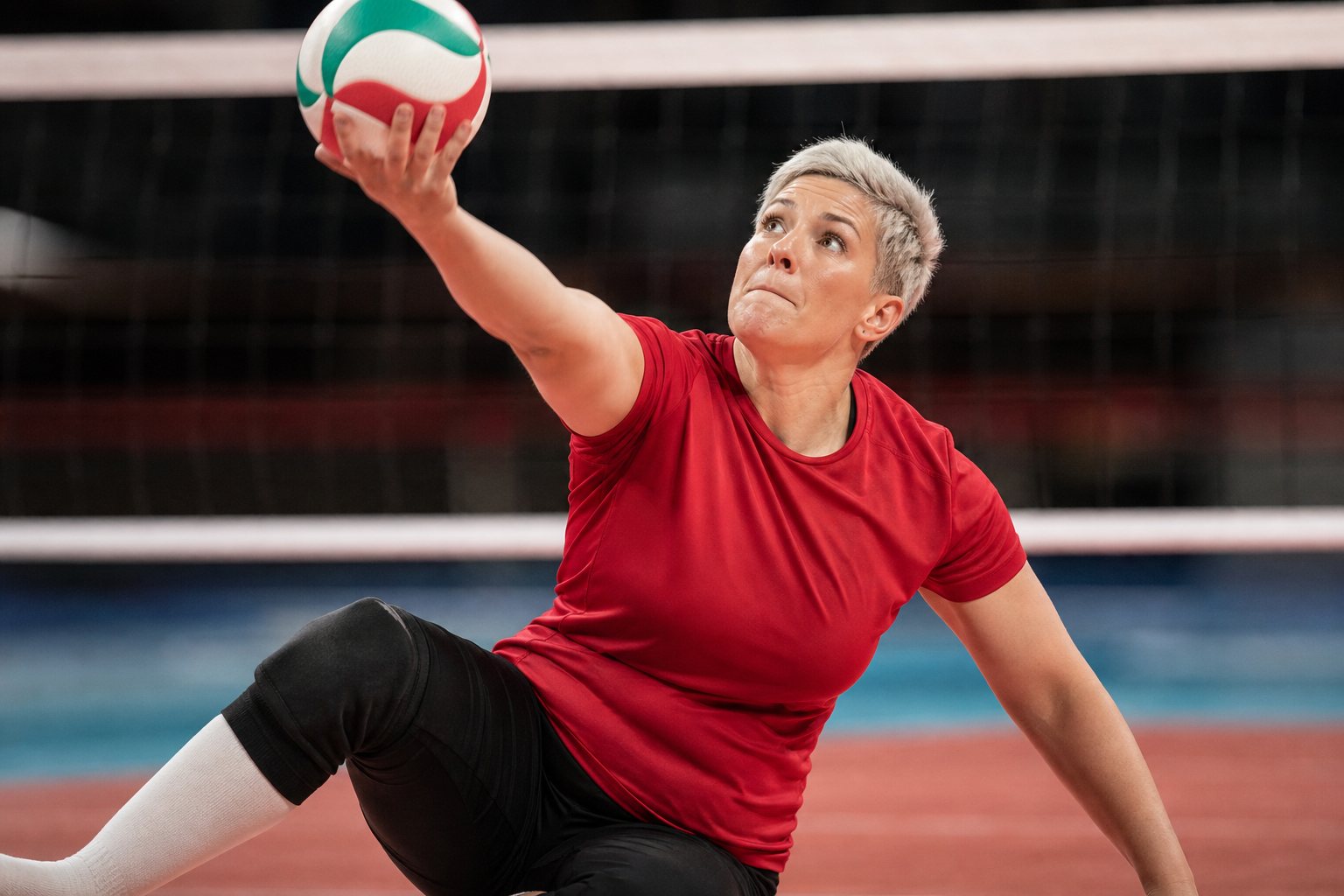
Tuesday evening in a school gym: the nets are up, half the squad is sliding backwards across the boards to cover a deep serve, and the other half is on a bench doing rows. Sitting volleyball training is everything a player does to be ready for that game: skills work on the floor, strength for the shoulders, arms and trunk, short fast conditioning, and enough rest to repeat it next week.
Quick answer: The sport leans on the upper body, the trunk and quick short moves on the floor. We found no published breakdown of its energy systems, so the weekly shape below is general coaching practice, not a prescription. A common pattern is two or three skill sessions, two strength sessions and some conditioning, with at least one full rest day. Exercise choices depend on the athlete’s impairment, so build the plan with a coach, physical therapist or athletic trainer who works with para athletes.
Rules and the basics of the game are on our rules page, injury patterns on injuries and injury prevention. General information, not medical advice.
What the game asks of the body
Research on the physical demands is thin. A 2023 scoping review (Petrigna and colleagues, Journal of Sports Medicine and Physical Fitness) found only 7 eligible studies on how fitness is measured in sitting volleyball and called the literature poor. The tests used most often were handgrip, the agility t-test and a speed and endurance test. What the studies do show points to the arms, shoulders and trunk:
- Hitting. In 30 elite players, men’s spike velocity averaged 67.2 km/h and women’s 51.5 km/h (Sun and colleagues, Frontiers in Physiology 2026). Spike speed was linked to hand span, sitting height, grip strength, bench press and a seated medicine-ball chest pass, but after adjusting for sex most links weakened and none held after statistical correction. Treat it as a pointer, not a recipe.
- Serving. In 37 athletes, a greater impact height and stronger abdominal muscles went with faster serves (Cavedon and colleagues, International Journal of Sports Medicine 2023).
- Moving. In a 2022 study of 35 male players, better sprint scores went with greater upper-body strength, longer hand span and lower body fat (Cavedon and colleagues, PeerJ). In nine players, grip strength was linked to the first metre of forward movement (Wiliński and colleagues, 2022).
A 2025 trial of caffeine in elite players described the sport as relying heavily on upper-body strength and anaerobic capacity (Diedhiou and colleagues); that is the authors’ framing, not a measured energy-system split.
A sensible weekly shape (general coaching practice)
For physical activity in general, the World Health Organization’s 2020 guidelines advise adults to accumulate 150 to 300 minutes of moderate or 75 to 150 minutes of vigorous aerobic activity a week plus regular muscle-strengthening, and include specific recommendations for people living with disability. Club players training for a team sport usually go beyond that. A week that many coaches use, shown as an example only:
- Two or three skill sessions of 60 to 90 minutes: serve and receive, setting, attack and block, floor movement, and match-style play.
- Two strength sessions built on pushing, pulling, rotator cuff, trunk and grip work. For lifters new to training, the American College of Sports Medicine’s position stand for healthy adults suggests loads in an 8 to 12 repetition range; it is not specific to athletes with impairments.
- One conditioning block of short, hard efforts such as seated sprints and repeat shuffles, with full recovery between sets, or arm-crank intervals.
- At least one full rest day, and a lighter day after matches.
Strength: shoulders, trunk and grip
Shoulders sit at the centre of the injury data (see injuries), so shoulder conditioning is the most defensible strength priority. In 13 Brazilian national team players, the dominant shoulder produced more rotation strength than the other side (Ahmadi and colleagues, 2020). A 2025 study of 16 sitting volleyball players and 12 standing volleyball players (Dupuy and colleagues, American Journal of Physical Medicine and Rehabilitation) found an imbalanced external-to-internal rotator ratio was associated with a history of shoulder overuse injury in the para athletes, and the authors suggested adding external rotator conditioning to regular training. In 53 elite male para athletes, including sitting volleyball players, side-to-side strength differences stayed within 15% and the authors read them as adaptation (Mahmoudkhani and colleagues, BMC Musculoskeletal Disorders 2026). A bit of asymmetry is normal in an overhead sport; a big gap or a painful shoulder is a reason to see a physical therapist.
Trunk and grip come next. The trunk links the hips to the swing, and Cavedon’s serve study points to abdominal strength. Grip appears in several of the studies above, and in 12 elite players handgrip strength was a rough stand-in for shoulder external rotator strength (Ahmadi and colleagues, 2020), though it does not replace a proper shoulder check.
Conditioning, speed and tracking load
Short and sharp matches the game: rallies are brief, and the movement is mostly a few metres at a time. The research test batteries use 5-metre sprints, an agility test and a repeat-effort speed and endurance test. A simple way to track how hard training was is the session rating of perceived exertion, a 0 to 10 score for how hard the session felt. A monitoring study of a provincial women’s sitting volleyball team found heart rate and rating of perceived exertion tracked each other (Liang and colleagues, Scientific Reports 2023), which supports using a cheap RPE score when heart rate monitors are unavailable. Our recovery page covers what to do with that number.
Load matters because injuries cluster when playing time is heaviest. In the Iran Sitting Volleyball Super League, injury incidence in the competition period was 33.5 per 1,000 athlete days against 14.5 before it (Mahmoudkhani and colleagues, Physician and Sportsmedicine 2025). In elite Olympic and Paralympic volleyball players, training volume may help predict low back pain (Zwierzchowska and colleagues, Scientific Reports 2023). Neither study tells you how many hours is too many, so the working rule is to raise load gradually and watch for pain that persists.
Periodisation basics (general practice)
- Off-season: build general strength, mobility and base fitness; learn new skills while the schedule is light.
- Pre-season: shift toward power, speed and match-style play; add volume slowly.
- In-season: keep one or two shorter strength sessions to hold gains, protect rest days, and plan lighter weeks around tournaments.
Body composition comes up often in the research. In the PeerJ study, VS1 players had a higher fat mass percentage than non-impaired players, and lower fat mass went with faster sprints. That is an observation, not a target; for women in particular, chasing leanness carries risks, which our nutrition page discusses.
Sitting volleyball training: FAQs
How many days a week should a sitting volleyball player train?
There is no published figure for the sport. Club players commonly train three to five days a week with at least one full rest day, and the right load depends on age, impairment and experience. Build it up slowly with a coach.
Which exercises matter most for sitting volleyball?
The sources we read point to the shoulders (especially external rotators), the trunk, the grip and the upper-body pushing and pulling muscles. The specific exercises depend on the athlete and are best chosen with a physical therapist or coach.
Do I need to lift weights?
Not to enjoy the game. For players who want to compete, strength work for the upper body and trunk is a common part of training and is linked to speed and power measures in research, though most of those studies are small.
Is there a fitness test for sitting volleyball?
Researchers use handgrip, an agility t-test, 5-metre sprints and a speed and endurance test, among others. A 2023 review found only 7 studies and proposed a standard set of tests. They are used for tracking, not for deciding who may play.
How should training change for a player with a leg amputation or limited range of motion?
Individually. Studies find lower limb amputation may affect the pattern of musculoskeletal complaints, but no published program tailors training to each class. Ask a clinician who works with para athletes.
Sources
- Petrigna et al., scoping review on physical fitness in sitting volleyball, J Sports Med Phys Fitness 2023
- Sun et al., spike velocity and physical characteristics, Front Physiol 2026
- Cavedon et al., predictors of serve velocity, Int J Sports Med 2023
- Cavedon et al., physique and performance in male sitting volleyball, PeerJ 2022
- Wiliński et al., hand grip strength and locomotor efficiency, J Hum Kinet 2022
- Diedhiou et al., caffeine in elite sitting volleyball players, BMC Sports Sci Med Rehabil 2025
- Ahmadi et al., shoulder isokinetic strength asymmetry in sitting volleyball, 2020
- Ahmadi et al., handgrip and shoulder isokinetic strength, J Bodyw Mov Ther 2020
- Dupuy et al., shoulder overuse injury history and strength ratios in para athletes, Am J Phys Med Rehabil 2025
- Mahmoudkhani et al., isokinetic shoulder strength in elite male Para athletes, BMC Musculoskelet Disord 2026
- Liang and Liang, load monitoring in women’s sitting volleyball, Sci Rep 2023
- Mahmoudkhani et al., injuries in the Iran Sitting Volleyball Super League, Phys Sportsmed 2025
- Zwierzchowska et al., injuries and pain in Olympic and Paralympic volleyball players, Sci Rep 2023
- WHO 2020 guidelines on physical activity and sedentary behaviour (Bull et al., Br J Sports Med 2020)
- ACSM position stand: progression models in resistance training for healthy adults, 2009
General information for education only, not medical advice. It does not replace a visit with a doctor, physical therapist or athletic trainer. See how we write and check our pages in our editorial policy.