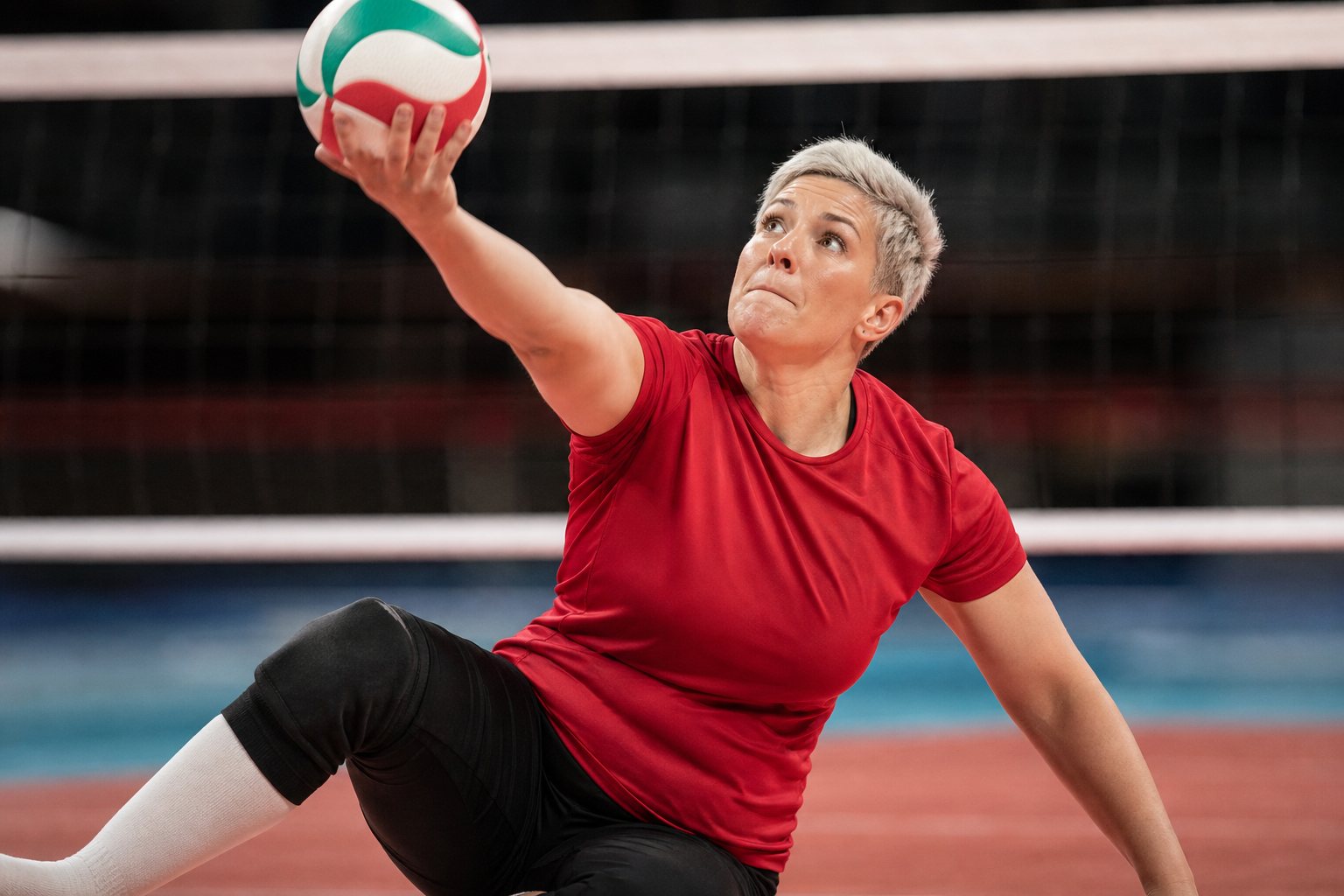
Third set, 22 all. The server stands behind the back line of a 10 by 6 metre court, and across a net barely over a metre high a blocker is already reaching up to swat the serve, which is legal here. Sitting volleyball is volleyball played on the floor by athletes with a physical impairment: a smaller court, a lower net, and one rule that defines the game, that part of the body between the buttocks and the shoulders stays in contact with the court during play. It is a Paralympic sport, run internationally by World ParaVolley.
Quick answer: Two teams of six, rally scoring, sets to 25 (win by two), best of five. Players must keep contact with the floor between the buttocks and shoulders when they play the ball, and blocking the serve is allowed. A beginner needs a volleyball, a net and a gym, and can start through a local adaptive sports club or by emailing USA Volleyball at [email protected]. Classification matters only for Paralympic-level and other international competition.
This page covers how the game works and how to start. Hub: sitting volleyball; standing game: volleyball hub. General information, not medical advice.
The court, the net and the ball
- Court: 10 m by 6 m, with an attack line 2 m from the centre line (World ParaVolley Official Sitting Volleyball Rules 2025-2028; USOPC sport overview). A standing volleyball court is 18 m by 9 m.
- Net: 1.15 m high for men and 1.05 m for women (World ParaVolley rules; IPC). The USOPC notes that a net of about 3.5 feet is the target for a recreational setup, and that a pickleball or tennis net can stand in for a volleyball net.
- Ball: the same standard as indoor volleyball: 65 to 67 cm around, 260 to 280 g, inside pressure 0.300 to 0.325 kg/cm2 (4.26 to 4.61 psi) (rule 3.1). World ParaVolley events use World ParaVolley approved balls.
- Floor: flat, horizontal and uniform, with no danger of injury (rule 1.2.1).
How a match is scored
The rules use the same rally point system as standing volleyball: whoever wins the rally scores, and a team that wins a rally on the other side’s serve gains the serve and rotates one position clockwise. A set goes to 25 points with a two-point lead, with play continuing past 24 all until someone leads by two. The first team to win three sets takes the match; a deciding fifth set goes to 15, win by two (rules 6.2, 6.3).
Each team gets three hits to return the ball, not counting the block. Each team may request up to two time-outs and six substitutions per set, and a time-out lasts 60 seconds (rules 15.1 and 15.4). Six players are on court. Teams may use up to two liberos, specialist defenders.
The seated rule, in plain words
At all times during playing actions, a player must keep contact with the court with some part of the body between the buttocks and the shoulders (rule 9.4.1). Lifting while playing the ball is a fault (9.3.5), with one exception: in a defensive action, a player may lift if the ball is not entirely higher than the top of the net. A short loss of contact is allowed at other times except while attacking. Standing up, raising the body and taking steps are forbidden (9.4.2). Legs may cross the centre and attack lines if they do not interfere with an opponent.
The other difference that catches newcomers out: the serve can be blocked and attacked (rule 14.5).
Basic skills a beginner works on
The skills are the standing game’s: serve, receive (pass or dig), set, attack and block. What changes is the base. The list below is general coaching practice, not from the rulebook, with the research we found noted where there is some.
- Moving on the floor. Players push, slide and pivot on the hips and hands. In a study of nine male players, hand grip strength was linked to the time taken to cover the first metre moving forward (Wiliński and colleagues, Journal of Human Kinetics 2022), a small study but a reminder that the arms are also the legs.
- Serving. In an analysis of 3,664 serves from the Tokyo 2020 Paralympics and the 2022 World Championship, more effective serves were linked to a higher chance of winning the match (Cavedon and colleagues, Frontiers in Sports and Active Living 2024). In 37 athletes, serve speed was linked to impact height and abdominal strength (Cavedon and colleagues, 2023).
- Attacking and blocking. In a study of 100 male players at the 2009 European Championships, seated vertical reach was strongly related to activity and effectiveness in attacking, blocking and receiving (Molik and colleagues, Adapted Physical Activity Quarterly 2017).
Classification in plain words
Classification decides who can compete at the Paralympic and other international levels, and in which sport class. World ParaVolley’s Sitting Volleyball Classification Rules (August 1, 2026) set two classes. VS1 is for athletes whose impairment more significantly affects the core functions of sitting volleyball. VS2 is for athletes whose impairment affects them minimally. Examples from the rules: a through-ankle or higher amputation, or a leg length difference of 33% or more, is VS1; a foot amputation at the Lisfranc level, or a leg length difference of at least 7% and under 33%, is VS2. No more than one VS2 player may be on court at a time.
Eligible impairment types, according to the USOPC, are coordination impairments, impaired muscle power, impaired passive range of movement, and limb deficiency or limb length difference. USA Volleyball does not provide official national classification; it brings a World ParaVolley classifier to its national team camps, but official classification takes place at World ParaVolley events. Research on classes continues: a 2022 study of 35 male players (Cavedon and colleagues, PeerJ) said its results did not confirm the validity of the system then in use.
How a beginner starts
- Find a program. USA Volleyball and the USOPC suggest a local adaptive sports organization or volleyball club that offers sitting volleyball (club directory: uspara.us/findaclub). USA Volleyball says programs across the country offer clinics and competition for new athletes; its contact is [email protected].
- Play before you commit. The USOPC says all you need is a ball, a court and a net, and games can be played 4 v 4 or 2 v 2 on a smaller court.
- Skip prior experience. USA Volleyball’s national team development camps do not require volleyball experience, although eligibility is limited to athletes with a physical impairment.
In a 16-week sitting light volleyball program for 32 adults with physical disabilities in Hong Kong (Leung and colleagues, 2021), the group that played reported greater physical activity enjoyment than a comparison group.
Levels, from community to the Paralympics
Levels run from community clinics and regional events to national team development camps and international competition. Sitting volleyball has been in the Paralympic Games since Arnhem 1980 for men and Athens 2004 for women, and the IPC’s LA28 programme lists men’s and women’s events with eight teams each. Check the official programme for the current Games. We did not find a confirmed school or college pathway; ask your regional volleyball association. The referee document is free: World ParaVolley Official Sitting Volleyball Rules 2025-2028.
Next: training and performance, injury prevention and gear.
Sitting volleyball rules and getting started: FAQs
What is the seated rule in sitting volleyball?
A player must keep part of the body between the buttocks and shoulders in contact with the court during playing actions. Lifting to hit an attack is a fault, with limited exceptions in defence.
Can you block the serve in sitting volleyball?
Yes. Blocking and attacking the serve are both legal in sitting volleyball, which they are not in standing volleyball.
Do I need a classification to play?
Not to play recreationally or in a clinic. Official classification is needed for World ParaVolley competition. USA Volleyball brings a classifier to its national team camps but does not classify nationally.
How high is the net?
1.15 m for men and 1.05 m for women in World ParaVolley rules. Recreational games often use whatever net is available, lowered to suit.
Can someone without an impairment play?
Recreationally, yes in many programs. At Paralympic level, eligibility requires an eligible physical impairment. Rules limit minimal-impairment (VS2) players on court.
Sources
- World ParaVolley: Official Sitting Volleyball Rules 2025-2028
- World ParaVolley: Sitting Volleyball Classification Rules, August 1, 2026
- IPC: Introduction to sitting volleyball
- IPC: LA28 medal event programme and athlete quotas
- USOPC: Sport overview, sitting volleyball
- USOPC: Sitting volleyball
- USA Volleyball: Sitting National Team Development Program
- Cavedon et al., physique, performance and classification in male sitting volleyball, PeerJ 2022
- Cavedon et al., serve reception effectiveness, Front Sports Act Living 2024
- Cavedon et al., predictors of serve ball velocity, Int J Sports Med 2023
- Molik et al., game performance in elite male sitting volleyball, APAQ 2017
- Wiliński et al., hand grip strength and locomotor efficiency, J Hum Kinet 2022
- Leung et al., sitting light volleyball program, BMC Sports Sci Med Rehabil 2021
General information for education only, not medical advice. It does not replace a visit with a doctor, physical therapist or athletic trainer. See how we write and check our pages in our editorial policy.