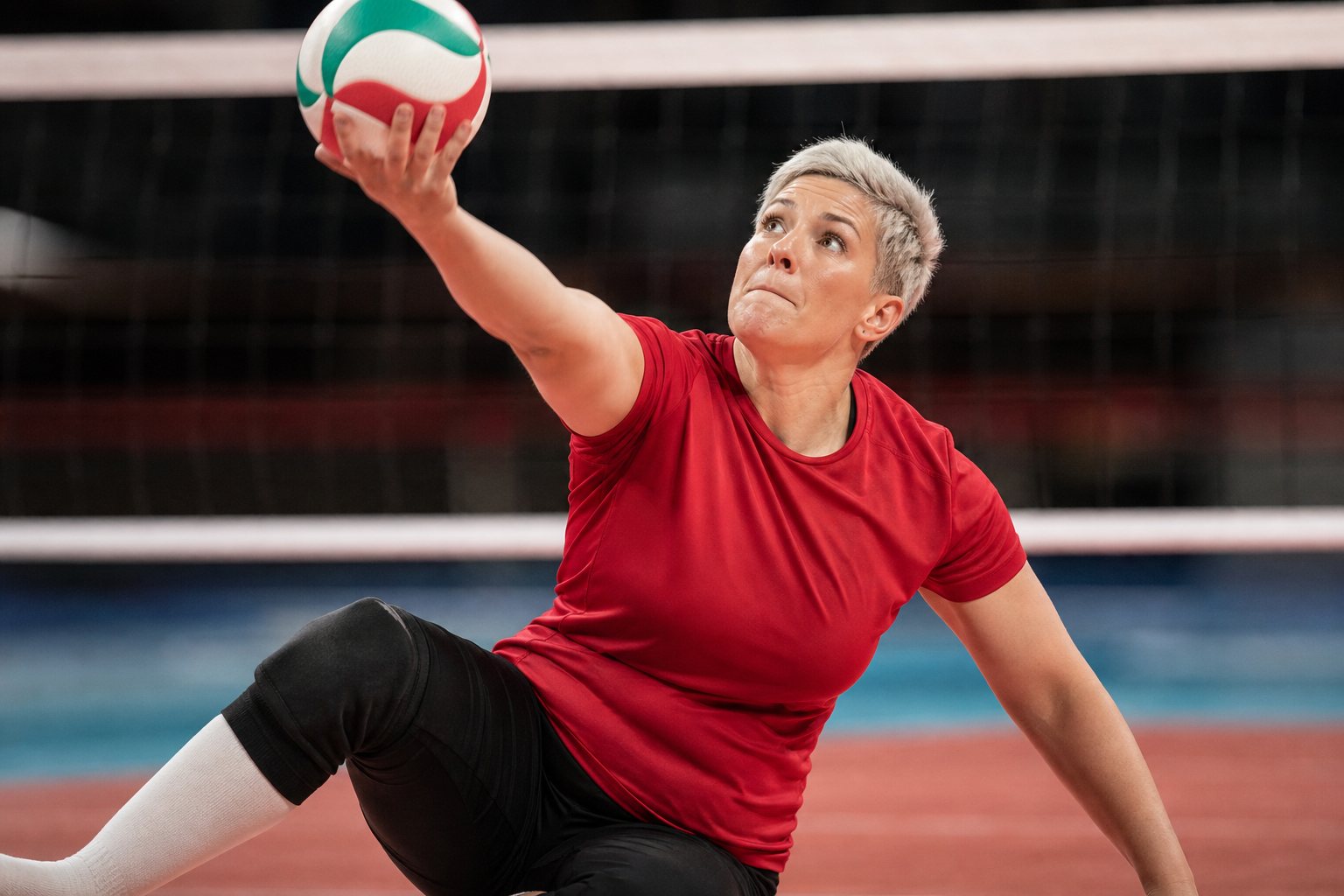
Sunday night after a two-day tournament: the arms feel like lead, the shoulders are tight, and Monday’s alarm is early. Sitting volleyball recovery is what a player does between sessions to be ready for the next one: sleeping enough, balancing hard and easy days, keeping the shoulders and back moving freely, and telling ordinary soreness from the kind of pain that needs a professional. Much of the evidence for recovery methods comes from other sports and from able-bodied athletes, and we say so below.
Quick answer: Sleep and a sensible mix of hard and easy days are the foundation. Massage and some other methods ease soreness for a while in studies, but the effects are small and mostly from able-bodied samples, and we found no recovery trials in sitting volleyball. Muscle soreness that fades in a day or two is common; pain in one spot, pain at rest or at night, or pain that changes how you swing is worth a visit to a sports medicine doctor, physical therapist or athletic trainer.
General information, not medical advice. Injury patterns are on our injuries page, and the strength work behind good recovery is on our training page.
Sleep: the first recovery tool
The 2021 expert consensus on sleep and the athlete (Walsh and colleagues, British Journal of Sports Medicine) says elite athletes are prone to short sleep (under 7 hours a night) and poor sleep quality, and it argues that one target for everyone, such as 7 to 9 hours, is unlikely to be ideal, so sleep needs are best individualised. It offers a toolbox of education and screening for practitioners. For para athletes, a narrative review notes that some impairments can raise the risk of poor sleep and that evidence-based practice is limited (Roberts and colleagues, Journal of Sports Medicine and Physical Fitness 2021). In 20 Paralympic athletes in athletics, swimming and powerlifting, poor sleep quality and poor sleep behaviour were common, and more insomnia symptoms and night awakenings went with more severe health problems (Silva and colleagues, Physical Therapy in Sport 2022). Among 1,603 Team USA Olympic and Paralympic athletes, 39.4% reported poor sleep on the Pittsburgh Sleep Quality Index (Anderson and colleagues, International Journal of Sports Physiology and Performance 2024).
Practical points, as general practice: keep bed and wake times steady across the week, plan how you will wind down after late evening matches, and ask a clinician if pain, spasms, bladder needs or breathing keep waking you, since some impairments affect sleep in specific ways.
Load management: hard days, easy days, rest days
Recovery starts with the schedule. In the Iran Sitting Volleyball Super League, incidence of injury in the competition period was 33.5 per 1,000 athlete days compared with 14.5 before it (Mahmoudkhani and colleagues, Physician and Sportsmedicine 2025). That suggests tournaments are a load spike worth planning around, though it does not say how much rest is right. A monitoring study of a provincial women’s team found heart rate and rating of perceived exertion tracked each other (Liang and colleagues, Scientific Reports 2023), so a 0 to 10 effort score after each session is a low-cost record. If your scores stay high for days and your arms do not feel fresh, ease the next session.
- After a match day: a light, easy session or full rest, then back to normal.
- Tournament weekends: eat, drink and sleep as planned; avoid adding new training.
- Return after time off: restart at a lower volume than where you stopped.
The list is general coaching practice, not a published sitting volleyball protocol.
Mobility and flexibility for shoulders, neck and back
Shoulders, neck and lower back are the usual trouble spots (see our injuries page). In seven college wheelchair basketball athletes, a 5-minute shoulder program done three times a week for six weeks increased dominant-side shoulder internal rotation by about 11 degrees and external rotation by about 8 degrees, without a gain in strength (Wilroy and Hibberd, Journal of Sport Rehabilitation 2018). It is a small, uncontrolled study in a different sport, but it suggests shoulder range of motion can respond to short regular work. In sitting volleyball, classification covers athletes with limited passive range of movement, so mobility goals should be set for the individual, not copied from another player. Common practice is to move gently through the shoulder blades, trunk and hips, change position after long periods of sitting, and avoid forcing a joint into pain.
What the evidence says about recovery methods
- Massage and other methods. A review of 99 studies (Dupuy and colleagues, Frontiers in Physiology 2018) found that active recovery, massage, compression garments, immersion, contrast water therapy and cryotherapy produced small to large decreases in soreness and fatigue ratings, and that massage seemed most effective for soreness and perceived fatigue, with massage and cold exposure strongest for reducing inflammation markers. The studies mostly involved able-bodied exercisers, and ratings of how you feel are not the same as performing better next week.
- Foam rolling. A meta-analysis of 21 studies (Wiewelhove and colleagues, Frontiers in Physiology 2019) found foam rolling before exercise gave a small improvement in sprint performance and flexibility, and rolling after exercise slightly reduced the drop in sprint performance. The effects were small. Whether rollers suit your body is a question for your clinician when you have limited sensation or skin concerns.
- Cold water. A cross-sectional study of Paralympic powerlifters compared cold-water immersion for muscle recovery (Aidar and colleagues, International Journal of Environmental Research and Public Health 2025). It is one small study in another sport, so we do not draw a conclusion. Cold carries risks for people with impaired sensation or circulation; ask a clinician first.
- Gaps. We found no randomised trials of recovery methods in sitting volleyball players, and no consensus statement for para athletes.
Soreness versus injury
Delayed muscle soreness after an unfamiliar session usually eases within a few days and feels like a broad ache in the working muscles. Injury pain tends to be sharper, in one spot, present at rest or at night, or linked to a particular movement. The AAOS OrthoInfo lists pain at rest and at night, weakness and pain lifting the arm among shoulder warning signs, and says continuing to use a painful shoulder can make some problems worse. See a sports medicine doctor, physical therapist or athletic trainer for these, for numbness or weakness, for a finger that cannot straighten, or for a head injury with danger signs. Skin checks belong in recovery too, especially for hands, hips and any residual limb after floor work.
Sitting volleyball recovery: FAQs
How much sleep does a sitting volleyball player need?
There is no single sitting volleyball figure. An expert consensus says needs are individual and that elite athletes often sleep under 7 hours, which is a risk. Talk to a clinician if sleep is a problem.
Is a foam roller worth using?
Studies show small effects on flexibility and soreness, with more benefit for how muscles feel than for performance. Fine as part of a routine if it feels good, but not a substitute for sleep and rest.
Should I stretch after matches?
Gentle mobility for the shoulders, trunk and hips is common practice. We found no sitting volleyball study of stretching, so keep it comfortable and avoid forcing painful ranges.
How do I know if soreness is an injury?
Broad aching that fades within a few days is typical soreness. Sharp pain in one spot, pain at rest or at night, weakness or pain that changes how you swing is a reason to see a clinician.
Are ice baths good for recovery?
Evidence is mixed and mostly from other sports. Cold may be unsuitable with impaired sensation or circulation, so check with a clinician before trying.
Sources
- Walsh et al., sleep and the athlete: 2021 expert consensus, Br J Sports Med
- Roberts et al., sleep disruption considerations for Paralympic athletes at Tokyo 2020, J Sports Med Phys Fitness 2021
- Silva et al., sleep in Paralympic athletes and injuries and illnesses, Phys Ther Sport 2022
- Anderson et al., sleep quality in Team USA Olympic and Paralympic athletes, Int J Sports Physiol Perform 2024
- Mahmoudkhani et al., injuries in the Iran Sitting Volleyball Super League, 2025
- Liang and Liang, load monitoring in women’s sitting volleyball, Sci Rep 2023
- Wilroy and Hibberd, shoulder injury prevention program in wheelchair basketball, 2018
- Dupuy et al., post-exercise recovery techniques meta-analysis, Front Physiol 2018
- Wiewelhove et al., foam rolling meta-analysis, Front Physiol 2019
- Aidar et al., cold-water immersion in Paralympic powerlifting, Int J Environ Res Public Health 2025
- AAOS OrthoInfo: Rotator cuff tears
General information for education only, not medical advice. It does not replace a visit with a doctor, physical therapist or athletic trainer. See how we write and check our pages in our editorial policy.