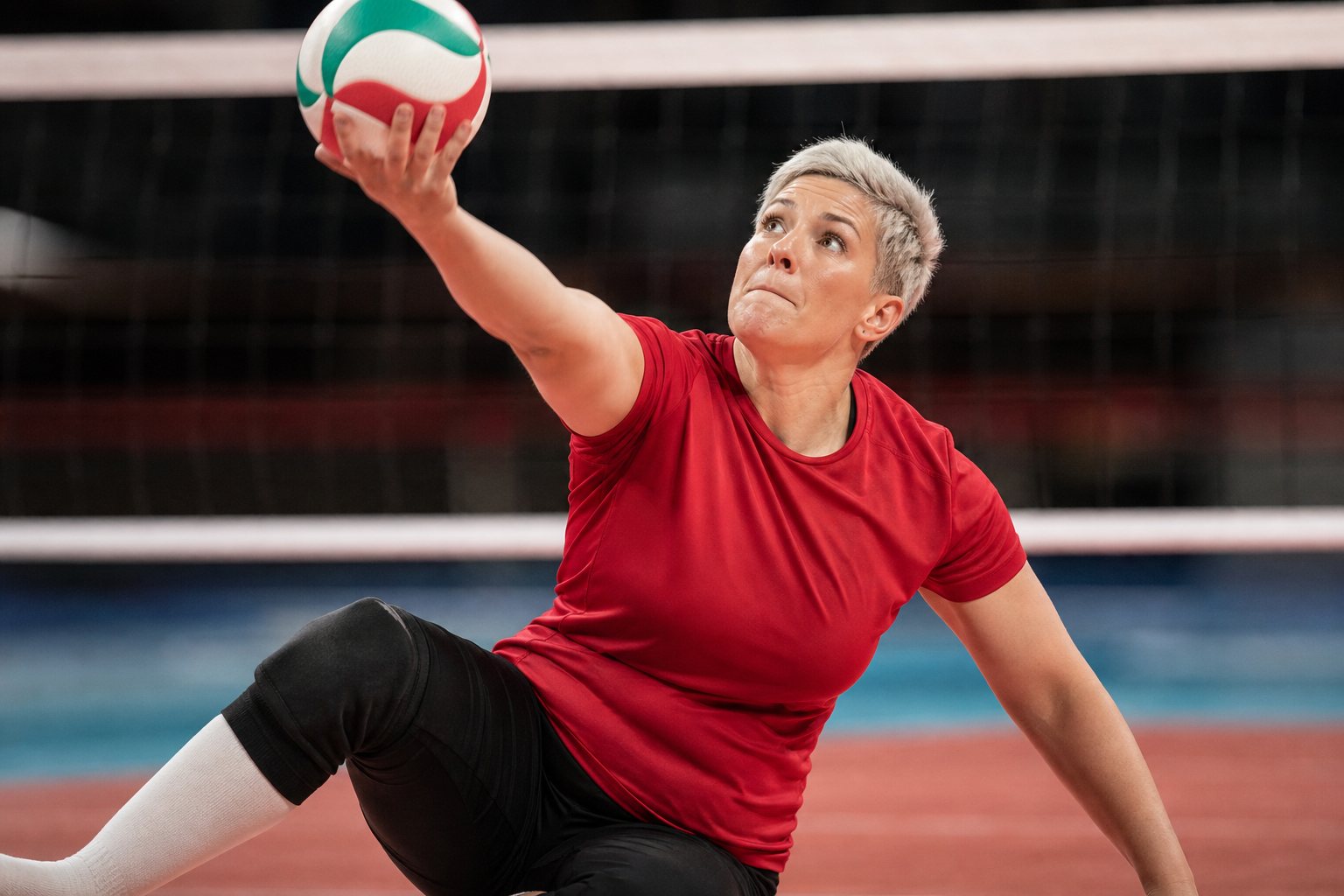
Saturday tournament, four matches, the second one at 11 a.m. and the last one after dark. A player’s bag holds a water bottle, a banana, a sports drink she has not tried before and a packet of something a teammate swears by. Sitting volleyball nutrition is the plan behind that bag: eating and drinking enough to fuel training and long match days, looking after bone and energy health, and treating supplements carefully because the rules of anti-doping sport apply to every athlete.
Quick answer: Fuel and fluids come first; supplements come last. Needs vary with the athlete’s impairment, body size and training, so a registered dietitian or sports dietitian is the best way to a personal plan. Low energy intake for the training done can harm bone, hormones and mood, and para athletes are not exempt. Supplements are a minor part of nutrition according to the IOC, and any supplement carries a risk of banned substances; choose products tested by a third party and check with a doctor or dietitian first.
General information, not medical advice, and not a diet plan. Training load is on our training page, and sleep and soreness on our recovery page.
Fuel and fluids for training and tournament days
The 2016 joint position statement of the Academy of Nutrition and Dietetics, Dietitians of Canada and the American College of Sports Medicine says performance and recovery are helped by well-chosen nutrition strategies, with guidance on the type, amount and timing of food, fluids and supplements for different training and competition scenarios, and refers athletes to a registered dietitian for a personal plan (Thomas and colleagues). We do not give grams or millilitres here, because requirements depend on the person. As general practice, tournament days usually work best with a familiar meal a few hours before the first match, small easy-to-digest snacks between matches, and water or a drink you have already tried in training.
Para athletes may have different needs. A 2025 review of 56 studies of Paralympic athletes (Ghazzawi and colleagues, Frontiers in Nutrition) says energy expenditure and nutrient needs vary with the impairment and the sport, that hydration is critical, particularly for athletes who struggle to regulate body temperature, and that research on nutritional requirements is lacking. A review of heat issues in Paralympic athletes notes that some impairments raise vulnerability to heat strain (Griggs and colleagues, Temperature 2020). Plan fluids with a clinician if your impairment affects sweating or temperature control. We found no weight classes in the rulebook, so cutting weight for competition is not part of the sport and should not become part of it.
Energy availability and RED-S awareness
Relative Energy Deficiency in Sport (REDs) describes health and performance problems that follow low energy availability, meaning too little energy intake for the energy used in training. The 2023 International Olympic Committee consensus statement (Mountjoy and colleagues, British Journal of Sports Medicine) updates the science, including more data in male athletes, links to mental health, and guidance for safe body composition assessment. Para athletes are in the picture, though measurement is harder. A 2022 review (Jonvik and colleagues, Nutrients) says Para athletes may be at higher risk of low energy availability than able-bodied athletes, but that the usual assessment tools are hard to apply, in part because published data on exercise energy expenditure across impairments are lacking, and some signs may reflect the impairment rather than low energy.
A survey of 260 elite US para athletes (Brook and colleagues, Scandinavian Journal of Medicine and Science in Sports 2019) found that 32.4% had elevated eating-disorder behaviour scores, 44% of premenopausal females reported irregular or absent periods, 9.2% reported a bone stress injury, and fewer than 10% knew about Triad or RED-S. Most were trying to change their weight or body composition to improve performance. It was a survey, not a diagnosis. Warning signs to take to a doctor or dietitian include losing weight unintentionally, missed periods, repeated bone pain, frequent illness, constant fatigue and anxiety about food. Disordered eating is a health matter, not a training problem.
Body composition, bone and measurement
Studies of sitting volleyball players often report body composition, and the numbers can be misused. In 13 Brazilian national team players, skinfolds agreed well with air-displacement plethysmography for body fat (Ahmadi and colleagues, 2024). In 20 female athletes with a physical impairment, those with impairments had higher fat mass in the lower body and lower lean mass and bone mineral content in the legs than male athletes with comparable impairments, and the authors called for tailored nutrition and training strategies (Cavedon and colleagues, Journal of Functional Morphology and Kinesiology 2025). A study of 40 male athletes with one leg amputation found low bone density at the impaired hip in about 80% of those with above-knee amputations and about 10% of those with below-knee amputations (Cavedon and colleagues, Frontiers in Physiology 2022). Ask a doctor about bone health, and do not set weight goals from body composition numbers without a professional.
Supplements: what the sports medicine bodies say
The IOC consensus statement on dietary supplements (Maughan and colleagues, British Journal of Sports Medicine 2018) says nutrition usually makes a small but potentially valuable contribution to performance and supplements a minor one; that only a few, including caffeine and creatine, have good evidence of benefit; that responses vary between individuals; that a nutritional assessment should come first; and that inadvertent intake of banned substances is a known risk. Anything intended to enhance performance should be trialled in training before competition.
- Caffeine. The International Society of Sports Nutrition position stand (Guest and colleagues, 2021) says caffeine improves performance in many but not all studies, and that individual responses differ. In 13 elite male Turkish players, a trial of caffeine found a possible trend toward faster serves, but it did not hold after statistical correction, and there was no effect on spike speed or speed-endurance (Diedhiou and colleagues, 2025). Caffeine is not for everyone: sensitivity, heart conditions or pregnancy are reasons to ask a doctor first, and we give no dose beyond a product label.
- Creatine. The ISSN position stand on its safety and efficacy (Kreider and colleagues, 2017) covers it; it is among the most studied supplements. We found no study in sitting volleyball players.
- Everything else. USADA strongly recommends avoiding bodybuilding, weight loss and sexual enhancement products.
Testing, banned substances and medicines
USADA says supplements are not reviewed by the FDA for safety or label accuracy before sale, that some are contaminated or spiked with banned substances, that labels can be wrong, and that athletes always assume some risk of a positive test. It recommends products certified by programs that test for banned substances, such as NSF Certified for Sport and Informed Sport, and notes that certification reduces but does not remove risk, and that USADA approves no supplement. For prescription and over-the-counter medicines, USADA points athletes to GlobalDRO to check anti-doping status; supplements are not covered there. If you compete in World ParaVolley or national events, check the rules with your team doctor before you take anything.
Sitting volleyball nutrition: FAQs
What should a sitting volleyball player eat on tournament days?
Familiar foods that sit well, a meal a few hours before play, light snacks between matches and fluids you have tried before. A registered dietitian can tailor this; amounts depend on the athlete.
Do sitting volleyball players need supplements?
No. The IOC says supplements make a minor contribution and only a few have good evidence. A nutrition check by a professional comes first.
Is caffeine safe before a match?
It is widely used, but responses vary and it is not for everyone. In one elite sitting volleyball trial, results were not robust after statistical correction. Ask a doctor if you have a heart condition, sensitivity or are pregnant.
What does third-party tested mean?
An independent program, such as NSF Certified for Sport or Informed Sport, tests products for banned substances. USADA recommends such products but says no certification removes all risk.
Are para athletes at risk of low energy availability?
Possibly at higher risk than able-bodied athletes, according to a 2022 review, but it is hard to measure. A survey of 260 elite para athletes found signs of Triad or RED-S factors. See a doctor or dietitian with concerns.
Sources
- Thomas et al., joint position statement on nutrition and athletic performance (AND, DC, ACSM), 2016
- Ghazzawi et al., tailored nutrition strategies for Paralympic athletes, Front Nutr 2025
- Griggs et al., heat-related issues for Paralympic athletes, Temperature 2020
- Mountjoy et al., IOC consensus statement on REDs, Br J Sports Med 2023
- Jonvik et al., assessing energy availability and RED-S in Para athletes, Nutrients 2022
- Brook et al., low energy availability, menstrual dysfunction and bone health in elite para athletes, 2019
- Ahmadi et al., body composition assessment in sitting volleyball players, J Bodyw Mov Ther 2024
- Cavedon et al., DXA body composition in female athletes with a physical impairment, 2025
- Cavedon et al., bone demineralization at the impaired hip in athletes with amputation, Front Physiol 2022
- Maughan et al., IOC consensus statement on dietary supplements, Br J Sports Med 2018
- Guest et al., ISSN position stand on caffeine and exercise performance, 2021
- Kreider et al., ISSN position stand on creatine, 2017
- Diedhiou et al., caffeine in elite sitting volleyball players, BMC Sports Sci Med Rehabil 2025
- USADA: Supplement Connect
General information for education only, not medical advice. It does not replace a visit with a doctor, physical therapist or athletic trainer. See how we write and check our pages in our editorial policy.