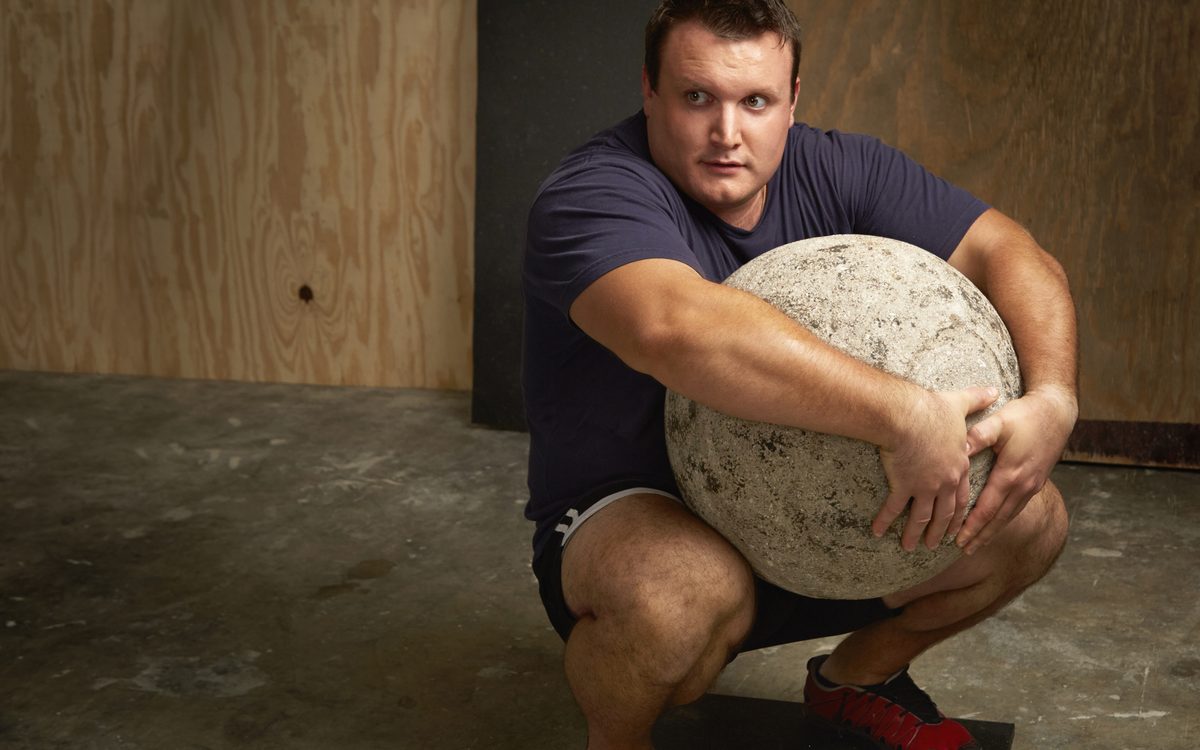
The stone is at hip height, the athlete’s forearms are locked around it, and everyone watching can tell that the next two seconds depend on a flat back and a clean hip drive, not on bravado. Strongman injury prevention is the set of habits around heavy, awkward lifting, a purposeful warm-up, careful technique, loads that rise gradually, support from spotters and sensible rest, that aim to lower the chance of getting hurt. They lower the odds. They cannot promise anything.
Quick answer: The best-supported steps for strongman athletes are a warm-up you practise, technique checked by a coach, slow progression on implements (surveyed athletes were hurt 1.9 times as often per exposure doing implement training), spotters or catchers, and enough rest. Evidence specific to strongman is thin and mostly self-reported. See a sports medicine doctor, physical therapist or athletic trainer if pain stays in one spot, wakes you at night or changes how you lift, and call emergency services after a head injury with danger signs.
General information, not medical advice. This page is about lowering risk. What each injury looks like is on our strongman injuries page, so we do not repeat it here. For the sport as a whole, see the strongman hub.
Warm-up: practise it before contest day
We found no published injury-prevention warm-up program tested in strongman athletes, so there is no named routine to point to. What surveys show is that warming up is nearly universal: in a 2019 survey of 132 strongman athletes (Winwood and colleagues), 94% warmed up in competition, usually self-directed and lasting about 16 minutes, with about 8.5 minutes of rest before the event seen as ideal. The most common reasons were injury prevention, activation and raising heart rate and blood flow, and athletes said they rehearsed the warm-up in training. Our training page covers how it fits into the week.
General coaching practice, not a study result: a common pattern is five to ten minutes of easy movement, joint mobility for hips, shoulders and upper back, then lighter versions of the day’s lifts building to working weights.
Technique and learning implements
The 2014 survey of 213 strongman athletes (Winwood, Hume, Cronin and Keogh, Journal of Strength and Conditioning Research) concluded that athletes should monitor technique and progressions for exercises that load the lower back, shoulder, biceps and knee. Practical points coaches commonly give, labelled as general practice: learn each implement at light weights, film your lifts, ask someone experienced to look for a rounding back or a shoulder pulled forward, and decide before the lift how you will drop and step away from the object.
Progressive training load
The same 2014 study found that although 54% of injuries occurred in traditional training, athletes were 1.9 times more likely to be injured per hour when doing strongman implement training once exposure was considered. We did not find a source stating a safe weekly increase for strongman, so we give no percentage. The ECSS and ACSM overtraining consensus describes the underlying idea: overload helps, but excessive overload with inadequate recovery can lead to prolonged under-performance. A 2025 review of resistance-training injuries (Kawa and colleagues) lists improper technique, excessive loading, insufficient recovery and anabolic steroid use among the key contributors.
Strength and conditioning as protection
The 2025 resistance-training injury review also notes that resistance training itself serves as a protective measure against future injuries, which is why a base of general strength matters before heavy implements. Surveyed strongman athletes train squats, deadlifts, pressing and Olympic-style lifts alongside implements (2011 survey of 167 athletes), which matches that idea, though the surveys do not show it prevents injuries. Weak links such as the upper back, trunk and grip are common focus areas for coaches (general practice).
Environment, surfaces and the contest field
- Heat: many shows run outdoors over a long day. The National Athletic Trainers’ Association (NATA) position statement on exertional heat illnesses is the standard reference; call emergency services for confusion, collapse or very high body temperature.
- Ground and footing: loose gravel, wet grass or sloped lots make stones, yokes and carries harder to control (general practice). Look over the event area on arrival.
- Staffing: Strongman Corporation’s licensing page says promoters must provide enough staff, including spotters, loaders and scorekeepers, so ask the promoter who will catch and how they are briefed. We found no federation safety standard beyond that.
- Training partners: in a 2026 nine-month study of 381 weight trainers (Naderi and colleagues), training with a partner was associated with 70% lower injury risk. That is an association, not proof.
Protective equipment and fit
Belts, wraps and straps are common, and our gear page covers fit and standards in detail. For prevention, the honest summary is that we did not find studies showing belts, wraps or sleeves lower injury rates in strongman athletes. A 2022 study of 20 recreational lifters found a belt with straps changed deadlift knee angle and lowered perceived effort, not injury, and a 2024 study found wrist wraps did not change bench-press strength, power or endurance. Maker words such as “approved” or “heavy duty” are not injury claims.
Teens and masters
Strongman Corporation allows athletes from age 12 and has teen and masters classes. For younger lifters the American Academy of Pediatrics 2008 statement on strength training and a 2014 international consensus on youth resistance training are the places to start; supervised, technique-first training is the common thread. In the 2014 strongman survey, athletes aged 30 or under reported more competition injuries than older athletes (0.5 against 0.3 per athlete per year), and those over 105 kg more than lighter ones.
What prevention cannot do
A 2017 systematic review (Keogh and Winwood) found strongman among the weight-training sports with the highest injury rates, 4.5 to 6.1 per 1,000 hours, and noted that few studies are of high quality. No habit removes that risk: implements move, rounds happen and fatigue is real. Prior injury also matters: in the 2026 cohort of weight trainers, a previous injury raised the risk of a new one 3.74 times, and obsessive passion and exercise addiction were linked to more injuries. Prevention is about stacking small advantages.
When to see a professional
- Pain in one spot that lasts more than a few days or gets worse with lifting.
- A sudden pop or tearing sensation, especially in the biceps, chest or shoulder, followed by bruising or weakness.
- Numbness, tingling or weakness in an arm or leg.
- Any head injury with headache, confusion, vomiting or loss of consciousness (see CDC HEADS UP).
- Pain that wakes you at night or does not ease with rest.
The 2014 survey found 54% of athletes treated injuries themselves and 41% saw a medical professional. A sports medicine doctor, physical therapist or athletic trainer can assess you; we cannot.
Frequently asked questions
Is strongman more dangerous than powerlifting?
Surveillance data suggest strongman has higher injury rates per training hour than most weight-training sports (4.5 to 6.1 per 1,000 hours against much lower figures for bodybuilding in the 2017 review), but most studies are retrospective and of mixed quality, so the comparison is rough. See powerlifting.
Does a lifting belt prevent injuries?
We did not find evidence that it does. Studies of belts looked at performance, joint angles and perceived effort. Use one for support if a coach advises it, and do not rely on it to cover poor technique.
How should I warm up for a contest?
Practise a routine in training and use it on the day. Surveyed athletes warmed up for about 16 minutes on average. Details are individual; ask a coach.
Should I use a spotter or catcher?
Strongman Corporation says promoters must provide spotters, loaders and scorekeepers at licensed shows. In training, work with a partner. A 2026 study associated training with a partner with lower injury risk.
Can teens do strongman safely?
Strongman Corporation sets a minimum age of 12 with parent or guardian registration. Supervised, technique-led programs are the standard advice in youth resistance-training statements; talk to a pediatrician or sports medicine doctor first.
Sources
- Winwood et al., retrospective injury epidemiology of strongman athletes, 2014
- Keogh and Winwood, epidemiology of injuries across the weight-training sports, 2017
- Winwood et al., competition-day preparation strategies of strongman athletes, 2019
- Winwood et al., strength and conditioning practices of strongman competitors, 2011
- Naderi et al., psychological factors and injuries in weight trainers, 2026
- Kawa et al., most common injuries in resistance training, Cureus 2025
- Meeusen et al., ECSS/ACSM overtraining syndrome consensus 2013
- Fong et al., weightlifting belts and wrist straps on deadlift, 2022
- Harris et al., wrist wraps and bench press, 2024
- NATA, exertional heat illnesses
- CDC HEADS UP, signs and symptoms
- Strongman Corporation, licensing regulations
- AAP, strength training by children and adolescents, 2008
- Lloyd et al., youth resistance training consensus, 2014
General information for education only, not medical advice. It does not replace a visit with a doctor, physical therapist or athletic trainer. See how we write and check our pages in our editorial policy.