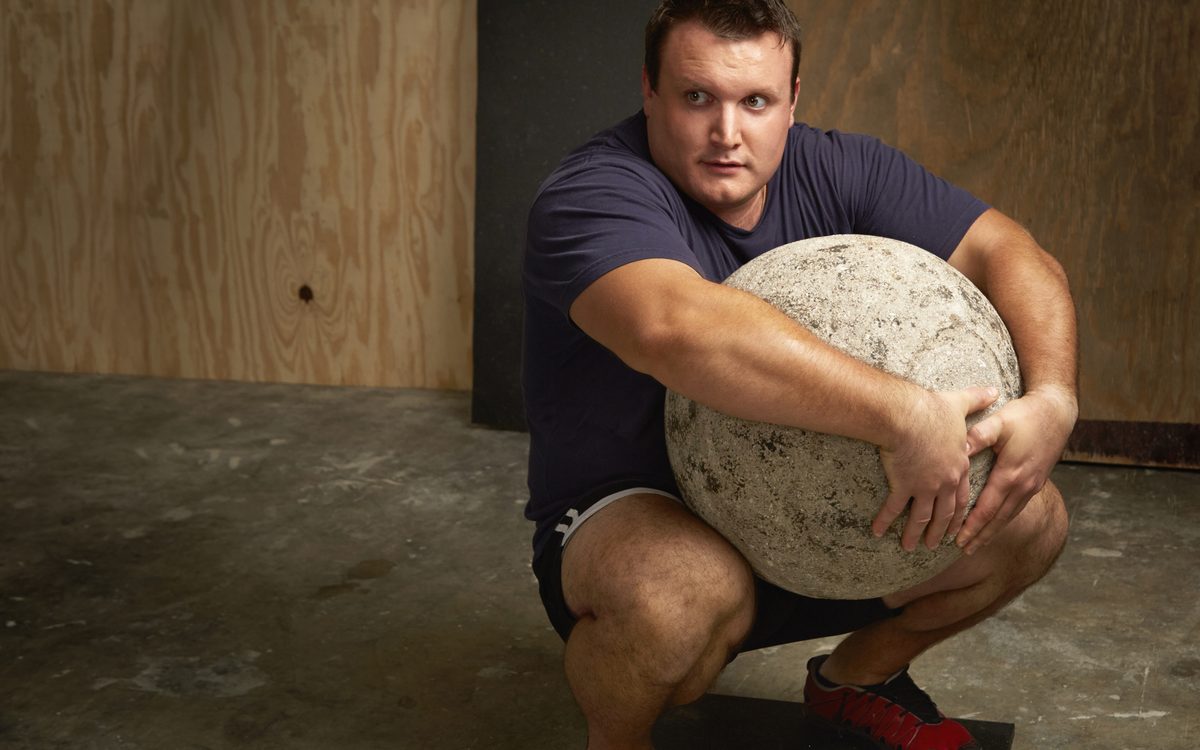
Tuesday night in a garage gym: a log sits against the wall, a loaded yoke waits on the rack, and an athlete is working through five sets of heavy squats before the implement work starts. Nobody is timing anything yet. Strongman training is the planning of heavy lifts, event practice, conditioning and rest so that an athlete can handle odd, heavy objects on a contest day. This page covers what the sport asks of the body, what strongman athletes say they do, and a sensible weekly shape. Where something is general coaching practice and not a study result, we say so.
Quick answer: Strongman performance leans on maximal strength, especially the squat, plus event practice, carries and grip. Surveyed strongman athletes mostly train heavy barbell lifts and implements, and most use some kind of periodization and a taper before contests. Big-picture reviews of resistance training favour heavy loads, enough weekly sets and at least two sessions a week. Learn implements from a coach, and see a doctor, physical therapist or athletic trainer for pain that persists.
What the sport asks of the body
Strongman mixes maximal strength, short bursts of power, loaded walking and heavy grip work, often with objects that shift or roll. A 2019 systematic review of 11 studies (Hindle and colleagues, Sports Medicine – Open) described preliminary biomechanics for the farmers walk, heavy sled pull and tire flip, and noted that data were missing for the yoke, vehicle pull, atlas stone, unilateral carries and log lift at that time. Two later studies filled some gaps: a 2021 study of 20 experienced athletes mapped the atlas stone lift into five phases, and a 2021 study of 19 athletes found the yoke walk was characterised by a high stride rate and short stride length.
Strength matters for results. In a 2012 study of 23 semi-professional rugby players with some strongman experience, the strongest link to overall strongman performance was system force (body mass plus squat 1RM), r = 0.87, and squat strength was moderately to very strongly related to every event tested (r = 0.61 to 0.85). These were novices, so the finding may not hold for elite athletes, as the authors note.
What strongman athletes report doing
A 2011 survey of 167 strongman competitors (83 local, 65 national, 19 international) found the back squat (65.8%) and conventional deadlift (88.0%) were the most used. Eighty percent used some form of periodization; 97% included maximal strength training, 90% power training and 74% hypertrophy training. Fifty-four percent used lower-body plyometrics and 88% did Olympic lifts, most often the clean. The farmers walk, log press and stones were the most commonly trained events. Surveys describe what athletes do, not what works best.
A 2015 study (Winwood and colleagues) randomised 30 experienced rugby players to seven weeks of strongman or traditional resistance training, twice a week with matched loads. Both groups improved by roughly 0.2 to 7%, with no significant between-group differences in functional performance. In other words, implement training and conventional lifting gave similar short-term results in that group, which is why most programs use both.
A sensible weekly shape
The template below is general coaching practice, not a prescription from any one study. A novice with a coach might train three or four days a week:
- Day 1, lower body and pull: heavy squat or deadlift variation, with carries or a sled afterwards.
- Day 2, overhead and upper back: log or axle pressing, rows, pull-ups, trunk work.
- Day 3, events: practise two implements at moderate weights with a catcher or spotter, such as stones or a yoke, while focusing on technique.
- Optional day 4: light conditioning, extra carries and mobility.
- At least one full rest day, more if you are sore or short on sleep.
The 2026 American College of Sports Medicine (ACSM) position stand, an overview of 137 systematic reviews, found that voluntary strength improved more with heavier loads (80% of one-repetition maximum or more), a full range of motion, two to three sets and at least two sessions a week, and that hypertrophy was enhanced by higher volumes (10 or more sets per week) and eccentric overload. It also found that equipment type and periodization did not consistently change outcomes, so a simple, consistent plan counts for more than a complicated one.
Periodization and peaking basics
Periodization means planning changes in sets, reps and loads across weeks. In the 2011 survey, 80% of strongman athletes used it in some form. For contests, tapering is common: a 2018 survey of 454 strongman athletes found 87% used a taper, with an average length of 8.6 days; volume fell by about 45.5% and training stopped 3.9 days out, while intensity fell to around 50% in the final week. The deadlift, yoke walk and stones took longer to recover from than other lifts, athletes said. A 2026 systematic review of tapering in weight-lifting sports (seven high-quality studies) found taper lengths of five to nine days, peak volume 4 to 6 weeks and peak intensity 2 to 3 weeks before competition, and a tendency toward self-coaching in strongman. Those are what athletes report doing; none proves an ideal taper.
Conditioning, grip and event practice
- Carries and sled work build the stride, trunk and grip patterns of many events. Start light and short.
- Event practice is best done fresh, not at the end of a heavy lower-body day (general coaching practice).
- Grip is trained with heavy holds, thick-handle work and carries; keep volume modest, as hands and forearms recover slowly (general coaching practice).
- Competition-day rehearsal: 94% of 132 surveyed athletes warmed up in competition, usually for about 16 minutes; practise your warm-up in training (see the injury prevention page).
Teens and masters
Strongman Corporation sets teen classes (19 and under, minimum age 12) and masters 40+ and 50+ classes. For young lifters, the American Academy of Pediatrics 2008 policy statement and a 2014 international consensus on youth resistance training are the starting points; programmes should be supervised and technique-led. Older athletes can use the same weekly shape with more rest between hard days, which is a general coaching practice.
When training stops being productive
The joint European College of Sport Science and ACSM statement describes how too much load plus too little recovery can lead from short-term fatigue to prolonged under-performance. If performance, mood or sleep stay worse for weeks, talk to a coach and a health professional. More on this on the recovery page.
Frequently asked questions
How many days a week should a beginner train strongman?
Most coaches suggest three or four days, with at least one full rest day (general coaching practice). The ACSM 2026 overview found strength gains from at least two sessions per week.
Do I need special implements to start?
No. Squats, deadlifts, presses and carries with a barbell, dumbbells or kettlebells are a base. Add implements gradually and learn them with a coach, because Winwood and colleagues found more injuries per hour in implement training than in traditional lifts (see our injuries page).
Is strongman training better than normal lifting?
In one seven-week study of 30 experienced rugby players, strongman and traditional training gave similar results. Neither was clearly better in that short trial.
How long should I taper before a contest?
Surveyed strongman athletes averaged 8.6 days, and a 2026 review of weight-lifting sports reported five to nine days. These are reports, not a rule; ask a coach to tailor it to you.
How much does squat strength matter?
In a study of 23 novices, squat 1RM plus body mass correlated strongly with overall strongman performance, but the athletes were rugby players and results may differ in specialists.
Sources
- Hindle et al., biomechanics of strongman exercises, systematic review 2019
- Hindle et al., atlas stone lift 2021
- Hindle et al., yoke walk 2021
- Winwood et al., strength and conditioning practices of strongman competitors 2011
- Winwood et al., strength, anthropometrics and strongman performance in novices 2012
- Winwood et al., strongman vs traditional resistance training 2015
- Winwood et al., tapering practices of strongman athletes 2018
- Winwood et al., competition-day preparation strategies 2019
- Winwood et al., tapering and peaking in weight-lifting sports, systematic review 2026
- ACSM position stand, resistance training prescription, overview of reviews 2026
- Meeusen et al., ECSS/ACSM overtraining syndrome consensus 2013
- AAP, Strength training by children and adolescents 2008
- Lloyd et al., youth resistance training international consensus 2014
- Strongman Corporation, athlete info
General information for education only, not medical advice. It does not replace a visit with a doctor, physical therapist or athletic trainer. See how we write and check our pages in our editorial policy.