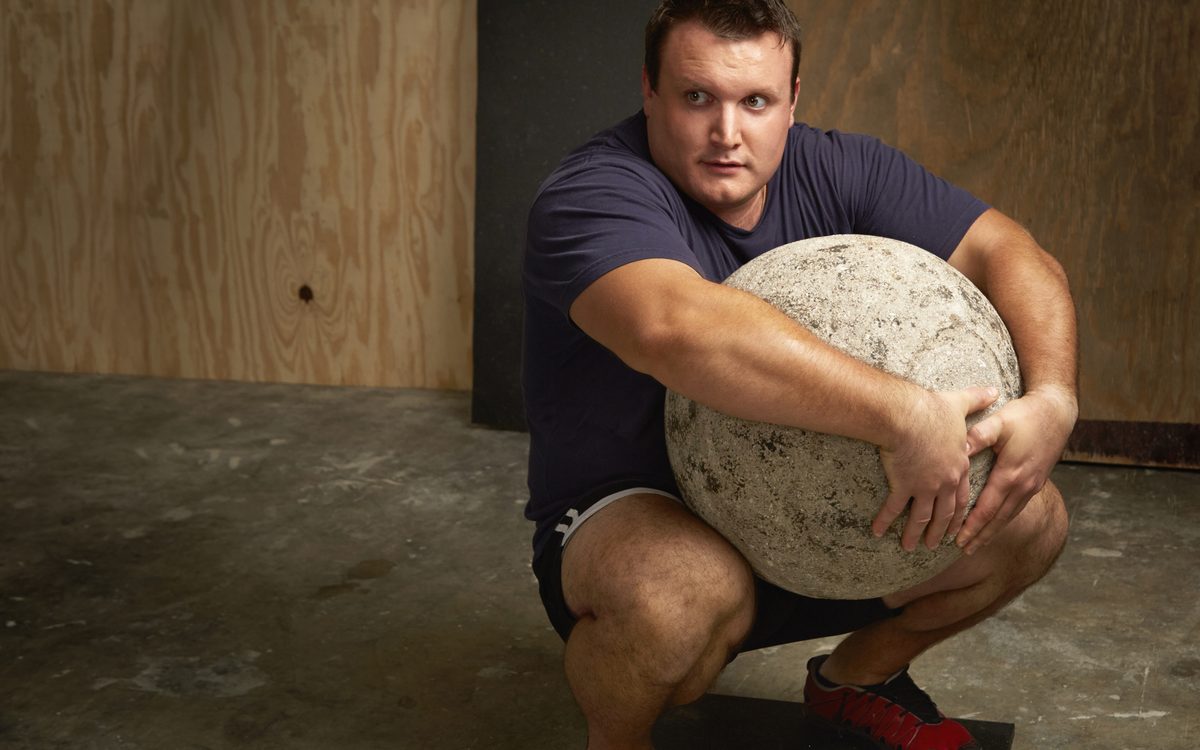
Sunday morning after a show: the hands are stiff, the forearms feel like they belong to someone else, and the stairs are a negotiation. A strongman contest strings together several heavy events in a day, and the body pays for it for days afterwards. Strongman recovery is everything that helps an athlete absorb hard training and be ready for the next session: sleep, sensible load, food, easy movement and, for some, tools such as massage or foam rolling. This page separates what has some evidence from what is mostly habit, and it is honest where the evidence is thin.
Quick answer: Sleep, planned rest days and a taper before contests are the foundations; the strongest evidence for a tool is that massage reduced soreness and perceived fatigue in a 2018 meta-analysis, while foam rolling mainly improves range of motion. Most recovery research is not on strongman athletes. Normal post-training soreness fades within days; sharp, localised or worsening pain is different, and a doctor, physical therapist or athletic trainer should look at it.
Sleep comes first
A 2020 British Journal of Sports Medicine review and expert consensus on sleep and the athlete (Walsh and colleagues) notes that elite athletes are prone to short sleep (under 7 hours a night) and poor sleep quality, that a night or more without sleep reduces performance, and that habitually sleeping under 7 hours raises susceptibility to respiratory infection in the wider population. The authors recommend an individualised approach instead of a single number, and say research on napping and sleep extension is still needed. The CDC’s sleep pages give general adult guidance. Hot, bright outdoor contests and early weigh-ins can interfere with sleep; plan for it (general practice).
Balancing load and rest
The 2018 Recovery and Performance consensus statement (Kellmann and colleagues) says an adequate balance between stress, including life demands, and recovery is essential, and that individuals respond differently, which is why monitoring matters. In a survey of 454 strongman athletes, those who tapered said the deadlift, yoke walk and stone lifts took longer to recover from than other lifts, and that poor tapering followed training too heavy or a taper too short. A practical read-through for a training week, labelled as general coaching practice: put the most taxing events (heavy pulling, stones, yoke) apart from each other and from hard lower-body days, and give grip and forearms a lighter day.
Rest does not have to mean no movement. The 2018 meta-analysis below found active recovery reduced muscle soreness, so easy walking or cycling is a reasonable option.
What the evidence says about recovery methods
A 2018 systematic review with meta-analysis (Dupuy and colleagues) pooled 99 studies on post-exercise recovery techniques. Active recovery, massage, compression garments, immersion, contrast water therapy and cryotherapy produced small to large decreases in delayed onset muscle soreness, while other methods showed no change. Massage appeared the most effective for soreness and perceived fatigue, and massage and cold exposure were the most powerful for reducing inflammation markers. These outcomes are soreness, perceived fatigue and blood markers, not later performance or injury rates, and most participants were not strength athletes. Treat the findings as modest.
- Massage: best evidence for soreness and perceived fatigue in that review, although the review did not show it improves later lifting.
- Foam rolling: a 2020 meta-analysis (Skinner and colleagues, 32 studies, average PEDro score 5.56) found a large effect on range of motion (d = 0.76) and that it appears useful for recovery after muscle-damaging exercise, but concluded that apart from range of motion it cannot be said to improve athletic performance. It did not appear to cause harm.
- Cold water immersion: in the 2018 review it reduced soreness. The sources we read did not cover its effect on long-term training adaptations, so ask a professional if muscle gain is your main goal.
- Compression garments: small effects on soreness and perceived fatigue in the 2018 review.
Strongman athletes say they use massage, foam rolling, nutritional changes and static stretching during the taper (2018 survey). That describes habits, not proof that each helps.
Mobility and flexibility
Strongman positions ask for hip, ankle and upper-back range in the squat, stone pickup and overhead press. Foam rolling and stretching can acutely raise range of motion; a 2024 meta-analysis (Warneke and colleagues) concluded foam rolling and stretching did not give acutely superior flexibility improvements compared with other warm-up interventions. Mobility work you can do consistently and that suits the lifts is a general coaching practice, such as hip and thoracic work for squats and presses. If a range-of-motion limit comes with pain, get it checked.
Soreness versus injury
- Usually normal soreness: a dull, spread-out ache in the muscles, worst a day or two after unfamiliar or heavy work, easing with movement.
- Worth getting checked: sharp or pinpoint pain, a pop, bruising, swelling, numbness, tingling, pain at night, weakness that does not return, or a pain that keeps coming back in the same place.
These lists are general guidance, not a diagnosis. For injury detail see the injuries page.
When recovery is not enough
The joint ECSS and ACSM statement (Meeusen and colleagues, 2013) describes how combining excessive load with inadequate recovery can move from short-term fatigue to prolonged maladaptation, with performance decline and mood disturbance. It adds that no single marker is accepted for detecting overtraining. If you have weeks of poor performance, disrupted sleep or low mood, talk to a coach and a health professional. Food also matters: see nutrition and athlete health.
Frequently asked questions
How much sleep does a strongman athlete need?
The 2020 expert consensus recommends an individualised approach rather than one number. Many athletes get under 7 hours, which the authors flag as a risk. See a doctor if sleep is a persistent problem.
Is foam rolling worth it?
It reliably raised range of motion in a 2020 meta-analysis and looks safe, but it has not been shown to improve performance directly. It is optional.
Does massage help?
In a 2018 meta-analysis of 99 studies, massage was the most effective technique for reducing muscle soreness and perceived fatigue. The studies were not specific to strongman, and benefits for later performance were not established.
How soon can I train again after a contest?
There is no universal rule. Soreness, sleep and mood are guides, and a coach can plan a lighter week. Any pain that is sharp or lasting should be assessed.
Should I do ice baths?
Cold exposure reduced soreness in the 2018 review. Long-term effects were not covered in the sources we read, and cold exposure is not suitable for everyone, for example if you have a heart condition; ask a doctor.
Sources
- Walsh et al., sleep and the athlete: review and consensus, 2020
- CDC, about sleep
- Kellmann et al., recovery and performance in sport: consensus statement, 2018
- Dupuy et al., post-exercise recovery techniques, systematic review with meta-analysis 2018
- Skinner et al., foam rolling systematic review and meta-analysis 2020
- Warneke et al., foam rolling and stretching vs other warm-up interventions 2024
- Meeusen et al., ECSS/ACSM overtraining syndrome consensus 2013
- Winwood et al., tapering practices of strongman athletes 2018
General information for education only, not medical advice. It does not replace a visit with a doctor, physical therapist or athletic trainer. See how we write and check our pages in our editorial policy.