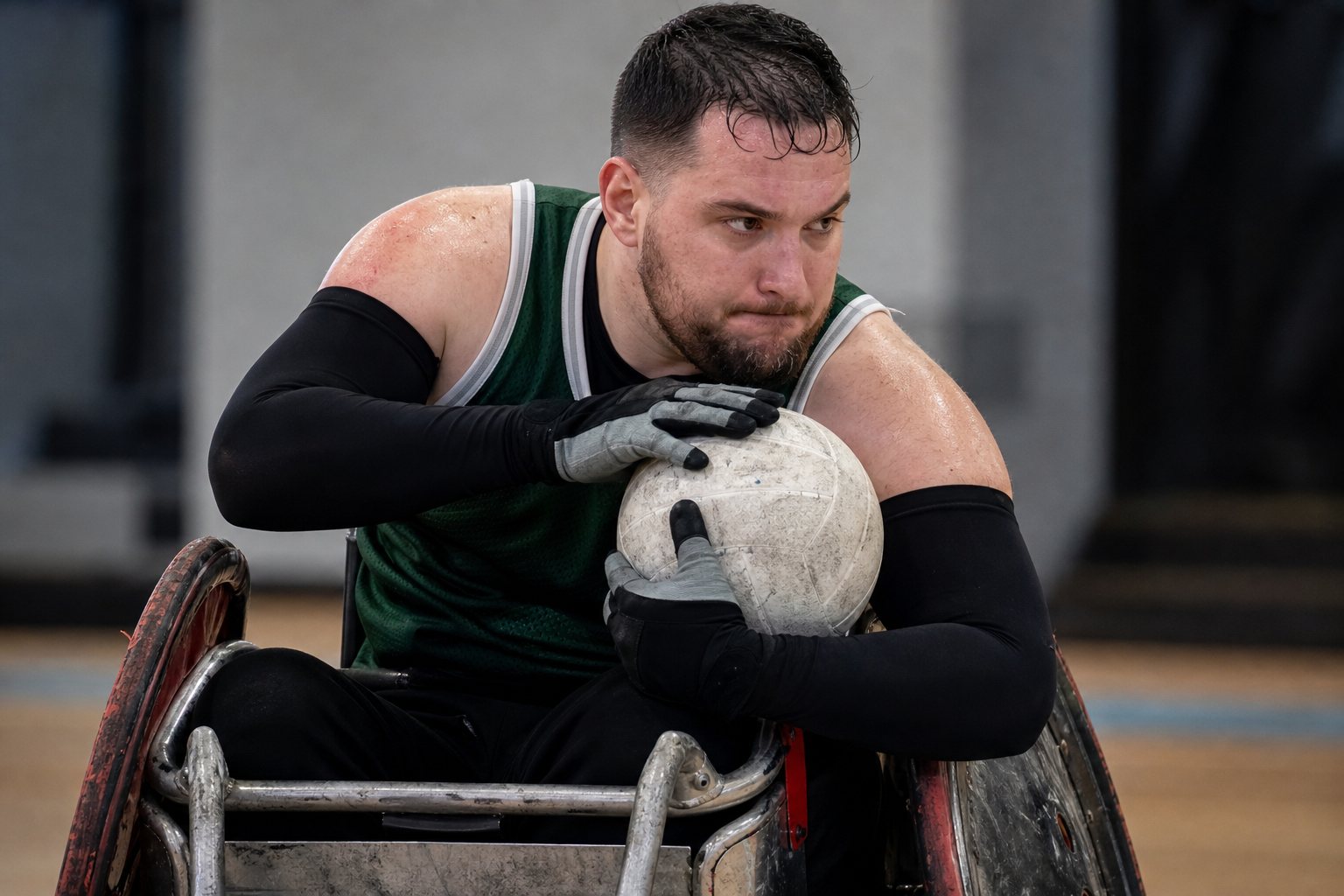
Eleven seconds left, one try down, and the ball is on the lap of a player who has been blocked twice already. The 40-second clock, the 8-second key rule and a crowd all squeeze the same moment. Mental training in wheelchair rugby means the skills of confidence, focus, routines, tactical thinking and teamwork that help a player perform under that kind of pressure. It is separate from mental health, which is a medical matter and is covered further down.
Quick answer: Mental skills such as goal setting, imagery, pre-game routines and a plan for mistakes are general sport-psychology practice. We found no published trial of them in wheelchair rugby, and nothing guarantees results. Wheelchair rugby adds its own mental load: line-up maths under the 8.0 class limit, short possession clocks and constant contact. If low mood, anxiety, sleep trouble or burnout are affecting daily life, talk to a doctor or qualified mental health professional; in the US you can call or text 988 (the 988 Suicide and Crisis Lifeline).
For rules and the clock see our rules page; for the physical side see training and recovery. The sport is introduced on the wheelchair rugby hub. General information, not medical or psychological advice.
What the sport asks of the mind
- Short clocks: 40 seconds to score, 12 seconds to cross the centre line, 8 seconds to pass or dribble, and 8 seconds in the key. Decisions have to be fast and rehearsed.
- Class maths: the four players on court add up to 8.0 or less (with allowances for women), so line-ups, substitutions and matchups are a tactical puzzle. The USOPC notes that players in each class often take specific roles.
- Contact: legal contact is part of the game, and fouls cost possession or a 30-second penalty. Staying composed after a hard hit helps avoid giving one away.
- Teamwork: picks, screens and passing lanes only work when teammates trust one another’s positioning.
A pilot study of the Polish national team (Bauerfeind and colleagues, 2015) found that offensive players tended to show higher anger and aggressiveness scores than defensive players and had more injuries. The sample was 14 men, so it shows a pattern to watch, not a rule, but it fits with the idea that emotional control is a skill to coach.
Skills many athletes use (general sport-psychology practice)
The following are widely used in sport. They are general practice, not wheelchair rugby findings, and none guarantees performance.
- Confidence and self-talk: short cue words you can use between whistles, built from what you have actually done in practice.
- Goal setting: pair a result goal (win the tournament) with process goals you control (tight picks, clean inbounds, 8-second dribble awareness).
- Imagery: picture a play before it happens: the chair position, the pass, the contact. Imagery is mental practice; it does not replace court time.
- Focus and routines: a repeatable routine before an inbound or after a timeout (breath, cue, look), so the next play starts clean. Timeouts are 60 seconds, three per half: decide in advance what the group will cover.
- Handling pressure and mistakes: name the error, reset with a cue, and play the next possession. A coach who reviews video together after the game, not during it, helps.
- Breathing and arousal: slow breathing can help settle nerves between plays. Because players with cervical injuries had lower heart rates in competition than other players in a 2020 study, “how I feel” is often a better guide to effort than a heart-rate number.
Tactics and teamwork
Wheelchair rugby tactics revolve around the class puzzle. Coaches decide which combinations of classes to field, who blocks, who carries and who inbounds, then rehearse those pairings until decisions are automatic. As general practice, teams use short set plays, agreed calls for key-area timing, and a clear plan for the last two minutes. Practise the rules under pressure too: drilling the 12-second and 8-second counts in scrimmage makes them easier to keep on the day. Clear communication, including calling who has a pick, keeps the plan together when the arena is loud.
Preparing for competition
Most of the logistics (travel, chair checks, classification paperwork, sleep) sit outside this page; for sleep on camp weeks, see recovery. Mentally, general practice is to write a one-page plan: warm-up routine, cue words, line-up roles, and what you will do if the game starts badly. Tournament weeks also bring a new place and a different bed, and in a study of 18 male players a three-night camp cut total sleep by about 38 minutes, so build calm into the routine.
Mental performance is not the same as mental health
Skills training is for performance. Anxiety, depression, disordered eating, burnout, trauma or ongoing stress are health matters for a qualified professional. The IOC consensus statement on mental health in elite athletes (2019) says mental health symptoms and disorders are common among elite athletes and can impair performance, that mental health cannot be separated from physical health, and that they raise the risk of physical injury and delay recovery. The evidence for Paralympic athletes is smaller: a 2019 narrative review found only seven publications on Paralympic athletes specifically and called for research on stressors such as trauma and transition out of sport. A 2021 survey of 749 elite Australian athletes found largely similar mental health symptom profiles between para- and non-para-sport athletes, with para-athletes reporting lower alcohol consumption but also lower self-esteem. If you are in distress, call or text 988 in the US, or contact your doctor or team medical staff.
Frequently asked questions
Do mental skills work in wheelchair rugby?
Techniques like goal setting, imagery and routines are widely used in sport, but we found no wheelchair rugby trials. Treat them as practice, not guarantees.
How do I stay calm after a hard hit?
General practice is a short reset routine: breathe, say a cue word, look at the next play. Practise it in scrimmage so it is automatic.
Should I use heart rate to measure nerves or effort?
With a cervical spinal cord injury, heart rate can run lower than expected in competition, according to a 2020 study. Many coaches use perceived effort alongside it.
Where can I get help with anxiety or low mood?
Start with your doctor or a mental health professional, and ask your team about sport psychology support. In the US, call or text 988 for crisis support.
Are para-athletes more likely to have mental health problems?
Evidence is limited. A 2021 Australian survey found mostly similar symptoms to non-para athletes, with lower self-esteem among para-athletes, and a 2019 review said research is sparse.
Sources
- Reardon et al. 2019: IOC consensus statement on mental health in elite athletes (PubMed)
- Swartz et al. 2019: mental health symptoms and disorders in Paralympic athletes (PubMed)
- Olive et al. 2021: mental health symptoms in para and non-para elite athletes (PubMed)
- Bauerfeind et al. 2015: sports injuries in wheelchair rugby (PubMed)
- Gee et al. 2020: heart rate in elite wheelchair rugby (PubMed)
- Murphy et al. 2021: sleep in wheelchair rugby athletes (PubMed)
- World Wheelchair Rugby: International Rules, April 2026 (PDF)
- USOPC: wheelchair rugby sport overview (PDF)
- 988 Suicide and Crisis Lifeline
General information for education only, not medical advice. It does not replace a visit with a doctor, physical therapist or athletic trainer who works with wheelchair athletes. See how we write and check our pages in our editorial policy.