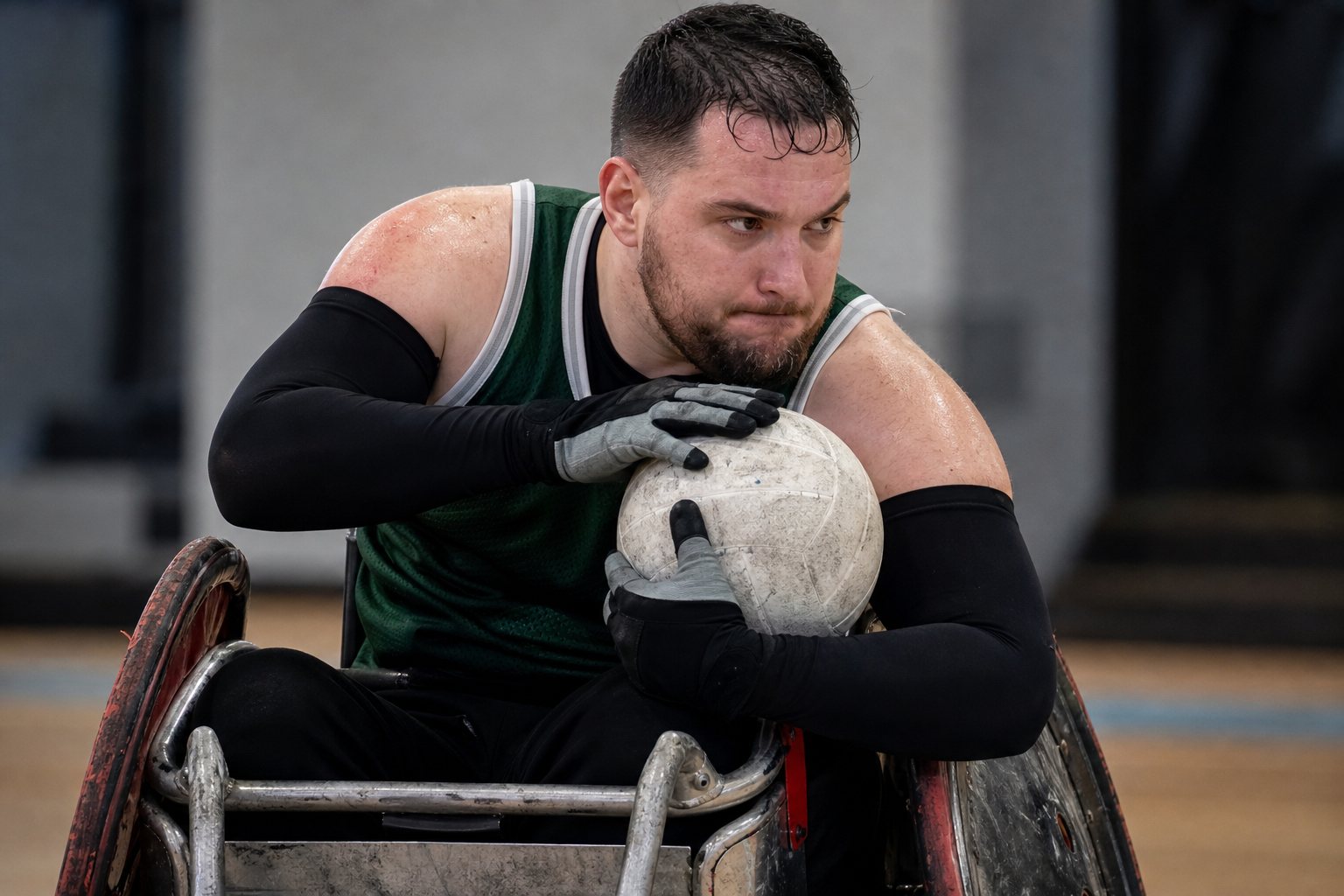
The tournament is two days away from home, the hotel bed is higher than yours, and the pre-game warm-up starts at 7 a.m. For a wheelchair rugby player, recovery is not just a day off. It covers sleep, skin and positioning, shoulders that have pushed and blocked for hours, temperature, fluids and the ordinary chores that also use the arms. This page covers what is known and where the evidence runs thin, because very little recovery research has been done on para athletes.
Quick answer: Sleep has the most wheelchair rugby-specific evidence: a 2021 study of 18 male players found sub-optimal sleep and 38 minutes less on a training camp. Most other recovery tools, including massage, foam rolling, compression and massage guns, have been tested in able-bodied athletes, not wheelchair rugby players, so treat them as comfort measures and check with your clinician. Pain that persists, a new numbness or weakness, or any skin breakdown needs a professional, not more rest.
Training and load are on the training page; injuries are on the injuries page; fuel and fluids are on nutrition. For the standing game see rugby recovery, written for standing players. General information, not medical advice.
Sleep first, because it is the best studied
Murphy and colleagues (2021) tracked 18 highly trained male wheelchair rugby athletes, 11 with a cervical spinal cord injury and 7 without, for 16 days with an activity monitor. The median total sleep time was about 7 hours and sleep efficiency 81 percent, with about an hour and 11 minutes awake after falling asleep. The authors described these as sub-optimal compared with National Sleep Foundation definitions. Objective scores did not differ between groups, but athletes with cervical injuries rated their sleep worse. During a three-night training camp, total sleep fell by about 38 minutes in both groups. A 2020 review of sleep and athletic performance by Charest and Grandner describes sleep as a fundamental part of performance, injury risk and recovery.
- Keep wake-up and bedtime steady on camp weeks, and bring familiar pillows and positioning aids.
- Ask your care team about night-time positioning, bladder routine and temperature, since these can break sleep. This is general practice, not a studied protocol.
- Treat a poor week of sleep as a reason to trim one hard session, not to add caffeine late in the day.
Load management and rest days
Shoulders, arms and hands do the work of the sport and daily life, so a day off from rugby is not a day off for them if you still push and transfer a lot. General coaching practice is to schedule at least one lighter day a week, follow a hard block with an easier one, and plan around travel. There is no published wheelchair rugby rule of thumb for how much load is too much; use trends in your own pain, sleep and mood as the guide, and share them with your coach.
Mobility and flexibility
Tight chest and front-shoulder muscles are common in people who push a lot. In a randomised trial of 42 wheelchair users, a six-month program of two stretches for the front of the shoulder and three strengthening exercises for the back cut shoulder pain scores by about 40 percent, against 2.5 percent in controls (Curtis and colleagues, 1999). That tested stretching and strengthening together, so we cannot say how much stretching alone helps. Ask a physical therapist to show you the exact positions for your arms and hands, since trunk control and hand function change what is safe.
Heat, cooling and temperature
Players with high-level spinal cord injuries sweat less below the injury and have less control of blood vessels there, so they are at greater risk of heat illness at a given intensity. A review in Sports Medicine (Griggs and colleagues, 2015) found that an ice vest worn during intermittent sprint exercise reduced heat strain and improved performance in athletes with a spinal cord injury, and it suggested combining methods before exercise and during rest periods or half-time might work better. It also said research is limited, so the best plan is individual. Between games, shaded rest and cool drinks are simple steps; talk with your medical team about what suits you. Warm baths, saunas and ice baths are risky if you cannot feel temperature in parts of the body, so ask a clinician before using them.
Recovery tools: what evidence says
A 2018 review of recovery methods after exercise in general athletes (Dupuy and colleagues) found massage the most effective for reducing muscle soreness and perceived fatigue. We found no studies of massage, foam rolling, compression boots or percussion guns in wheelchair rugby players. If you use them, apply them to areas where you have normal feeling and stay clear of skin that is red or broken. Our general guides cover the products but were written for standing athletes: see the recovery tools guide.
Soreness versus injury
General practice: soreness is usually a dull ache in the muscles that settles within a few days and eases with movement. Pain that is sharp, one-sided, getting worse, waking you at night or coming with numbness, weakness, swelling or skin changes should be assessed. A sudden pounding headache, sweating or flushing in a player with a high injury should be treated as a possible autonomic dysreflexia emergency (see injury prevention).
Frequently asked questions
How much sleep do wheelchair rugby players get?
In the 2021 study of 18 male players, median total sleep time was about 7 hours with 81 percent sleep efficiency, and a training camp cut sleep by about 38 minutes. Athletes with cervical injuries rated their sleep worse.
Does stretching help shoulder pain?
A trial of stretching plus strengthening cut shoulder pain scores in wheelchair users. We do not know the effect of stretching alone, so get a personalised plan.
Is an ice vest worth it?
A review found an ice vest during intermittent sprint exercise reduced heat strain in athletes with a spinal cord injury, but research is limited. Discuss cooling with your medical team.
Do massage guns or foam rollers work for wheelchair athletes?
No studies in wheelchair rugby players were found. Massage helps general athletes with soreness, so some players use these tools for comfort. Use them only where you have normal feeling and healthy skin.
When is soreness a problem?
If pain is sharp, worsening, one-sided or comes with numbness, weakness, swelling or skin changes, see a professional.
Sources
- Murphy et al. 2021: sleep in wheelchair rugby athletes (PubMed)
- Charest and Grandner 2020: sleep and athletic performance (PMC)
- Curtis et al. 1999: exercise protocol and shoulder pain in wheelchair users (PubMed)
- Griggs et al. 2015: cooling athletes with a spinal cord injury (PubMed)
- Dupuy et al. 2018: recovery methods after exercise (PubMed 29755363)
- Christopher and Dana Reeve Foundation: autonomic dysreflexia
General information for education only, not medical advice. It does not replace a visit with a doctor, physical therapist or athletic trainer who works with wheelchair athletes. See how we write and check our pages in our editorial policy.