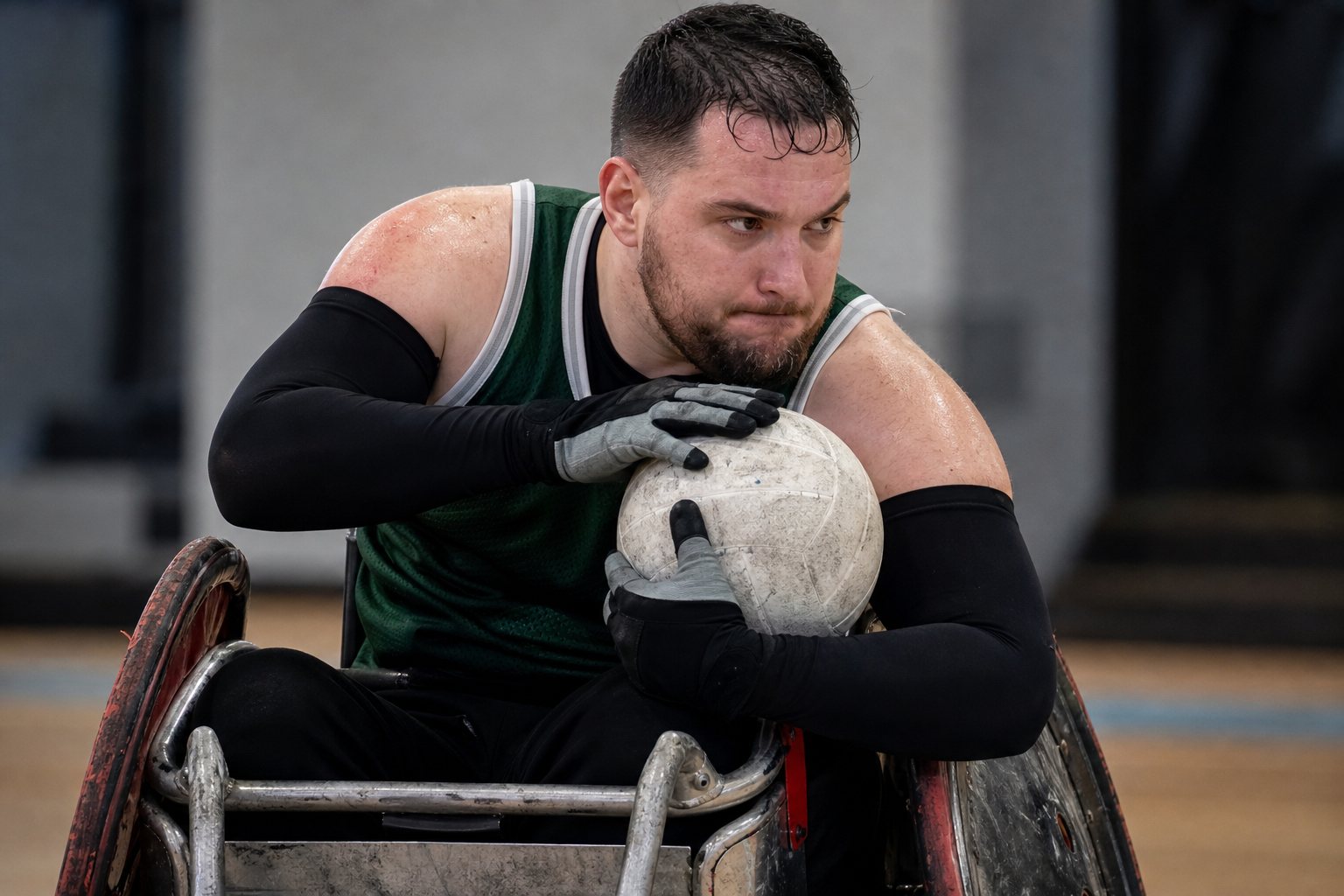
A team bag at a weekend tournament holds the usual mix: bottles, a banana, a protein bar, something someone’s cousin swears by. For a wheelchair rugby player the question is a little harder than for a standing athlete, because the body’s energy use, fluid handling and temperature control can all differ after a spinal cord injury. Wheelchair rugby nutrition is the fuel, fluids and day-to-day eating that support training, play and long-term health. The honest starting point is that research on this group is thin, and most guidance has to be borrowed carefully.
Quick answer: There is no published nutrition guideline for wheelchair rugby. Reviews of athletes with spinal cord injury say that protein and carbohydrate advice for able-bodied athletes should not simply be copied, and that fluids matter because temperature control can be impaired. Work with a registered dietitian who knows para sport, treat supplements with caution (only a few have good evidence, per the IOC), choose products tested for banned substances, and see a doctor before any new supplement, especially with heart, blood pressure or bladder issues.
This page covers eating, drinking and supplements. Training and recovery are on training and recovery; heat and safety are on injury prevention. For standing athletes see rugby nutrition. General information, not medical or dietetic advice.
Why borrowed advice needs care
Two 2021 narrative reviews on athletes with spinal cord injury (SCI) make the same point. Flueck and Parnell, writing on protein, examine loss of active muscle mass, reduced energy expenditure and secondary complications, and conclude that protein recommendations for able-bodied athletes may not transfer directly. Ruettimann and colleagues reach the same conclusion for carbohydrate, noting that muscle atrophy, lower energy expenditure and secondary complications may change carbohydrate needs. Both call for guidelines specific to athletes with SCI. A 2025 review of 56 studies on Paralympic athletes aged 18 and older (Ghazzawi and colleagues) likewise says there is little research focused on this group and stresses close monitoring of each athlete’s intake. Wheelchair rugby players also differ among themselves: some have cervical SCI and others have other conditions affecting the arms and legs, so a one-size diet does not exist.
Fuel for training and games
As general practice (not a wheelchair rugby study), most sports dietitians build plates around regular meals with carbohydrate, protein, fruit and vegetables and fats, and time a snack or meal before and after hard sessions. How much you need depends on body size, muscle mass, injury level and training load, which is exactly why a personal plan from a registered dietitian is worth more than a number from this page. Wheelchair rugby is a stop-clock game, so a tournament day with several games is more about steady fuelling between games than one big meal. Keep easy options in the bag: something familiar you can eat with your hand function.
Fluids, heat and bladder routines
Hydration is flagged as critical for athletes with spinal cord injury in the 2025 review, because they may struggle with body temperature regulation. A Sports Medicine review of cooling (Griggs and colleagues, 2015) explains that athletes with high-level injuries are at greater risk of heat illness at a given exercise intensity, because of reduced sweating and blood-vessel control below the injury. Practical points as general practice: keep a bottle within reach of the chair, drink steadily rather than waiting for thirst, and ask your care team how fluids fit with your bladder routine, since that can change drinking habits and is personal. Our gear page covers bottles and electrolyte options.
Energy availability and RED-S awareness
The IOC 2023 consensus statement on Relative Energy Deficiency in Sport (REDs) describes health and performance problems linked to low energy availability, meaning too little energy intake for the energy used in exercise and for body functions, in female and male athletes. We did not find a consensus that applies REDs thresholds to wheelchair rugby players; energy needs can be lower after SCI and are hard to estimate, so the safest approach is to watch for warning signs and involve a dietitian and doctor. Warning signs include persistent fatigue, frequent illness or injury, mood changes, and unplanned weight loss. Weight loss is not a performance tool in this sport: there are no weight classes, and the class limit is about points for impairment, not body weight.
Supplements: be sceptical, be careful
- What the IOC says: its 2018 consensus statement on dietary supplements and high-performance athletes says supplements can make a minor contribution after a full nutritional assessment, that only a few (including caffeine, creatine, specific buffering agents and nitrate) have good evidence of benefit, and that some supplements may harm health or cause an anti-doping rule violation.
- Caffeine: the International Society of Sports Nutrition position (2021) says caffeine can enhance exercise performance in many, but not all, studies. We found no research in wheelchair rugby players, and caffeine is not suitable for everyone (sensitivity, heart or blood pressure conditions, pregnancy). Check with a doctor, and avoid late-day use that hurts sleep.
- Creatine: the ISSN position stand (2017) reviews safety and efficacy generally. We found nothing specific to athletes with SCI, so ask your clinician.
- Third-party testing: choose products certified for sport, such as NSF Certified for Sport or Informed Sport, and still check the current prohibited list. “Natural” or “proprietary blend” is not a safety guarantee.
- Anti-doping and medications: World Wheelchair Rugby runs a Therapeutic Use Exemption committee, so athletes who take prescribed medicines should ask their national anti-doping organisation and team doctor before competing.
We do not give doses; follow the label and your clinician. No supplement replaces sleep, food or training.
Frequently asked questions
Is there a diet plan for wheelchair rugby players?
No published one. Reviews of athletes with spinal cord injury say able-bodied protein and carbohydrate advice may not transfer, so a registered dietitian who knows para sport can build a personal plan.
How much should I drink during a tournament?
There is no sourced number. Hydration matters, especially with a high-level injury, because temperature control can be impaired. Drink steadily and plan fluids with your care team.
Do wheelchair rugby players need supplements?
Most do not need them. The IOC says supplements play a minor role and only a few have good evidence. Talk to a doctor or dietitian first.
Are supplements tested for banned substances?
Only if they say so on third-party certification such as NSF Certified for Sport or Informed Sport. Check the label and the prohibited list.
Should I try to lose weight to play better?
Not as a general goal. There are no weight classes, and low energy intake carries health risks. A dietitian and doctor should guide any change.
Sources
- Flueck and Parnell 2021: protein considerations for athletes with a spinal cord injury (PubMed)
- Ruettimann et al. 2021: carbohydrate considerations for athletes with a spinal cord injury (PubMed)
- Ghazzawi et al. 2025: tailored nutrition strategies for Paralympic athletes (PMC)
- Griggs et al. 2015: cooling athletes with a spinal cord injury (PubMed)
- Mountjoy et al. 2023: IOC consensus statement on REDs (PubMed)
- Maughan et al. 2018: IOC consensus statement on dietary supplements (PubMed)
- Guest et al. 2021: ISSN position stand on caffeine (PubMed)
- Kreider et al. 2017: ISSN position stand on creatine (PubMed)
- World Wheelchair Rugby: get involved (TUE Committee)
- World Wheelchair Rugby: International Rules, April 2026 (PDF)
General information for education only, not medical advice. It does not replace a visit with a doctor, physical therapist or athletic trainer who works with wheelchair athletes. See how we write and check our pages in our editorial policy.