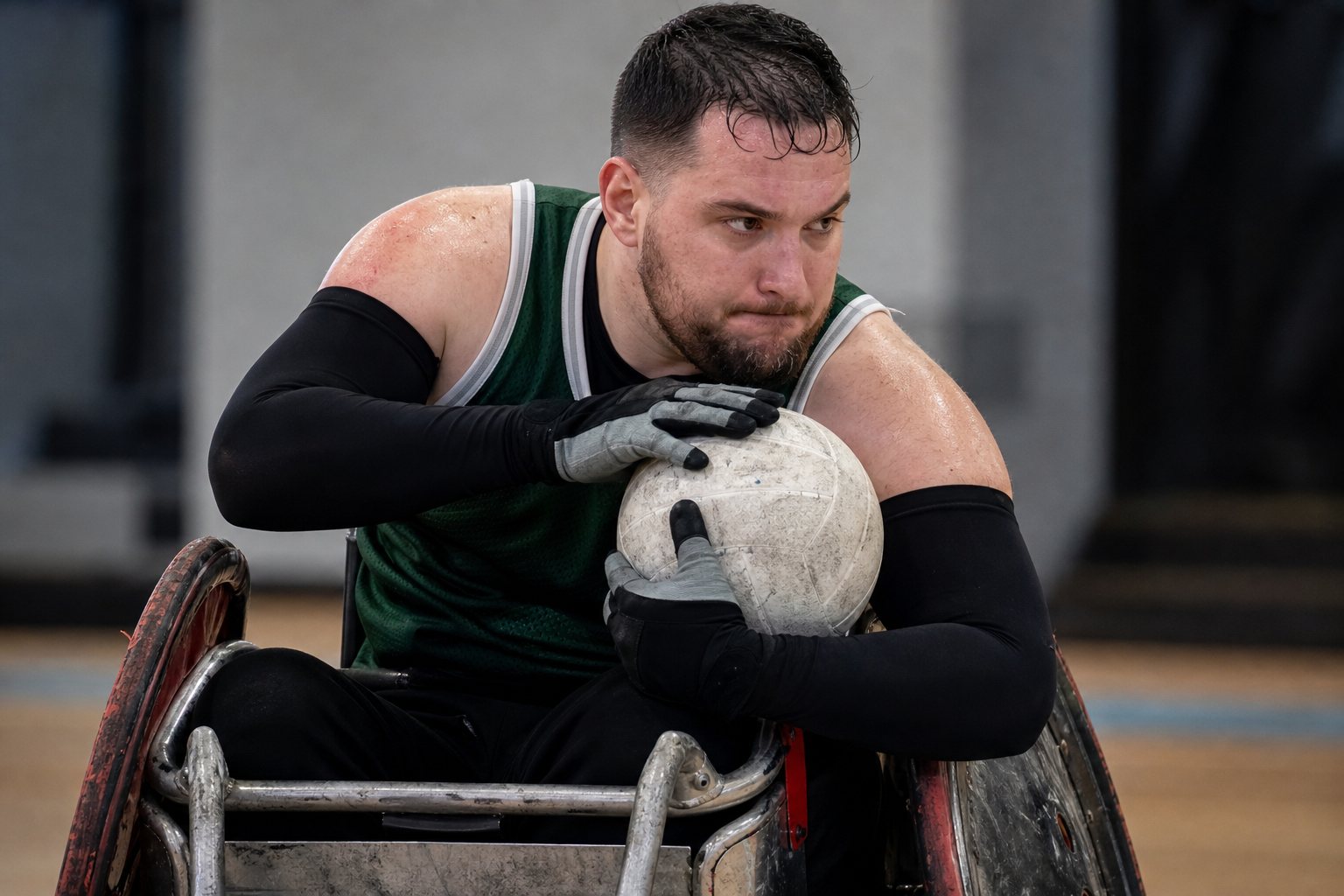
Practice ends, the chairs roll toward the wall, and one player rubs his shoulder before he starts the push to the van. Players in this sport use their arms to push, transfer, block and play, so the shoulder takes load all day, not only in games. Wheelchair rugby injury prevention means the habits around the player (warm-up, shoulder conditioning, chair set-up, heat and skin care, safe falling and equipment checks) that may lower the chance of getting hurt. They lower the odds. They cannot promise anything, and the research is still small.
Quick answer: The best-supported ideas are a regular warm-up, shoulder strength and stretching work planned with a clinician, a chair that is set up and inspected properly, and a heat and blood-pressure plan for players with cervical spinal cord injuries. Evidence comes mostly from small surveys and trials, so treat it as sensible habits, not guarantees. See a sports medicine doctor, physical therapist or athletic trainer for shoulder pain that lingers, and call emergency services for danger signs such as a pounding headache with high blood pressure or after a head impact.
This page is about lowering risk. What each injury looks like is on our wheelchair rugby injuries page, so we do not repeat it. Basics are on the rules page and the wheelchair rugby hub. General information, not medical advice.
Warm-up
There is no official WWR or federation warm-up routine we could find. The best evidence is a 2026 survey of 61 US wheelchair rugby athletes (Rider and colleagues) that linked more frequent warm-ups with lower shoulder pain scores (r = -0.53). A survey like that cannot prove cause. A 2024 scoping review of prevention programs for adaptive athletes found only four studies, in wheelchair basketball and wheelchair rugby, with improved shoulder range of motion and less shoulder pain, but all were small and none had a control group. As a general coaching practice, many teams spend five to ten minutes on easy pushing, shoulder circles and band work before contact. Ask your clinician which movements suit your arms and hands.
Shoulder conditioning
- Strength and balance: a study of 8 elite quadriplegic rugby players found shoulder pain was related to a deficit in adductor strength and wasting of scapular muscles (Miyahara and colleagues, 1998). It is an old and small study but it points to muscle balance, not only total strength.
- Stretch and strengthen: in a randomised trial of 42 long-term wheelchair users, a six-month program of two stretches for the front of the shoulder and three strengthening exercises for the back lowered shoulder pain scores by about 40 percent, compared with 2.5 percent in a control group (Curtis and colleagues, 1999).
- More trials: a 2015 systematic review of seven studies in manual wheelchair users with spinal cord injury found exercise programs were associated with reductions in shoulder pain larger than the minimal detectable change on the pain index (Cratsenberg and colleagues).
Those studies were about pain in everyday wheelchair users, not rugby players specifically, and none of them is a guarantee. Programs should be set by a clinician, because your hand function, trunk control and any existing shoulder pain change what is safe.
Falls, contact and head impacts
Contact is built into the game, and falls happen. A video study of the Rio 2016 Paralympics counted 96 falls in 18 wheelchair rugby games, about 5.3 per game; in rugby the falls were mostly sideways and caused by contact (Sasadai and colleagues, 2020). The authors said a fall to the side or back may indicate a risk of injury, though they did not count injuries. Practical points from the rulebook: referees can remove a player who has taken a significant blow to the head or shows concussion symptoms, and that player cannot return until meeting WWR Medical Guidelines return-to-play criteria. The CDC HEADS UP guidance and the Concussion in Para Sport Group position statement agree on the same steps: remove from play, rest, and have a health professional decide return case by case.
Heat, blood pressure and skin
- Heat: a review of cooling in athletes with spinal cord injury (Griggs and colleagues, 2015) reports that players with high-level injuries are at greater risk of heat illness at a given intensity, because of reduced sweating and blood-vessel control below the injury, even in moderate conditions (about 21 degrees C). It says an ice vest worn during intermittent sprint exercise has been shown to reduce heat strain and improve performance, but notes there is little research and no proven best plan.
- Autonomic dysreflexia: in players with injuries at T6 or above, a sudden rise in blood pressure triggered by something below the injury is a medical emergency, according to the Christopher and Dana Reeve Foundation. Teammates and coaches should know the athlete’s plan. Deliberately inducing it to improve performance (“boosting”) is banned by the International Paralympic Committee because of the health risk.
- Skin and pressure: check skin and equipment after long sessions and report red or broken areas to your care team. This is general practice, not a studied rugby protocol.
Chair set-up and equipment
The rulebook treats the wheelchair as part of the player and sets safety features: protrusions such as push bars and ball holders must be padded, bumpers must be rounded with no sharp edges, a rear anti-tip device is required, a strap or elastic must prevent the feet slipping off the footrest, and hand protection cannot include hard or rough material. Those are rules, not injury-reduction evidence. Chair fitting (seat height, wheel position) is a job for a seating clinician or experienced coach; see our gear page.
What prevention cannot do
Even careful players get shoulder pain. A 2026 survey found high shoulder pain scores overall (average 56.08 on the Wheelchair User’s Shoulder Pain Index) among US wheelchair rugby athletes. Prevention aims to reduce risk and catch problems early, not to remove them. Tell a clinician early if pain changes your pushing, wakes you at night, comes with numbness or weakness, or does not settle.
Frequently asked questions
Should I warm up before wheelchair rugby practice?
A survey of US players linked more frequent warm-ups with lower shoulder pain, and a warm-up with easy pushing and light band work is common practice. Ask your clinician for movements that suit you.
Does shoulder strength training prevent pain?
Trials in wheelchair users found stretching and strengthening programs lowered shoulder pain scores, but these were not rugby-specific and cannot promise prevention. Work with a clinician.
Is heat a problem for players with spinal cord injuries?
It can be. Players with high-level injuries have a greater risk of heat illness at a given intensity. Cooling, drinks and a plan with the medical team matter, and an ice vest has shown benefit in sprint exercise in research.
What should coaches know about autonomic dysreflexia?
It is a medical emergency in athletes with injuries at T6 or above. Know each athlete’s plan, sit them upright, loosen anything tight and call emergency services if it does not settle, per the Reeve Foundation.
Do helmets or head protection exist for the sport?
The rulebook we read sets concussion removal and return rules, but we did not find any head-protection requirement. Ask your team and clinician.
Sources
- Rider et al. 2026: shoulder pain in wheelchair rugby athletes (PubMed)
- Koerber et al. 2024: scoping review of prevention programs for adaptive athletes (PubMed)
- Miyahara et al. 1998: shoulder strength and pain in quadriplegic rugby players (PubMed)
- Curtis et al. 1999: exercise protocol and shoulder pain in wheelchair users (PubMed)
- Cratsenberg et al. 2015: exercise programs for shoulder pain in manual wheelchair users (PubMed)
- Sasadai et al. 2020: falls in team wheelchair sports, Rio 2016 (PubMed)
- Griggs et al. 2015: cooling athletes with a spinal cord injury (PubMed)
- Christopher and Dana Reeve Foundation: autonomic dysreflexia
- Blauwet et al. 2013: testing for boosting at the Paralympic Games (PubMed)
- Weiler et al. 2021: Concussion in Para Sport position statement (PubMed)
- CDC HEADS UP
- World Wheelchair Rugby: International Rules, April 2026 (PDF)
General information for education only, not medical advice. It does not replace a visit with a doctor, physical therapist or athletic trainer who works with wheelchair athletes. See how we write and check our pages in our editorial policy.