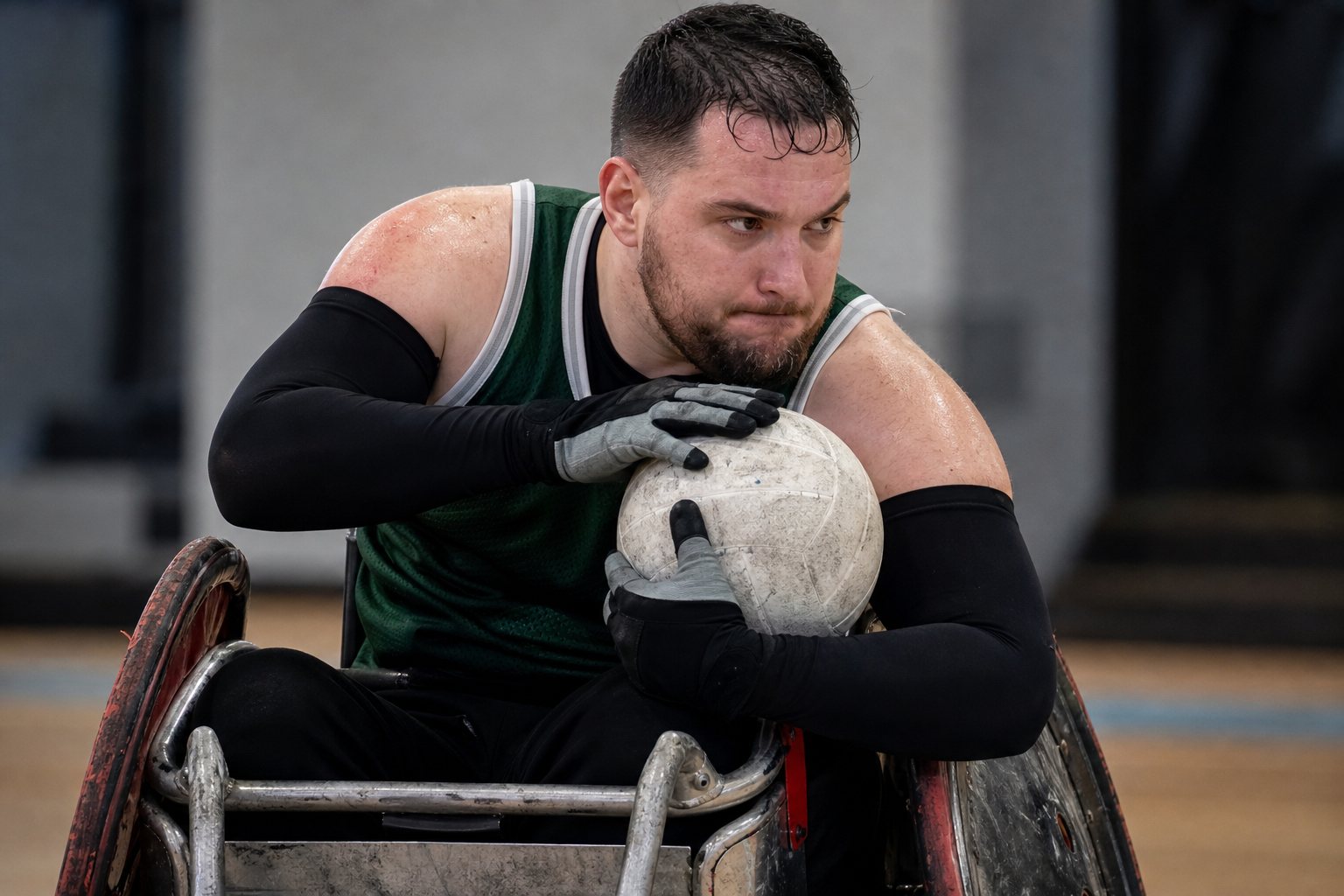
A sideways hit at full speed, the chair tips onto two wheels, the anti-tip bar scrapes the floor, and the player is back upright before the referee reaches him. Most of the time that is all it is. Wheelchair rugby injuries are the strains, bruises, falls, skin problems and shoulder pain that come with a contact sport played in a sport chair by athletes whose bodies already work differently. This page lays out what the research shows, where the evidence is thin, and when to get professional help.
Quick answer: The best-documented pattern is shoulder pain and overuse, along with frequent minor knocks and falls from contact. Surveillance at Paralympic Games found the shoulder was the most commonly injured area across all sports, but sport-specific wheelchair rugby injury rates are limited to small studies. Do not self-diagnose. See a sports medicine doctor, physical therapist or athletic trainer who works with wheelchair athletes, and treat any head impact as a possible concussion.
For ways to lower risk see our injury prevention page; for recovery and mobility see recovery. The sport is introduced on the wheelchair rugby hub. General information, not medical advice: no diagnosis, no return-to-play decisions and no standard recovery times.
What injury research shows
- A national-team pilot: Bauerfeind and colleagues (2015) followed 14 men on the Polish national team for nine months (a mean of 25 training and tournament days). They recorded 102 minor injuries that did not need medical intervention and only four that needed a physician, an incidence of 0.3 injuries per athlete per training day. Offensive players had more injuries than defensive players. It is a small pilot, not a rate for the sport.
- Paralympic Games surveillance: at Rio 2016, Derman and colleagues monitored 3,657 athletes over 51,198 athlete days and recorded 510 injuries, 10.0 per 1,000 athlete days. The shoulder was the most common area (1.8 per 1,000 athlete days). The study’s highlighted sports were football 5-a-side, judo and football 7-a-side, and the abstract does not give a wheelchair rugby rate. At the 2018 Winter Games the shoulder, arm and elbow complex was again most common, and the authors called the shoulder a consistent finding in elite para sport.
- Illness is part of the picture: at Rio 2016 the illness rate was also 10.0 per 1,000 athlete days, with respiratory (3.3), skin and subcutaneous (1.8) and digestive (1.3) problems the most common.
- Falls: video analysis of 18 wheelchair rugby games at Rio 2016 counted 96 falls (5.3 per game), mostly sideways and caused by contact (Sasadai and colleagues, 2020). The study did not count injuries.
Shoulder pain: the common complaint
In a 2026 survey of 61 US wheelchair rugby athletes, Rider and colleagues measured shoulder pain with the Wheelchair User’s Shoulder Pain Index and reported an average of 56.08, which they described as high. Pain was lower with more years of wheelchair use, more adaptive-sport participation, more frequent warm-ups and shoulder strength training, and higher among power-wheelchair users. Most participants managed pain with medication (67.2 percent) or exercise (57.4 percent), and the services used most were physical therapy (54.1 percent), occupational therapy (44.3 percent) and primary care (41 percent). An earlier study of 8 elite quadriplegic rugby players tied shoulder pain to weaker adductor muscles and wasting of scapular muscles.
A shoulder that hurts when pushing, lifting or transferring, or that wakes you at night, deserves an assessment. Please do not train through worsening pain and assume it will settle.
Head impacts and concussion
Chairs collide and players fall, so head impacts happen. The Concussion in Para Sport Group position statement (2021) says concussion is common in para athletes, applies the “remove, rest, reconsider, refer” steps, and calls for case-by-case decisions on return. The WWR rulebook lets referees remove a player with a significant head blow or concussion symptoms, who may not return until the WWR Medical Guidelines return-to-play criteria are met. The CDC HEADS UP guidance says a player who may have a concussion should stop playing and be checked by a health care provider, and that danger signs such as repeated vomiting or a seizure need emergency care. A provider, not a teammate or this page, decides when return is appropriate.
Heart, blood pressure, temperature and skin
Some health problems in this sport are not “injuries” in the usual sense but need the same quick attention. Players with injuries at T6 or above can experience autonomic dysreflexia, a medical emergency that the Reeve Foundation says calls for sitting up, loosening tight items, checking triggers and calling 911 if it does not ease. Heat illness risk is higher in players with high-level spinal cord injuries, per a review in Sports Medicine. Pressure injuries and skin breakdown are a concern for chair users generally; we did not find rugby-specific figures, so ask your care team how to check your skin after long sessions.
General rehabilitation principles
- Report early. Small niggles are easier to manage than long-standing pain.
- Exercise is a common component of shoulder care. A 2015 systematic review (Cratsenberg and colleagues) of seven studies found exercise programs, including stretching and strengthening, were associated with reduced shoulder pain in manual wheelchair users with spinal cord injury, and called for more research on which methods work best.
- Programs are individual. Hand function, trunk control, skin and blood pressure change what a safe exercise is, so rehab should be planned by a clinician who knows spinal cord injury.
- Return is a clinical decision. Timelines differ widely. We do not give recovery times.
Frequently asked questions
What is the most common injury in wheelchair rugby?
Shoulder pain is the best-documented problem. A 2026 US survey found high shoulder pain scores, and Paralympic Games surveillance found the shoulder was the most common injured area across all sports.
How common are injuries in wheelchair rugby?
We could not find a reliable per-game rate. A Polish national-team pilot recorded mostly minor injuries (0.3 per athlete per training day), and falls from contact average about five per game at the Rio 2016 Paralympics.
Can I keep playing with shoulder pain?
Pain that changes how you push or lift, wakes you at night or does not settle should be assessed by a clinician. Do not decide alone.
What should I do after a head impact?
Stop playing and have a health professional check you, per CDC HEADS UP and the para sport concussion statement. Call emergency services for danger signs.
Who should I see?
A sports medicine doctor, physical therapist or athletic trainer who works with wheelchair athletes, along with your spinal cord injury care team. In the 2026 survey, physical therapy was the most-used service.
Sources
- Bauerfeind et al. 2015: sports injuries in wheelchair rugby, a pilot study (PubMed)
- Derman et al. 2018: injury profile at the Rio 2016 Paralympic Games (PubMed)
- Derman et al. 2018: illness at the Rio 2016 Paralympic Games (PubMed)
- Derman et al. 2020: injuries at the PyeongChang 2018 Paralympic Winter Games (PubMed)
- Sasadai et al. 2020: falls in team wheelchair sports, Rio 2016 (PubMed)
- Rider et al. 2026: shoulder pain in wheelchair rugby athletes (PubMed)
- Miyahara et al. 1998: shoulder pain in quadriplegic rugby players (PubMed)
- Cratsenberg et al. 2015: exercise programs for shoulder pain in wheelchair users (PubMed)
- Weiler et al. 2021: Concussion in Para Sport position statement (PubMed)
- CDC HEADS UP
- Griggs et al. 2015: cooling athletes with a spinal cord injury (PubMed)
- Christopher and Dana Reeve Foundation: autonomic dysreflexia
- World Wheelchair Rugby: International Rules, April 2026 (PDF)
General information for education only, not medical advice. It does not replace a visit with a doctor, physical therapist or athletic trainer who works with wheelchair athletes. See how we write and check our pages in our editorial policy.