This article contains affiliate links: if you buy through them we may earn a commission, at no extra cost to you. Read our affiliate disclosure.
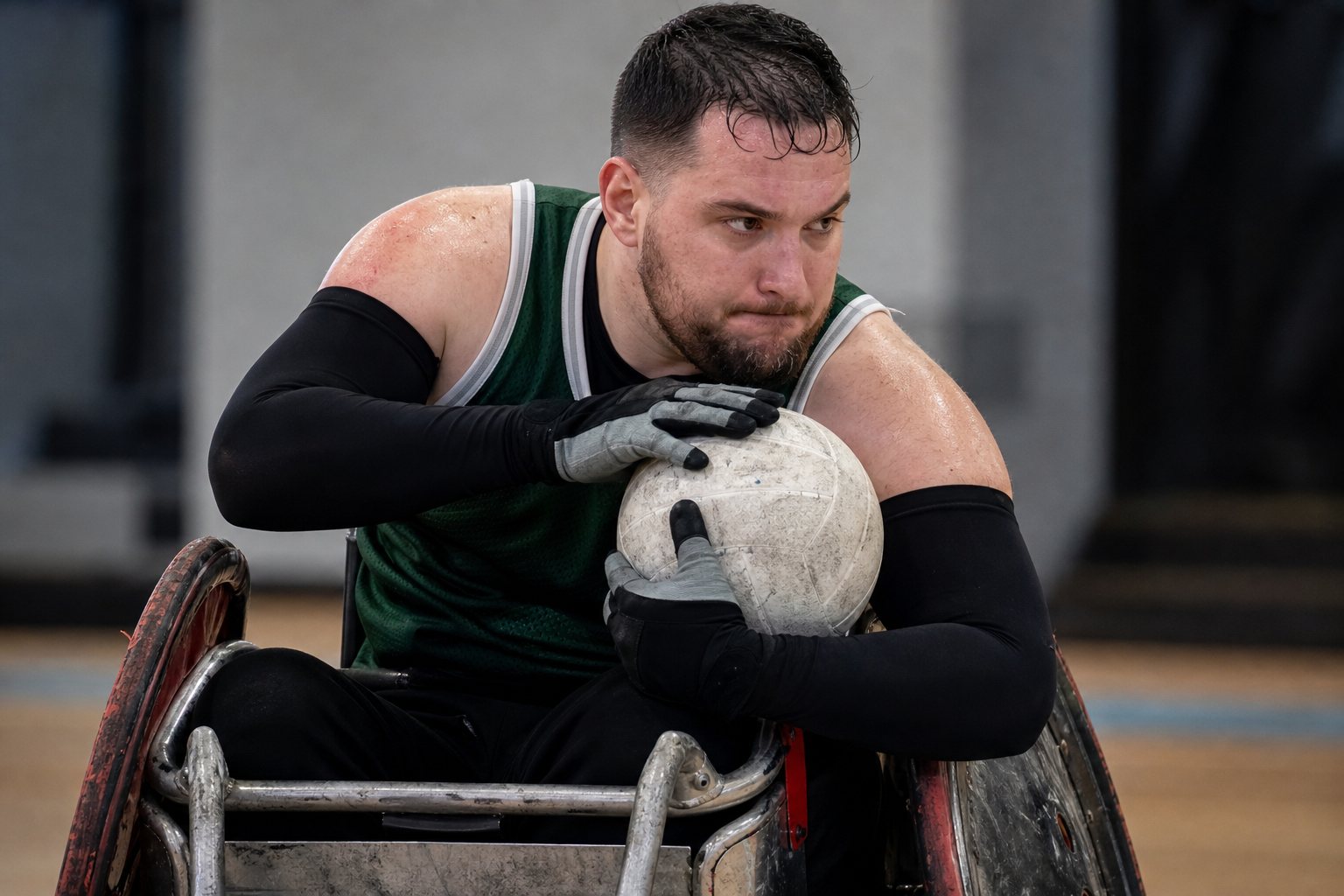
Before the first game of a tournament, an official walks the line of chairs with a tape measure. Bumper height, caster spacing, anti-tip bar: the wheelchair is part of the player, and the rulebook says each player is responsible for making sure it meets the specifications for the whole game. Wheelchair rugby gear centres on the sport chair, but also covers the ball holder, straps, cushion, hand protection and the bag of small things that get a player through a hot tournament day.
Quick answer: Rules, not marketing, define a legal wheelchair rugby chair: World Wheelchair Rugby sets maximum length and height, rear anti-tip devices, bumper dimensions, caster spacing and padding. Chair fit is personal and should be done with an experienced coach, seating clinician or therapist. The accessories on this page, such as resistance bands, bottles and electrolyte tablets, are general-purpose and are not sport-chair equipment. Ask your team and clinician before buying anything for a body or chair that already works in a specific way.
Rules basics are on the rules page; safety and shoulder care are on injury prevention. The sport is introduced on the wheelchair rugby hub. General information, not medical advice.
The sport chair: what the rulebook specifies
The April 2026 WWR International Rules treat the wheelchair as part of the player and bar a chair that does not meet specifications until it complies. These are the verified standards, in the rulebook’s own units:
- Length and height: no more than 46 cm from the front of the back wheel to the front of the chair; no more than 53 cm from the floor to the seat rail midpoint. There is no maximum width, but no point may extend beyond the widest point of the push rims.
- Casters: on separate axles at least 20 cm apart, centre to centre, and caster wheels must not emit light (a 2026 change).
- Anti-tip: a rear anti-tip device is required, no more than 2 cm above the floor, and spring-loaded anti-tips are prohibited.
- Bumper: optional, with rules on width, height above the floor and rounded tubing with no edges or protrusions.
- Padding and straps: protrusions such as push bars and ball holders must be padded; players may be strapped to the chair; a strap or elastic is required if feet could slip off the footrest; knee padding may not protrude above the top of the knees.
- Cushion: one seat cushion, up to 10 cm thick.
- No counterweights, and tyres that do not mark the floor.
Modifications for comfort, safety or medical reasons are allowed if they follow the specifications, create no mechanical advantage, and are listed on the team roster and approved by the Technical Delegate and Head Official before competition. Innovative changes need written approval from WWR in advance. The USWRA describes an offensive chair for higher-point players and a defensive chair for lower-point players; talk to experienced players about the difference before you buy.
Ball holder, gloves and straps
- Ball holder: a rigid device that may touch no more than the bottom 25 percent of the ball and must leave 75 percent visible; it must not create a mechanical advantage (for example, no adhesive and no pressure-fit holding).
- Hand protection: players may wear any form, but not hard or rough materials that could hurt other players. The rulebook does not recommend a brand or type; ask your team and clinician what suits your hands and your skin.
- Straps: trunk and leg straps are allowed. Straps that support posture also change blood flow and skin pressure, so get them fitted by someone who knows spinal cord injury.
The ball and the court
The rules call for a WWR-approved ball inflated to at least 7.5 pounds of pressure, with the first referee the sole judge of whether a ball is suitable; the USOPC describes it as similar to a volleyball. You do not need to buy one to try the sport, since clubs bring their own. The court is indoors, 15 m by 28 m, and surfaces and lines are the venue’s concern.
Standards versus maker claims
We did not find an independent test programme for sport chairs. The rulebook limits dimensions and safety details; everything else, such as weight, frame stiffness or “fastest” claims, comes from the maker. Treat these as marketing unless a source shows how they were measured. Try a team chair first, ask experienced players, and get your final setup measured by a seating professional. As general practice, inspect before each session: tyres and push rims, wheel bolts, the anti-tip device and bumper for cracks or sharp edges, padding, straps and cushion, and the caster spacing.
Small kit that helps (general-purpose, not sport-chair gear)
Three simple extras, none specific to wheelchair rugby: a THERABAND resistance band kit for light shoulder warm-up work your clinician approves, a Nalgene 32 oz bottle you can reach from the chair, and Nuun Sport electrolyte tablets for hot days (the maker says it holds an Informed Choice certification; check the label and your own needs). Hydration matters because players with high-level injuries are at greater risk of heat illness, per a Sports Medicine review; see our nutrition page. Some players like a heart-rate strap, but a 2020 study found lower heart rates in athletes with cervical spinal cord injuries, so do not rely on it alone. See also our resistance band guide and electrolyte powder guide.

THERABAND Resistance Band Beginner Kit
- 3 latex bands
- Yellow, red, green
- For light strength work
$11.99 at Amazon, as of Nov 17, 2026 01:07 UTC
Check price on Amazon
Nalgene Sustain 32 oz Bottle
- 32 oz, wide mouth
- BPA-free Tritan
- Fits most bottle cages

Nuun Sport Electrolyte Tablets
- 300 mg sodium per tablet
- 1 g sugar
- Informed Choice (maker)
Latex bands are not suitable for anyone with a latex allergy, so check the pack and ask your clinician before use. We link to Amazon as an affiliate; the picks are general-purpose, not endorsements for wheelchair rugby.
Frequently asked questions
What makes a chair legal for wheelchair rugby?
It must meet the WWR specifications: maximum length of 46 cm and height of 53 cm, a rear anti-tip device, caster spacing of at least 20 cm, padded protrusions, and any modifications approved before competition.
Do I need my own chair to start?
No. Ask a club whether a team chair is available to try first, and get fitting help from a coach or seating clinician before buying.
Are gloves required?
The rulebook says players may wear any form of hand protection, but nothing hard or rough that could hurt another player.
Can I use a ball holder?
Yes, within the rules: it must touch no more than the bottom 25 percent of the ball, leave 75 percent visible and give no mechanical advantage.
How do I know a chair maker’s claims are true?
The rulebook sets legal dimensions; other claims come from the maker. Try the chair, ask experienced players and get it checked by a seating professional.
Sources
- World Wheelchair Rugby: International Rules, April 2026 (PDF), Articles 14 and 22-32
- World Wheelchair Rugby: summary of rule changes, 1 January 2026 (PDF)
- USWRA: rugby basics (chair types)
- USOPC: wheelchair rugby sport overview (PDF)
- Griggs et al. 2015: cooling athletes with a spinal cord injury (PubMed)
- Gee et al. 2020: heart rate in elite wheelchair rugby (PubMed)
General information for education only, not medical advice. It does not replace a visit with a doctor, physical therapist or athletic trainer who works with wheelchair athletes. See how we write and check our pages in our editorial policy.