A parent in the bleachers watches a gymnast salute the judges, run, and punch off a springboard. Eight seconds later the number on the screen is 14.70, and nobody around her can say why. Artistic gymnastics rules turn out to be simpler than they look from the stands: every routine earns one score for how hard it was and one for how cleanly it was done. This page explains the scoring, the events, the first skills a beginner learns, how competitive levels work and how to find a program. It is a plain-language guide, not the rulebook; the official Codes of Points are linked at the end.
Quick answer: A routine score is the D score (difficulty, with no cap) plus the E score (execution, which starts at 10.00 and loses points for errors). Women compete on four events (vault, uneven bars, balance beam, floor) and men on six (floor, pommel horse, still rings, vault, parallel bars, horizontal bar). A beginner starts in a recreational class at a club or gym, not at a competitive level. For pain that does not go away, see a sports medicine doctor, physical therapist or athletic trainer.
How a routine is scored
World Gymnastics (the international federation, still widely known as the FIG; it changed its name in December 2025) publishes a Code of Points for women and another for men. For 2025-2028 both use the same two-part idea.
- D score (difficulty). Judges add up the value of the gymnast’s hardest skills, plus any required connections or composition credit. There is no ceiling on D.
- E score (execution). It starts at 10.00 and judges subtract for bent legs, flexed feet, poor body shape, steps or hops on a landing, and falls. The FIG code example is D 5.70 plus E 9.00, for a final 14.70.
In the women’s code, the eight highest-value skills (including the dismount) count toward D on bars, beam and floor. In the men’s code, the count of skills used for D also dropped from ten to eight on events other than vault, according to a 2025 summary from Inside Gymnastics,. A 0.1 bonus applies to a stuck dismount worth C or more on every men’s event except pommel horse, and one press summary describes a 0.2 women’s vault bonus for two vaults with contrasting salto directions. Values and bonuses change every four-year cycle and sometimes in between, so for anything that matters to a score, read the current code and its appendix.
The events and what a beginner will see
| Event | Who | What to know |
|---|---|---|
| Vault | Women and men | A run, a springboard and a table; a short, explosive event with a landing at the end. |
| Uneven bars | Women | Two bars at different heights; swings, release moves and a dismount. Handguards and chalk are allowed. |
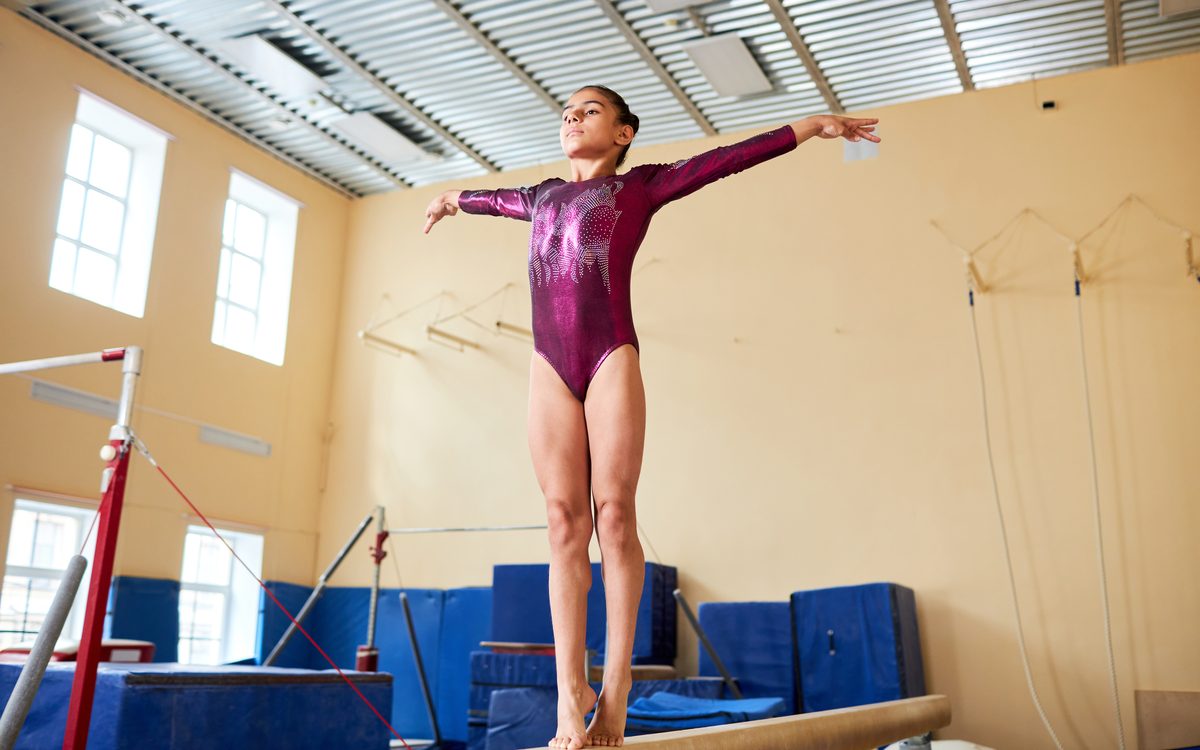
| Balance beam | Women | 500 cm long, 10 cm wide and 125 cm high in the FIG Apparatus Norms. Routines are capped at 90 seconds. |
| Floor exercise | Women and men | A 12 by 12 meter sprung carpet. Women’s routines are capped at 90 seconds with music; the men’s code caps floor at 70 seconds, down from 75. |
| Pommel horse, still rings, parallel bars, horizontal bar | Men | Upper-body strength and swing events. The men’s code asks for singlets and long pants on these four events. |
Falls are costly. The FIG men’s code lists a one-point deduction for a fall, and a fall also costs the skill’s value and often breaks the flow of the routine. Attire follows the code: leotards or unitards for women with only small stud jewellery, and handguards and wraps fastened securely; singlets for men.
Basic skills: what beginners really learn first
Most programs introduce skills in a steady order. This list is general coaching practice, not a rule; each gym sets its own progression.
- Body positions. Hollow, arch, tuck, pike and straight shapes on the floor and on a low beam.
- Basic rolls and balance. Forward and backward rolls, bridges, walking and turning on a low beam.
- Cartwheel and handstand. The first inverted skills, often practiced against a wall or on a mat.
- Swing and support. Pull-overs and casts on a low bar for girls, supports and swings on parallel bars for boys, learned over mats.
- Landings. Learning to stick a landing is taught early because every event ends with one.
A coach adds skills only when the earlier ones are solid. The AAP says most children lack the motor skills for organized sport before about age 6 and that preschool tumbling in beginner gymnastics fits younger children.
Levels: from recreational to elite
Recreational classes are for fun and fitness and do not require meets. In the US, competitive girls in USA Gymnastics (USAG) clubs follow the Development Program, formerly called Junior Olympics, which runs from Level 1 up to Level 10 and then elite. The lower levels use set (compulsory) routines and the upper levels use routines the coach designs (optional); check the USAG Women’s Rules and Policies for the exact level boundaries. USAG’s 2026-27 rules set minimum ages such as the 4th birthday for Level 1, the 5th for Level 2 and the 6th for Level 3. Xcel is a separate USAG track, with divisions from Bronze up through Silver, Gold, Platinum, Diamond and Sapphire, for gymnasts who want a flexible competitive experience.
High school and college. In the NFHS 2023-24 survey girls gymnastics was offered in 26 states and boys gymnastics in 7. Women’s NCAA teams compete six gymnasts per event and count the best five, for a top team score of 200, according to College Gym News. Men’s NCAA gymnastics has 12 Division I programs, per USAG.
How a first meet works
USAG’s rules for women’s development programs describe the format: a general warm-up of 15 to 30 minutes, then a timed warm-up on each apparatus, with the time rising by level. Competition order is vault, bars, beam, floor for women and floor, pommel horse, rings, vault, parallel bars, high bar for men. For the day itself, see our gymnastics meet day page.
How to get started
- Decide the goal: tumbling and fitness, recreational classes, or a competitive team.
- Look for a gym that is a USA Gymnastics member club (USAG reports more than 3,300 clubs) or a school or community program. Ask who coaches, what safety certification they hold and whether they will let you watch a class.
- Ask about class size, mats and how skills are taught in steps. USAG professional members must hold safety and Safe Sport credentials, and the U.S. Center for SafeSport policy says training should be observable and interruptible.
- Start with the lowest-pressure class and let the child set the pace.
More on ages, hours and what to look for in a gym is on our youth gymnastics page, and the gymnastics rules page covers the whole sport.
Official rulebooks
Read the FIG Women’s Code of Points 2025-2028, the Men’s Code of Points 2025-2028 and the Apparatus Norms. For US youth competition use the USAG Women’s Rules and Policies. The Olympic programme changes by edition; LA28 lists a new mixed team event in artistic gymnastics with the format still to be set by the FIG, so check the official programme for the current Games.
Keep going with artistic gymnastics training, gear and the artistic gymnastics hub.
Artistic gymnastics rules FAQs
What is a good score in artistic gymnastics?
It depends on the event, level and code. The FIG example shows 14.70 (D 5.70 plus E 9.00). Scores in US levels use different routines and values, so compare gymnasts only within the same level and scoring system.
What is the difference between D score and E score?
D is the difficulty of the skills, with no maximum. E is execution, starting from 10.00 and reduced for errors. They are added together.
How many events do men and women compete?
Women compete on four events and men on six. Both do floor and vault; women add uneven bars and balance beam, and men add pommel horse, rings, parallel bars and horizontal bar.
How old do you have to be to start?
Recreational classes begin in the preschool years. For competition in the USAG Development Program, Level 1 has a minimum age of the 4th birthday, according to the 2026-27 rules. The AAP says organized sport suits most children from about age 6.
Sources
- FIG Women’s Code of Points 2025-2028
- FIG Men’s Code of Points 2025-2028
- FIG Apparatus Norms
- Inside Gymnastics, Breaking Down the 2028 Men’s Code of Points
- Gymnastics Coaching, FIG Women’s Gymnastics Code changes
- USA Gymnastics Women’s Rules and Policies 2026-27
- USA Gymnastics, About and men’s NCAA pathway
- NFHS 2023-24 participation survey
- College Gym News, NCAA gym guide
- AAP HealthyChildren, Is Your Child Ready for Sports?
- LA28 medal event programme
- U.S. Center for SafeSport, 2025 MAAPP
General information for education only, not medical advice. See our editorial policy for how we research and write.