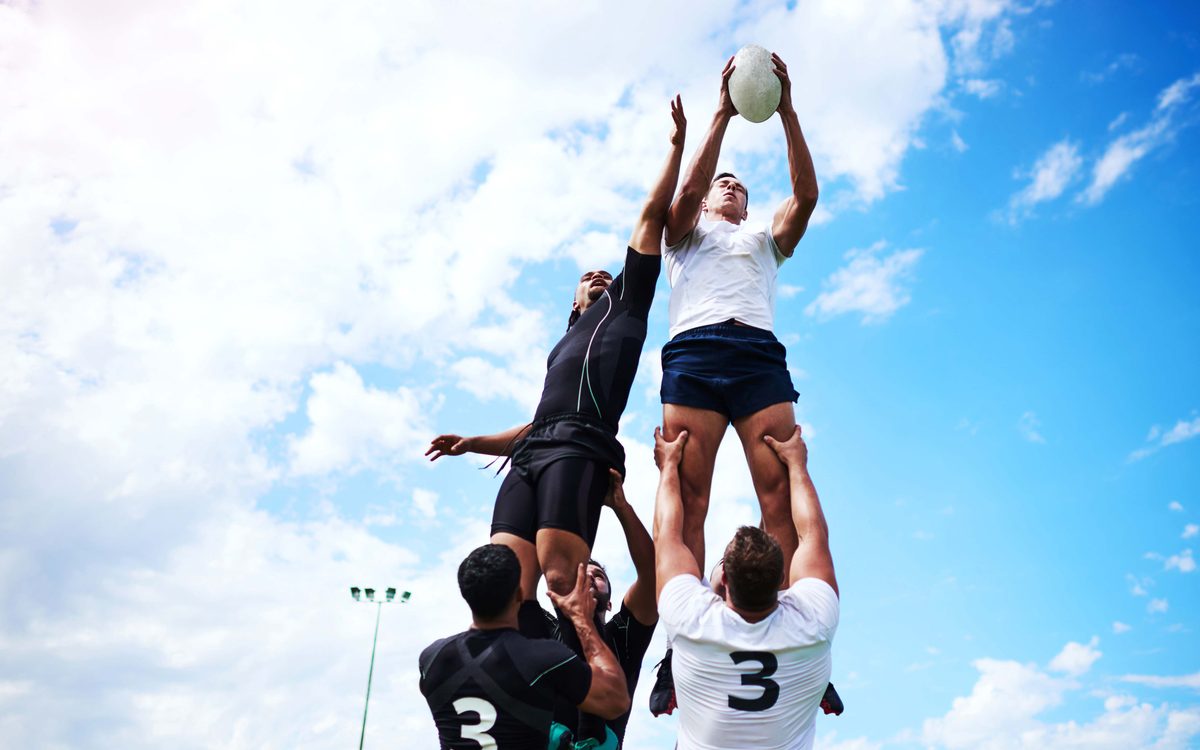
Sunday morning after a hard match, you get out of bed and find out where the game went: thighs, shoulders, ribs. Rugby union recovery is everything a player does between matches and training to get ready for the next one: sleep, food and fluids, easy movement and managing how much hard work is stacked together.
Quick answer: Sleep (7 or more hours for adults, 8 to 10 for teens per the CDC and AASM), refuelling and fluids, and keeping the days after a match light do the most. Evidence for many gadgets and methods is limited (a 2026 review of elite rugby union recovery said so), and cold water immersion can blunt strength gains. Sharp, persistent or one-spot pain, and any head injury symptoms, call for a sports medicine doctor, physical therapist or athletic trainer.
What a match does to the body
A tackle, ruck or scrum is a collision, and a 2025 narrative review describes impact-induced muscle damage from tackles, rucks, scrums and ground contact that can reduce force and delay recovery. In a study of 14 professional rugby union players (West and colleagues, Journal of Strength and Conditioning Research, 2014), jump peak power was below baseline at 12 and 36 hours after a match and back to baseline at 60 hours. Cortisol was raised and testosterone lowered at 12 and 36 hours, and mood was disturbed at 12 hours. Those are professionals and one study, so do not treat 60 hours as a rule for anyone else. The practical point is that the day or two after a match is when players are most fatigued, and most teams keep those days light (common practice, no source gives a figure).
Sleep comes first
The CDC and the American Academy of Sleep Medicine put adults at 7 or more hours a night and teenagers aged 13 to 18 at 8 to 10 hours. In a 2025 study of 36 professional rugby players, 34 slept less than 8 hours at baseline; after a sleep-hygiene seminar and relaxation work, the poor sleepers’ average sleep rose from about 405 to about 426 minutes. Simple habits that coaches and sleep guides list are a regular wake time, a dark cool room, and limiting caffeine late in the day. A match played in the evening makes this harder, so plan the night in advance.
Refuel and rehydrate
The joint position statement from the American College of Sports Medicine, the Academy of Nutrition and Dietetics and Dietitians of Canada (2016) says to replace 125% to 150% of the fluid lost, that is 1.25 to 1.5 litres for every kilogram of body weight lost, to eat carbohydrate early when the next session is within a day (1.0 to 1.2 grams per kilogram an hour for the first hours) and to include 0.25 to 0.3 grams per kilogram of protein, about 15 to 25 grams, in the early recovery meal. It also discourages excessive alcohol in recovery. Our nutrition page has more.
Load management across the week and season
Recovery is mostly about not stacking hard days. The training page covers a weekly shape and World Rugby’s contact-load guidelines. For teenagers, the American Academy of Pediatrics (Brenner, 2016) advises one to two days off a week from the main sport. A heavy tournament weekend, such as a sevens-style two matches a day, puts more collisions in the later matches (a 2022 study of sevens tournaments), so plan extra rest after one. See our rugby sevens page.
Mobility and flexibility
We did not find a rugby-specific study showing that stretching or mobility routines speed recovery or prevent injury. Mobility work is still widely used by coaches (general practice) to keep the hips, ankles and shoulders moving freely after hard contact weeks, and Tackle Ready lists mobility among its contact-confidence prerequisites. Easy movement such as walking, cycling or pool work is a common choice for the day after a match; the 2026 scoping review of elite men’s rugby union recovery lists pool-based recovery among the strategies studied.
Recovery tools: what the evidence says
That scoping review (37 articles) found cold water immersion was the most studied method, followed by compression, cryotherapy, electrical stimulation, fish oil, pool recovery and mattresses, and concluded that many strategies have limited empirical support. A few specifics from other reviews:
- Cold water immersion: a 2016 review (Machado and colleagues) found it slightly better than passive rest for soreness, using water at 10 to 15 degrees Celsius for 10 to 15 minutes, while a 2015 study (Roberts and colleagues) found regular cold water immersion after strength training reduced strength gains. So it may fit a heavy match weekend better than a lifting block. If you have a heart condition or are unsure, ask a doctor before cold plunges.
- Massage: a 2018 review (Dupuy and colleagues) found massage was the best-supported method for soreness and perceived fatigue.
- Compression garments: a 2017 review (Brown and colleagues) found small benefits.
- Foam rollers and massage guns: popular and generally low risk for soreness. Avoid them over a suspected fracture, a deep bruise or the front of the neck. We make no recovery claims for any device.
Soreness or injury?
Muscle soreness that peaks a day or two after hard exercise, feels spread across a muscle and eases with movement is common. Pain that is sharp, in one spot, present at rest or at night, comes with swelling, joint instability, numbness, or changes how you move is a reason to see a sports medicine doctor, physical therapist or athletic trainer. Any head impact with symptoms is a different matter: CDC HEADS UP says to stop playing and see a provider, and World Rugby’s community guidance has a minimum 21-day stand-down. See the injuries page.
Frequently asked questions
How long does it take to recover after a rugby match?
In one study of 14 professionals, jump power was back at baseline by 60 hours, but fatigue differs by player, position and match. Keep the first two days light, and let soreness and energy guide you.
How much sleep do rugby players need?
The CDC and AASM say 7 or more hours for adults and 8 to 10 hours for teens aged 13 to 18. Consistent timing matters as much as the number.
Are ice baths worth it after rugby?
The evidence is mixed. Cold water immersion may reduce soreness slightly, but a 2015 study found it blunted strength gains after resistance training. Use it, if at all, after match days.
Should I stretch after a match?
We found no rugby-specific evidence that it speeds recovery. Gentle mobility work is common practice and feels good to many players.
Is it normal to feel flat for a couple of days after a match?
Many players do. Studies of professionals found lower power and disturbed mood in the first day and a half. Persistent fatigue, poor sleep or low mood is a reason to talk to a doctor.
Sources
- Impact-induced muscle damage in rugby, narrative review 2025, PubMed
- West et al. 2014, recovery after professional rugby matches, J Strength Cond Res
- Sleep intervention in 36 professional rugby players, PubMed
- CDC, About sleep
- ACSM, Academy of Nutrition and Dietetics, Dietitians of Canada joint position statement: nutrition and athletic performance (2016)
- AAP, Brenner 2016, sports specialization and intensive training
- Recovery strategies in elite men’s rugby union, scoping review 2026, PubMed
- Machado et al. 2016, cold water immersion and muscle soreness, PubMed
- Roberts et al. 2015, cold water immersion after strength training, PubMed
- Dupuy et al. 2018, recovery methods and DOMS, PubMed
- Brown et al. 2017, compression garments and recovery, PubMed
- Study of sevens tournaments, 2 matches a day, PubMed
- World Rugby, Tackle Ready
- World Rugby, concussion for the general public: summary principles
- CDC HEADS UP, signs and symptoms
- AASM adult sleep duration consensus, PubMed
General information for education only, not medical advice. It does not replace a visit with a doctor, physical therapist or athletic trainer. See how we write and check our pages in our editorial policy.