This article contains affiliate links: if you buy through them we may earn a commission, at no extra cost to you. Read our affiliate disclosure.
Stade de France, Paris, July 2024. France’s Antoine Dupont, the rugby union superstar who switched to sevens for the Games, helps beat Fiji 28-7 in the men’s final and ends Fiji’s unbeaten Olympic run. Three days later, the US women won bronze with a 14-12 victory over Australia, the first US rugby medal since 1924, while New Zealand beat Canada 19-12 to keep the women’s gold. A whole tournament, from the first pool match to the medals, takes three days.
Rugby Sevens guides: what do you need?
New to rugby sevens? Start with the first card. Everything here is general education, not medical advice.
History & Origins of Rugby Sevens
Sevens was first played in Melrose, in the Scottish Borders, in 1883, as a fundraiser for the local club. A butcher’s apprentice, Ned Haig, and his master David Sanderson are credited with the idea of a shortened game with seven players a side (World Rugby).
For well over a century sevens stayed a tournament game. The first Rugby World Cup Sevens was played in Edinburgh in 1993. Rugby fifteens had appeared at four Olympic Games between 1900 and 1924, then left the programme; sevens secured a return in 2009 and made its Olympic debut at Rio 2016, where Australia won the women’s gold and Fiji the men’s, Fiji’s first Olympic medal. The Paris 2024 sevens tournament ran from July 24 to 30 at the Stade de France (World Rugby).
- 1883: First sevens tournament, Melrose, Scotland.
- 1993: First Rugby World Cup Sevens, Edinburgh.
- October 2009: Sevens’ return to the Olympic programme is secured (World Rugby).
- 2016: Olympic debut in Rio; Australia (women) and Fiji (men) win gold.
- 2024: Paris Olympics at the Stade de France.
- 2025: World Rugby confirms a three-tier HSBC SVNS model (SVNS).
Recent Champions
Scope: only the rows we confirmed on an official page, not every sevens title.
| Event | Result |
|---|---|
| Rio 2016 Olympics, women | Australia, gold |
| Rio 2016 Olympics, men | Fiji, gold |
| Paris 2024 Olympics, women | New Zealand gold (19-12 over Canada), Canada silver, USA bronze |
| HSBC SVNS 2026 Series titles | New Zealand (women), South Africa (men) |
| HSBC SVNS 2026 World Championship | Australia (women), South Africa (men) |
Source: World Rugby (Rio 2016), World Rugby (Paris 2024 women), HSBC SVNS. Results verified through November 13, 2026. The Paris 2024 men’s result and Tokyo 2020 are on the official pages below.
Legends of the Sport
Not a ranking, and not complete. No one listed endorses AthleteRx.
- Waisale Serevi (Fiji): nicknamed “The King of Sevens”; five Hong Kong Sevens Cups, captained Fiji to its first World Series title in 2005-06, and scored a record 297 points at the Rugby World Cup Sevens. Inducted into the World Rugby Hall of Fame in 2013 (World Rugby).
- Portia Woodman-Wickliffe (New Zealand): won her second Olympic gold at Paris 2024 (World Rugby).
- Tyla King (New Zealand): also won a second Olympic gold at Paris 2024 (same source).
- Michaela Blyde (New Zealand): scored nine tries in the Paris 2024 tournament by the semi-final (same source).
Official results and records
- HSBC SVNS: Series results and standings.
- Olympics.com rugby sevens
- World Rugby
How we keep this current: we re-check results after each major championship and update the date above. Spot an error? See our editorial policy.
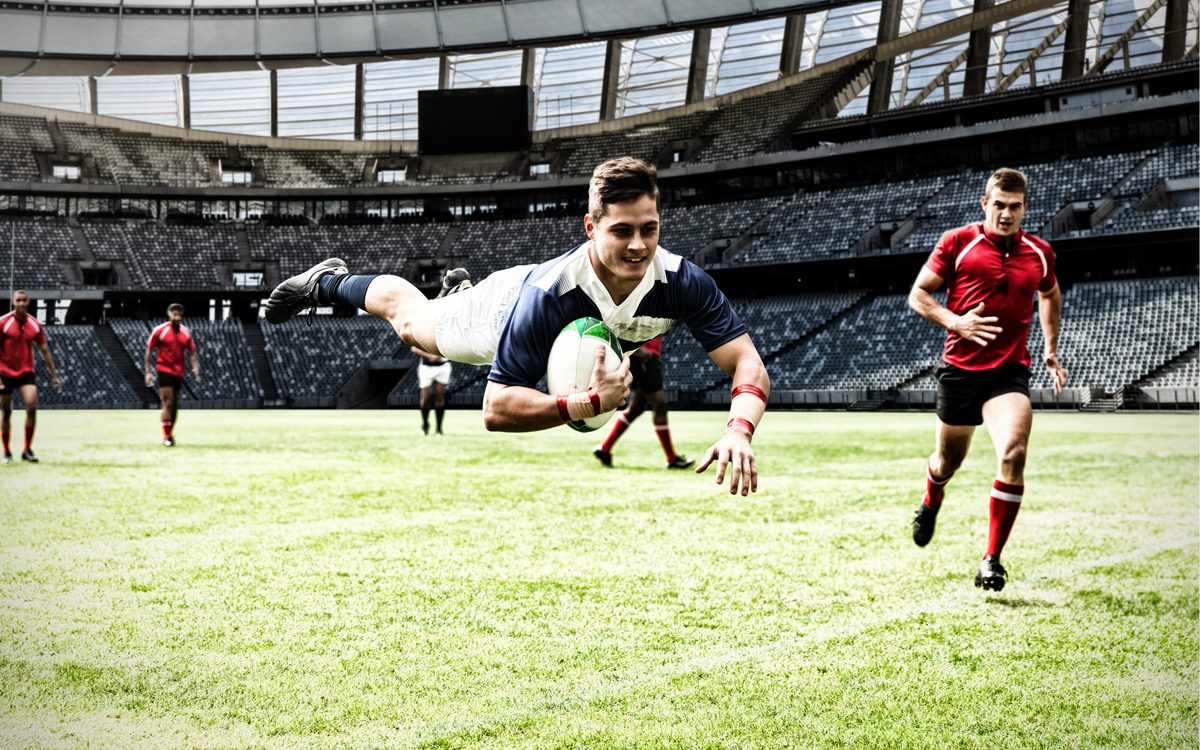
Rugby sevens (also written 7s or VII) is the seven-a-side version of rugby union, played on a full-size field in two short halves of seven minutes. It is faster, more open and more about space and speed than the 15-a-side game, and it is the version of rugby that is in the Olympics. For the other codes, see rugby union and rugby league.
Rugby sevens at a glance
| What it is | A seven-a-side form of rugby union with the same field and the same scoring, but faster restarts and fewer forwards. |
|---|---|
| How it is scored | Try 5, conversion 2, penalty goal 3, dropped goal 3 (World Rugby Laws 2026). |
| Match length | Seven players, two halves of not more than 7 minutes (14 minutes), half-time no longer than 2 minutes; a competition final can be up to 20 minutes. A yellow card is a 2-minute suspension. |
| Participants and levels | Club and school players, college sevens, national teams, and the HSBC SVNS series; men and women play in the same events. |
| Where it is played | The same field as union (94 to 100 m long, 68 to 70 m wide), in a stadium or on a club pitch; tournaments run over one to three days. |
| Governing body | World Rugby; USA Rugby in the US. |
| Olympics | Men’s and women’s tournaments since Rio 2016; on the LA28 program at Carson Stadium. |
How rugby sevens works
Most rules are rugby union’s: the ball goes backward by passing, a tackled player has to release it, a ruck forms over the ball, and a scrum involves fewer players. The difference is the load: seven players cover the same field, so there is more space and more running. The whole match is 14 minutes, so one mistake in defense can decide it.
Tournament format
Sevens is played as a tournament: a team plays several matches over one to three days. At LA28, the men’s and women’s tournaments each have 12 teams in three pools of four, then knockout rounds for the medals, over three days at Carson Stadium. In the HSBC SVNS series, men’s and women’s teams play integrated tournaments with equal participation fees and representation.
Who plays it and at what level
- Youth and school: Rookie Rugby and USA Youth & High School Rugby run youth programs; ask a club whether it offers sevens.
- College: National Collegiate Rugby (NCR) runs a National 7s alongside its XVs championships. Women’s rugby is an NCAA Emerging Sport.
- Professional and international: the HSBC SVNS series. For 2027, World Rugby lists the top-tier men’s teams as South Africa, New Zealand, Spain, Australia, Argentina, Fiji, France and the USA, and the women’s as Australia, New Zealand, Canada, USA, France, Japan, Fiji and Spain. The 2026-27 series visits Dubai, Cape Town, Singapore, Perth, Vancouver and New York, followed by a World Championship in Hong Kong, Valladolid and Bordeaux in 2027.
Olympic status (as of 2026): the IOC voted 81 to 8 in 2009 to add rugby sevens for 2016 and 2020. Fiji won the first men’s gold at Rio 2016 and Australia the first women’s gold. At Tokyo 2020 (played in 2021) Fiji’s men beat New Zealand 27-12 and New Zealand’s women beat France 26-12. At Paris 2024, France beat Fiji for the men’s gold and New Zealand beat Canada for the women’s, with South Africa and the USA taking bronze. Sevens is on the LA28 program, men’s and women’s, at Carson Stadium. The 2027 series is the start of the race to qualify for Los Angeles, but we could not confirm the number of qualifying places or the route; check the official programme.
What it asks of the body
Sevens asks for repeated high-speed running, hard contact and the ability to recover between matches. A 2026 study tracked 19 men and 11 women across 88 international fixtures and found four movement categories; the “very high” band began above 7.20 m/s for the men and above 5.97 m/s for the women, and the women covered more distance in their own very high-speed band. A 2026 scoping review found elite female sevens players had better aerobic capacity (Yo-Yo IR1) than sub-elite players. Speed, aerobic fitness and the ability to repeat sprints are the headline qualities.
Health and safety in rugby sevens
Sevens has higher injury rates per hour than the 15-a-side game, though matches are much shorter. A 2024 meta-analysis of 20 studies (Behardien and colleagues, Eur J Sport Sci) found about 108.5 injuries per 1,000 player hours for men and 76.1 for women, with more injuries in the second half of matches, mostly acute, mostly to the lower limb, mostly joint or ligament, and mostly from being tackled. Fatigue, fitness and previous injury were linked to higher risk. A 2026 review of women’s sevens (15 studies) found 40.5 to 153.6 injuries per 1,000 match hours at the elite level and 26.5 to 46.3 in the community game, with elite injuries lasting longer (45.6 to 124 days). Evidence was limited and mixed in quality.
- Concussion. A 2026 meta-analysis of rugby union (sevens and XVs) and league found about 9.7 concussions per 1,000 player hours in union, mostly in matches. CDC HEADS UP: recognize and remove; a health care provider decides about return. World Rugby’s community guidance includes a minimum 21-day stand-down.
- Fatigue and back-to-back matches. Injuries cluster in the second half and in the later matches of a tournament, so rest, fuel and sleep between games matter.
- Tackle skills. World Rugby’s Tackle Ready program and Activate warm-up are free. Tackle height rules for community rugby changed in July 2026.
- Heat. Tournaments are often outdoors; NATA guidance covers heat acclimatization and cooling.
See a sports medicine doctor, physical therapist or athletic trainer for injuries that do not settle. More at the rugby injuries page.
Training, recovery and nutrition pointers
Sevens training leans on speed, repeat sprints and aerobic fitness, plus tackle practice. Because a tournament packs several matches into a few days, plan fuel and fluids between games with a dietitian or coach; our rugby game-day page has the basics, plus training, recovery and nutrition and supplements.
Gear for rugby sevens
The rules are the same as union’s: World Rugby Regulation 12 limits shoulder pads and headgear to soft, thin material, and USA Rugby says mouthguards should be worn by every player, every time in contact rugby. Many sevens players also use a heart rate monitor or GPS to track load; our GPS tracker guide compares options. Product notes below are from the makers’ pages, not tests.

Gilbert G-TR4000 Training Rugby Ball (Size 5)
- Size 5
- 3-ply, hand stitched
- Ships deflated

Shock Doctor Gel Max Mouthguard
- Boil-and-bite
- Youth and adult sizes
- Gel lining

Related sports and disciplines
- Parent: Rugby.
- Siblings: rugby union and rugby league.
- Other fast team sports: soccer, lacrosse and field hockey.
Frequently asked questions
How long is a rugby sevens match?
Two halves of not more than 7 minutes each, with a break of no more than 2 minutes. A competition final can run up to 20 minutes.
Is rugby sevens in the 2028 Olympics?
Yes. LA28 lists men’s and women’s tournaments of 12 teams each at Carson Stadium. Check the official programme for the current Games.
What is the difference between sevens and union?
Sevens has seven players instead of 15 and 14-minute matches. The scoring and field are the same, but the space makes it faster.
Is sevens safer than 15s?
Not in the data we found: per-hour injury rates are higher in sevens, but matches are shorter. Neither is risk-free.
How can a young player start in sevens?
Ask a local club or your state youth rugby organization (see USA Youth & High School Rugby) whether it plays sevens.
Sources
- World Rugby, Laws of the Game 2026: PDF; Olympic history
- LA28, Rugby sevens
- World Rugby, Paris 2024: men’s final; women’s final; Team USA, US women bronze
- World Rugby, HSBC SVNS 2026-27 schedule; SVNS about
- Behardien MR et al. 2024: PubMed; Braga C et al. 2026, women’s sevens: PubMed; De Sousa-De Sousa L et al. 2026: PubMed
- Finnegan C et al. 2026, movement categories: PubMed; Brassington RJ et al. 2026: PubMed
- CDC HEADS UP; World Rugby concussion principles; NATA heat
- USA Youth & High School Rugby, get into rugby; NCR; USA Rugby equipment guidelines
Keep exploring: the rugby rules, rugby leagues and associations, rugby gear, our HRV guide and the sports hub.