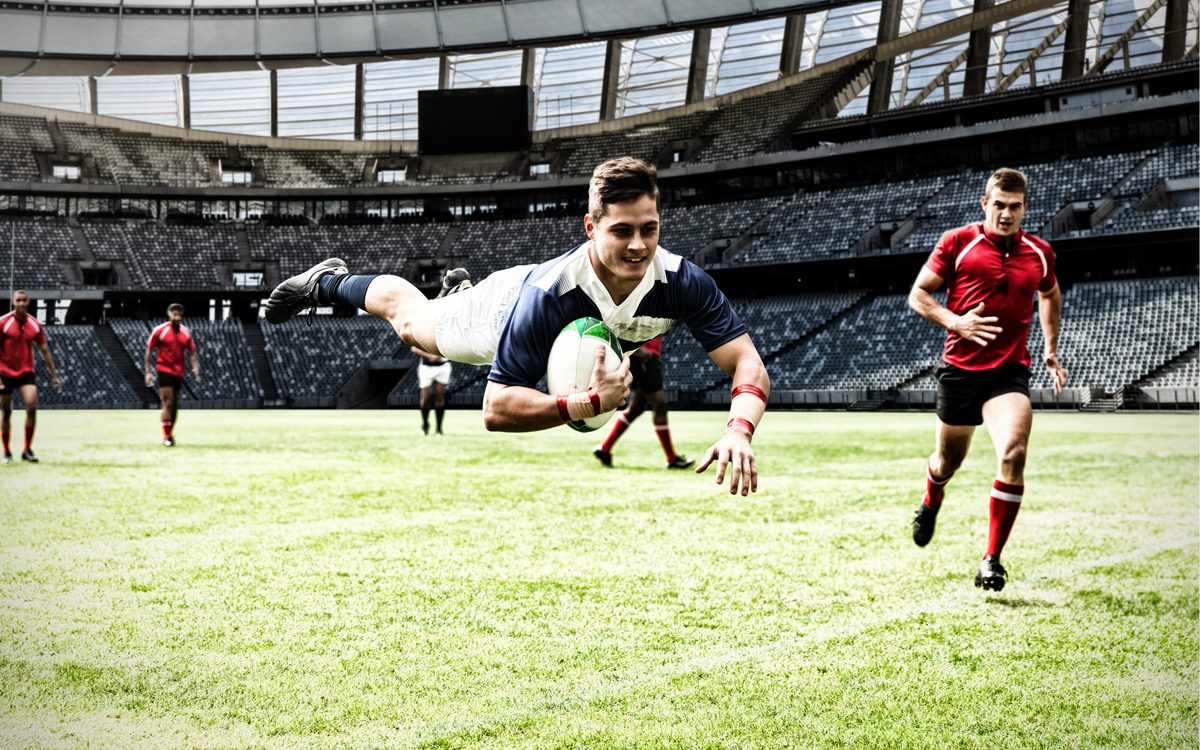
Saturday afternoon, the second day of a tournament. Your first two matches were yesterday, your legs feel like wet sand, and the pool game kicks off in ninety minutes. Rugby sevens recovery is what you do between matches, between tournaments and between hard training days so that the next effort is possible: sleep, food and fluids, an easy day when needed, mobility work and, for some players, tools such as cold water or massage. Evidence for many of those tools is weaker than the marketing suggests, so this page says where it is solid and where it is not. For the bigger picture, see the rugby sevens hub.
Quick answer: Sleep, eating and drinking enough, and spacing hard sessions are the foundations. Studies show hard contact leaves muscles weaker for a day or two, and tools like cold-water immersion, massage and compression give small or mixed benefits. Muscle soreness that eases is normal; sharp pain, swelling, or any head injury symptom is not, so see a sports medicine doctor, physical therapist or athletic trainer.
The recovery problem in sevens
A sevens tournament packs matches into a short window. In a study of men at the 2015 and 2016 Asia Rugby Sevens series (PMID 35959342), four matches were played over two days and heavy, very heavy and severe collisions were generally higher in matches 3 or 4 than in matches 1 or 2, even though running performance was generally maintained. LA28 plans its Olympic sevens tournaments over three days. You are not recovering for a week; you are recovering for a few hours, which changes the priorities: fluids, carbohydrate, shade or warmth, and rest between games come first.
After a tournament, the damage from contact catches up. A 2014 study of 14 professional rugby union players (West and colleagues, PMID 23539085) found jump power was below baseline at 12 and 36 hours after a match and back to baseline at 60 hours, with changes in stress hormones over the same period. A 2025 narrative review (PMID 40819341) describes impact-induced muscle damage from tackles, rucks, scrums and ground contact. These are 15-a-side and mostly men’s data, but they support a common practice of keeping the first day or two after a heavy weekend light. That is general practice, not a rule.
Sleep comes first
A 2016 survey of 175 elite or highly trained rugby sevens, rugby union and cricket athletes (PMID 26697921) found an average 7.9 hours of sleep a night, yet half scored as poor sleepers on the Pittsburgh Sleep Quality Index and daytime sleepiness was common. A study of 36 professional rugby players (PMID 41133958) found a sleep-hygiene seminar and relaxation training lengthened sleep in the poor sleepers (405 to 426 minutes). The American Academy of Sleep Medicine consensus is at least 7 hours for adults and 8 to 10 hours for teens aged 13 to 18. The CDC’s sleep pages give the basics.
- Keep a regular wake-up time, even on tournament weekends.
- Keep the room dark, cool and quiet; limit screens before bed.
- Caffeine late in the day can cut into sleep, and tournament nerves often do too.
- Tournament nights in hotels or team houses: bring an eye mask and earplugs.
Refuel and rehydrate between matches
The 2016 joint position of the American College of Sports Medicine, the Academy of Nutrition and Dietetics and Dietitians of Canada (PMID 26891166) says rapid refuelling needs about 1.0 to 1.2 g of carbohydrate per kilogram of body weight per hour for the first hours, and that fluid losses should be replaced at 125% to 150% of the body mass lost, with some sodium. It also suggests 0.25 to 0.3 g of protein per kilogram (15 to 25 g) early in recovery. Details for tournament days are on our nutrition page. These are population guidelines; a dietitian can tailor them.
Recovery tools: what the evidence says
- Cold-water immersion. A 2016 review (Machado and colleagues, PMID 26581833) found it slightly better than passive rest for soreness, using water of about 10 to 15 degrees C for 10 to 15 minutes. A 2015 study (Roberts and colleagues, PMID 26174323) found cold-water immersion after strength training led to smaller strength gains, so it may not suit a strength block. Do not use it if you have a heart or circulation condition without asking a doctor.
- Massage. A 2018 meta-analysis (Dupuy and colleagues, PMID 29755363) found massage was the most effective of the methods it compared for soreness and perceived fatigue. Massage guns and foam rollers are cheaper versions; avoid them over a bruise, a suspected fracture, or the neck.
- Compression garments. A 2017 review (Brown and colleagues, PMID 28434152) found small benefits. Compression boots are a different tool, and we do not have sevens-specific evidence for them.
- Overall. A 2026 scoping review of 37 studies in elite rugby union (PMID 42384272) found cold-water immersion the most studied recovery method and said many strategies have limited empirical support.
In short, sleep and food are well supported. The tools are optional extras with small effects and some trade-offs; choose what you like and can afford, and do not lose sleep over it.
Mobility and flexibility
Rugby sevens needs hips, hamstrings, ankles and shoulders that move well, since sprinting, stepping, and tackling stress them. We did not find a sevens study showing that a particular stretching routine prevents injury, so treat mobility work as comfort and movement quality, not a guarantee. A common approach, again general practice, is dynamic movement before play and gentle stretching or a short walk after. See our training page for where mobility fits in a week.
Soreness or injury?
- Normal soreness is a dull, widespread ache in muscles you used, that peaks a day or two after play and eases with gentle movement.
- Warning signs are pain in one spot, sharp pain with movement, swelling or bruising, a joint that gives way, numbness or tingling, or pain that is getting worse after several days. This is a general safety rule, not a study figure. See a professional.
- Head injury symptoms are not soreness: any suspected concussion needs a health care provider (CDC HEADS UP). Sleep changes can follow a concussion, so tell the provider about them.
Rugby sevens recovery FAQs
How do I recover between matches at a sevens tournament?
Rehydrate and refuel early, keep warm or cool as needed, move gently, and rest off your feet. The ACSM, Academy of Nutrition and Dietetics and Dietitians of Canada position gives numbers for refuelling; see the nutrition page.
Are ice baths worth it for rugby players?
They gave slightly less soreness than passive rest in a 2016 review, but a 2015 study found smaller strength gains when used after strength training. A 2026 scoping review of elite rugby union found limited support for many strategies.
How much sleep do rugby players need?
The American Academy of Sleep Medicine says adults need at least 7 hours and teens 13 to 18 need 8 to 10. A 2016 survey of rugby and cricket players found half were poor sleepers.
How long after a tournament should I wait to train hard?
There is no universal number. In one study of professional rugby union players, jump power was back to baseline 60 hours after a match, but that is one group of men. Start light and see how you feel.
Is it normal to be sore for days?
Some soreness for a day or two after hard contact is common. Pain that is sharp, in one spot, swollen, or getting worse needs a professional.
Sources
- Running demands in a sevens tournament (PMID 35959342)
- LA28 rugby sevens
- West et al. 2014, muscle damage and recovery in rugby (PMID 23539085)
- Impact-induced muscle damage review 2025 (PMID 40819341)
- Sleep in rugby sevens, union and cricket athletes (PMID 26697921)
- Sleep intervention in professional rugby players (PMID 41133958)
- CDC, about sleep
- ACSM / AND / DC nutrition and athletic performance 2016 (PMID 26891166)
- Cold-water immersion, Machado 2016 (PMID 26581833)
- Cold-water immersion and strength gains, Roberts 2015 (PMID 26174323)
- Massage, Dupuy 2018 (PMID 29755363)
- Compression garments, Brown 2017 (PMID 28434152)
- Elite rugby union recovery scoping review 2026 (PMID 42384272)
- CDC HEADS UP
General information for education only, not medical advice. See a sports medicine doctor, physical therapist or athletic trainer about any injury or health concern. How we write these pages is in our editorial policy.