This article contains affiliate links: if you buy through them we may earn a commission, at no extra cost to you. Read our affiliate disclosure.
Accor Stadium, Sydney, October 4, 2026. Newcastle has just scored in the 77th minute and converted to close within a point, and the Sydney Roosters, who led thanks to a Daly Cherry-Evans field goal, hold on to win the NRL Grand Final 19-18. Eleven days later, the sport’s World Cup kicks off in Australia and Papua New Guinea, with men’s, women’s and wheelchair tournaments scheduled from October 15 to November 15, 2026.
Rugby League guides: what do you need?
New to rugby league? Start with the first card. Everything here is general education, not medical advice.
History & Origins of Rugby League
Rugby league was born on August 29, 1895, when 21 northern English clubs broke away from the English rugby union. The main reason was the clubs’ wish to pay players for time lost from work, which union forbade. The new body was called the Northern Union (Rugby Football League).
The game then began to look different from union. In 1906 it became 13-a-side and introduced the play-the-ball, and all 31 professional teams merged into one league. Super League began in 1996, moving the English game to a summer season, and a play-off and Grand Final system followed in 1998. Catalans Dragons joined Super League in 2006, after Paris Saint Germain in 1997.
- August 29, 1895: 21 northern clubs split from rugby union.
- 1906: 13-a-side and the play-the-ball introduced.
- 1996: Super League begins, with a summer season.
- 1997: Paris Saint Germain joins Super League.
- 1998: Play-off and Grand Final system introduced.
- 2006: Catalans Dragons join Super League.
Source: RFL history and heritage, read November 13, 2026.
Notable Athletes
Three Welsh-born players named by Wales Rugby League among the first International Rugby League Hall of Legends (42 players chosen in all). Not a ranking, and far from complete. No one listed endorses AthleteRx (Wales Rugby League).
- Sir Billy Boston: Wigan winger, second on the all-time try-scorers list, with 32 Great Britain caps.
- Jim Sullivan: full-back and goal-kicker, the highest goal scorer in the sport’s history, with 60 international appearances between 1924 and 1933.
- Gus Risman: 18 caps each for Wales and Great Britain between 1932 and 1946, and captain of Great Britain on its 1946 tour of Australia and New Zealand.
Official results and records
The 2026 Rugby League World Cup was still under way when we checked, so we list no champions. Official pages:
- International Rugby League: World Cup results.
- NRL: premiership results.
- Rugby Football League: Super League and Challenge Cup.
How we keep this current: we re-check facts after each major championship and update this page. Spot an error? See our editorial policy.
Rugby league (also called league, 13s, or “footy” in parts of Australia) is a 13-a-side contact team sport in which teams get a limited number of tackles to score, and it is one of rugby’s two main codes alongside rugby union. Its top professional competitions are the NRL in Australia and Super League in England.
Rugby league at a glance
| What it is | A 13-a-side game built around a six-tackle set: the attacking team keeps the ball until it is tackled six times, then hands it over. |
|---|---|
| How it is scored | Try 4 points, conversion 2, penalty goal 2, drop goal 1 (International Rugby League Laws 2026). |
| Match length | 80 minutes, with a ten-minute interval at half-time. |
| Participants and levels | Youth, women’s, men’s and wheelchair clubs; amateur and semi-professional leagues; the NRL in Australia and professional competitions in England and elsewhere; international rugby league. |
| Where it is played | A field about 100 m between goal lines and 68 m wide (as drawn in the International Laws), plus in-goal areas of 6 to 11 m. |
| Governing bodies | International Rugby League (IRL) worldwide; USA Rugby League (USARL) in the United States. |
| Olympics | Not on the Olympic program. |
How rugby league works
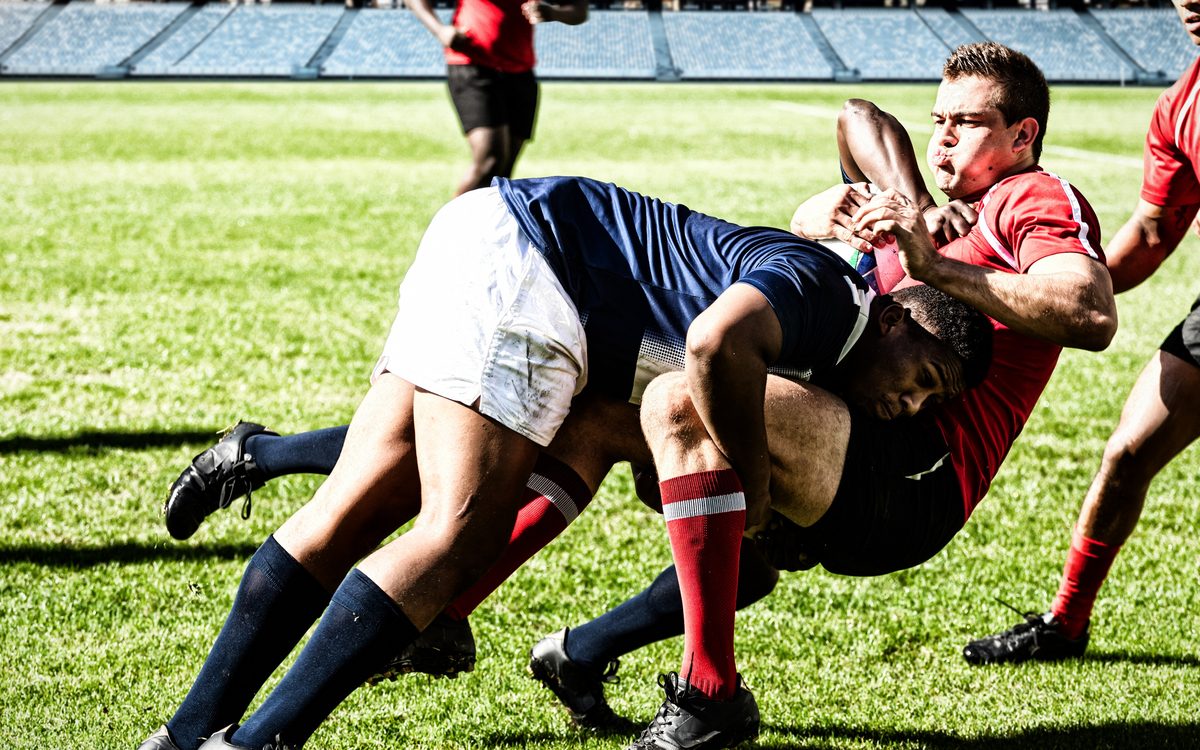
The International Laws give each team of 13 on the field a set of tackles. After a tackle, the player gets up and plays the ball with their foot to a teammate (the “play-the-ball”). The team can have five successive play-the-balls; a handover happens after the sixth tackle, or after a knock-on, a ball kicked out on the full, or a player held up in the opponent’s in-goal. Because the contest after each tackle is reset rather than fought over, league has no rucks or lineouts, and scrums are used to restart after certain stoppages.
The 17-player squad is allowed up to eight interchanges under the International Laws, and a team can bring on an 18th player in specific cases, such as two teammates being ruled unable to return after head injury assessments or one player hurt by an opponent’s foul play. Local competitions may set their own limits.
Formats beyond the 13s game
The IRL has said it wants to promote Nines and wheelchair rugby league. The 2026 World Cup includes a wheelchair tournament. Wheelchair rugby league is a different sport from wheelchair rugby, the Paralympic sport with a similar name.
Who plays it and at what level
- Australia and New Zealand: the National Rugby League (NRL) is the top competition; the Roosters were 2026 premiers and also won the NRLW grand final 30-6 over the Broncos.
- Europe: England has a professional Super League. We did not confirm team counts or the 2026 champion.
- United States: USARL describes itself as the official governing body of rugby league in the country, with men’s, women’s, youth and wheelchair clubs; its men’s clubs are described as a pathway to the US men’s national team, the Hawks. We did not find a confirmed US high school or NCAA rugby league championship.
- International: the 2026 Rugby League World Cup is hosted by Australia with matches in Papua New Guinea, with a ten-team men’s, an eight-team women’s and an eight-team wheelchair tournament. The next men’s World Cup is listed for 2030 and a stand-alone women’s one for 2028. Check the results; we have not confirmed the 2026 winners.
Olympic status (as of 2026): rugby league has not been an Olympic sport. The IRL has pursued inclusion, naming Nines and wheelchair as its targets for Brisbane 2032 and hoping to showcase the sport at the 2026 Commonwealth Games; the sources we found are from 2018 to 2021, and we found no 2025 or 2026 IOC decision. Rugby’s Olympic place is rugby sevens (see our sevens page), which is a rugby union format. Check the official programme for the current Games.
What it asks of the body
League is a game of repeated collisions: players take a lot of contact in defense, get up and run again. A 2026 systematic review of adult male union and league players found forwards stronger and heavier, and backs faster with better aerobic scores, though many strength differences shrank once body mass was accounted for. Expect conditioning that mixes strength, sprint speed, tackling technique and the ability to repeat efforts quickly.
Health and safety in rugby league
A 2026 meta-analysis of 148 rugby reports (Laaksonen and colleagues, BMJ Open Sport Exerc Med) pooled about 24.3 time-loss injuries and 61.9 medical-attention injuries per 1,000 player hours in rugby league, compared with 19.9 and 33.6 for union and much higher rates for sevens. Match injuries were higher than training injuries in every format. Pooled across many different studies, these numbers are rough, and they depend on how each study defined an injury.
- Concussion. A 2026 meta-analysis of 98 studies reported 9.20 concussions per 1,000 player hours in rugby league (9.74 in union, no significant difference), with 10.45 in matches against 0.32 in training. The IRL laws provide for head injury assessments. CDC HEADS UP: recognize and remove; a health care provider decides about return.
- Equipment rules. The International Laws let players wear protective clothing as long as it contains nothing rigid or dangerous, and referees can order the removal of items such as rings, rigid shoulder pads, and dangerous studs.
- Tackle technique. League uses the same research base as union on safer tackling, but check the rules your league uses, since height and technique rules vary.
- Heat and cold. Winter and summer leagues play in very different weather; ask about the heat plan and acclimatize slowly.
For any suspected head, neck or spine injury, or pain that does not settle, see a sports medicine doctor, physical therapist or athletic trainer. More at the rugby injuries page.
Training, recovery and nutrition pointers
Rugby league training centers on tackling practice, repeated-effort conditioning and strength. Between games, sleep and food matter most. See rugby training, rugby recovery and rugby nutrition and supplements; the basics of fueling for a match are on the game-day page.
Gear for rugby league
A league player’s kit is simple: a jersey, shorts, socks and boots, with a mouthguard. The International Laws set what is not allowed (rigid or dangerous items), and USA Rugby’s equipment guidance for union says mouthguards should be worn by every player in contact rugby; ask your USARL club what it requires. We did not find a league-specific equipment standard, so the cards below are general picks drawn from our rugby pages, not league-certified products.

OPRO Gold Level Mouthguard
- Self-fit, no strap
- Kids' and adult sizes
- Not for fixed braces
$19.99 at Amazon, as of Nov 17, 2026 02:07 UTC
Check price on Amazon
Shock Doctor Gel Max Mouthguard
- Boil-and-bite
- Youth and adult sizes
- Gel lining
$11.99 at Amazon, as of Nov 17, 2026 02:07 UTC
Check price on Amazon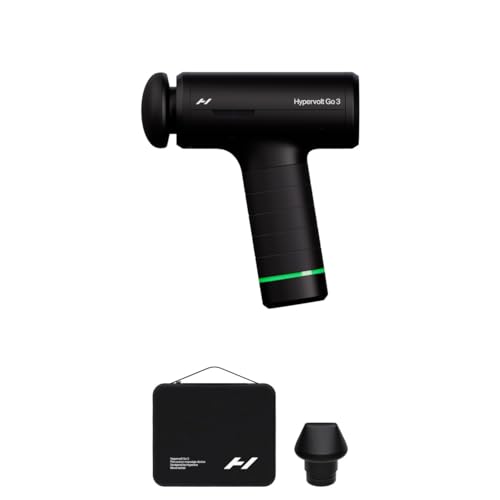
Hypervolt Go 3
- 1.6 lb massage gun
- 5 speeds
- Up to 4 hr battery
$149.00 at Amazon, as of Nov 17, 2026 02:07 UTC
Check price on AmazonSee also our massage gun guide.
Related sports and disciplines
- Parent: Rugby.
- Siblings: rugby union and rugby sevens.
- Elsewhere: football, wheelchair rugby and MMA.
Frequently asked questions
What is the difference between rugby league and rugby union?
League has 13 players, a six-tackle set and a try worth 4 points. Union has 15 players, contested rucks and lineouts, and a try worth 5. See our rugby union page.
Is rugby league an Olympic sport?
No. The IRL has been working toward inclusion, but we found no confirmed decision. Check the official programme for the current Games.
What happens on the sixth tackle?
The team that has had the ball hands it over to the opponents, who start their own set of tackles.
Is rugby league played in the United States?
Yes. USARL describes itself as the governing body, with men’s, women’s, youth and wheelchair clubs.
Is rugby league more dangerous than union?
Per hour, pooled data show higher injury rates for league than union, and similar concussion rates. It depends on level and how studies counted injuries, so treat it as a rough picture.
Sources
- International Rugby League, Laws of the Game 2026: PDF
- SBS, NRL Grand Final 2026; NRL, NRLW decider
- Rugby League World Cup 2026: host announcement; schedule
- USA Rugby League, domestic clubs overview
- NRL (2021), Olympics a priority
- Laaksonen J et al. 2026: PubMed; De Sousa-De Sousa L et al. 2026: PubMed; Czyz K et al. 2026: PubMed
- CDC HEADS UP; USA Rugby equipment guidelines
Keep exploring: the rugby rules, youth rugby, rugby gear, our recovery tools guide and the sports hub.