Quick answer: Rugby league is 13 against 13 for 80 minutes. A team keeps the ball for up to six tackles (five play-the-balls, then a handover on the sixth tackle), and a try is worth 4 points. To start, find a club through USA Rugby League (in the US) or your national league body, ask about a first-timer or touch-style session, and learn tackling from a coach before any full-contact game. Rules in this page follow the International Rugby League Laws of the Game 2026; your local league may add its own.
Watch a first game and the thing that puzzles you is the quiet moment after a tackle. The tackled player gets up, puts the ball on the ground and rolls it back with a foot, and the game starts again from that spot. That small ritual is the heartbeat of rugby league. This page explains how the game works under the International Rugby League Laws of the Game 2026, the basic skills, and how a beginner can get started. For the wider picture of the sport, see our rugby league hub; for the two sister codes, see rugby.
The basics: players, time and points
- Players. Each team has 13 on the field, numbered 1 to 13 by position: full back (1), wings (2 and 5), centres (3 and 4), stand-off or five-eighth (6), scrum half (7), props (8 and 10), hooker (9), second rows (11 and 12) and loose forward or lock (13). A match must be stopped for safety if a team drops below nine players on the field or in the sin bin (Laws, Section 4).
- Squad and interchange. Seventeen players are named, and a maximum of eight interchanges are allowed (Section 4). Local competitions may set their own limits.
- Time. A match is normally 80 minutes with a ten-minute interval at half-time. The length can be reduced by agreement if the competition rules allow it (Section 7).
- Points. A try is 4 points, a conversion or a penalty goal is 2, and a drop goal is 1 (Section 6).
The six-tackle set
The central idea of league is the set. A team in possession is allowed five successive play-the-balls, and a handover to the opposition happens when the team is tackled a sixth time (Section 11, law 7). A handover also follows other events, such as the ball going out of play or being kicked out on the full. That limit is why teams kick, usually on the last tackle, to move the ball downfield rather than give it away on their own line.
The play-the-ball
After a tackle, the Laws set out what happens (Section 11, law 10). The tackled player is released at once, gets to their feet where they were tackled, lifts the ball, faces the opponent’s goal line and places it on the ground in front of their foremost foot. They must then make a genuine attempt to play it backwards with the foot. One defender may stand opposite them, and a teammate called the acting half-back may stand directly behind. Other defenders must retire ten metres.
Scrums, knock-ons and kicking restarts
League has no rucks and no lineouts. Play restarts with a scrum after an accidental knock-on or forward pass, and after a tackled player accidentally loses the ball, except after the fifth play-the-ball (Sections 10, 11 and 12). A ball kicked in general play from deep inside your own half that bounces into touch between the opponents’ 20-metre line and goal line earns a tap restart for the kicking side, the so-called 40-20 (Section 9); the 20-40 works the same way from the other direction.
What the tackle rules protect
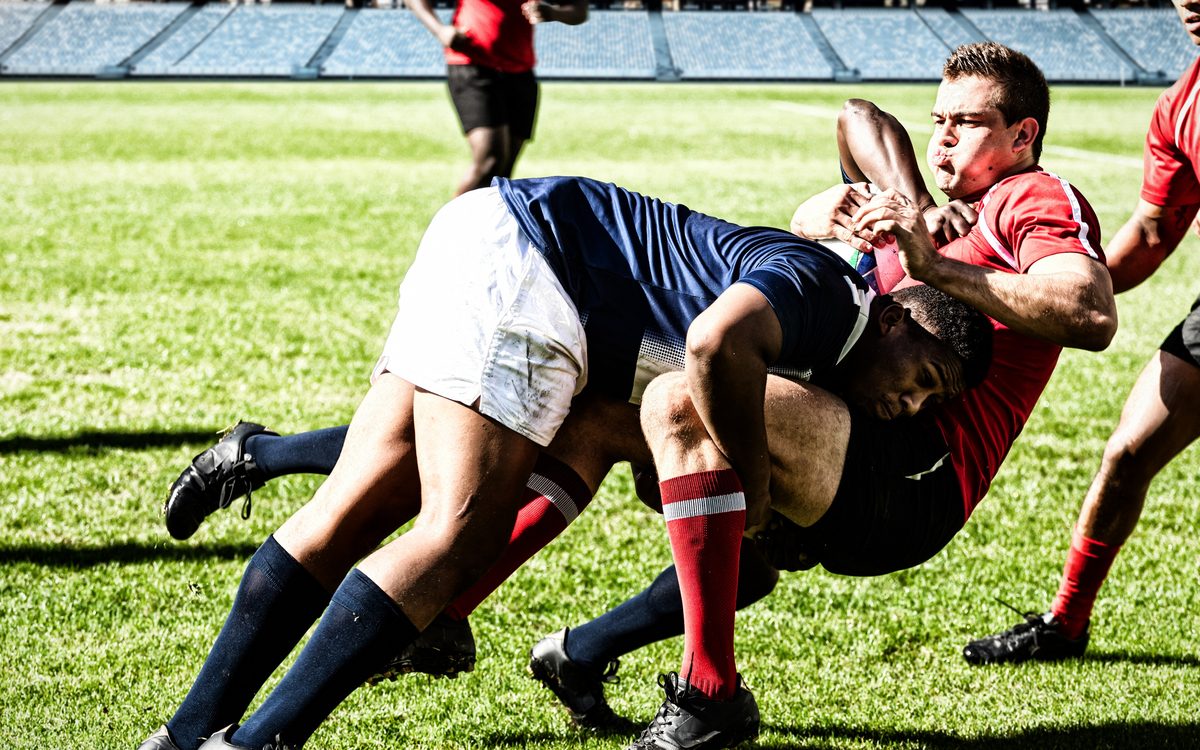
The Laws give a short list of tackles that are not allowed, and beginners should learn them before anything else because they are about safety as well as fairness. Under Section 15, misconduct includes making contact with the head or neck of an opponent intentionally, recklessly or carelessly, using a dangerous throw, dropping the knees first onto a player on the ground, a shoulder charge, and applying unnecessary pressure or twists such as a grapple, a crusher or a “chicken wing”. A tackle that lifts a player so that their head or neck is likely to hit the ground first is treated as a dangerous throw unless the dangerous position could not have been avoided with reasonable care. It is illegal to tackle a player who is still in the air catching a kick, and when a player is held upright by two defenders, any other defender must make first contact above the knees (Section 11).
A referee can caution a player, send them to the sin bin for ten minutes, or dismiss them (Section 16). Two teammates failing head injury assessments, or one player hurt by foul play that led to a sin-bin or dismissal, allows an 18th-player replacement (Section 4).
Basic skills a beginner learns first
The sources for this page cover the Laws, not a coaching manual, so the list below is general coaching practice, not a rule of the sport. Most clubs start newcomers on:
- Catching and passing with both hands, since the ball cannot be passed forward.
- The play-the-ball and getting back to your feet quickly.
- Running lines and support so a ball carrier always has someone to pass to.
- Defensive line shape and staying onside: players must retire ten metres at a play-the-ball (Section 11) and an offside player must not interfere with play (Section 14).
- Safe tackling, taught gradually, with a coach, first on pads or in a controlled drill and only then in live play.
How a beginner gets started
- United States. USA Rugby League (USARL) describes itself as the governing body and lists men’s, women’s, youth and wheelchair clubs on its domestic clubs page, with a “Get Involved” section. The site does not give a club directory on that page, so contact the organisation or a nearby club for details.
- Elsewhere. Go through your national body or the International Rugby League, which publishes the Laws. In Australia and England the top competitions, the NRL and Super League, run pathways from junior clubs; we did not verify local pathway details.
- Ask first. Ask whether there is a non-contact or introductory session, what the club requires for mouthguards and protective gear, who the trained first-aider is, and how the club follows head-injury rules.
- Get cleared. If you have not exercised lately or have a health concern, see a doctor before starting a contact sport.
Levels run from youth and amateur clubs to the professional NRL and NRLW in Australia. The 2026 Rugby League World Cup was scheduled in Australia and Papua New Guinea from October 15 to November 15, 2026, with men’s, women’s and wheelchair tournaments; we have not confirmed results. Wheelchair rugby league is a separate sport from wheelchair rugby.
Official rulebook
The International Rugby League publishes the Laws of the Game as a PDF (linked in Sources). Your competition’s own rules win for your games. Rugby league is not on the Olympic programme as far as we could confirm; check the official programme for the current Games.
Frequently asked questions
How many players are on a rugby league team?
Thirteen on the field, with seventeen named in the match squad and a maximum of eight interchanges under the International Laws.
What is a six-tackle set?
The attacking team can have five successive play-the-balls, and the ball is handed to the opponents when the team is tackled a sixth time. Teams often kick on the last tackle.
How many points is a try worth in rugby league?
Four. A conversion or penalty goal is 2 points and a drop goal is 1 point, according to the International Laws.
What is the difference between rugby league and rugby union?
League has 13 players, no rucks or lineouts and the six-tackle limit. Union has 15 players and contests the ball in rucks and lineouts. See our rugby union page for that code.
Can I try rugby league without being tackled?
Ask a club. Some run introductory or non-contact sessions, but we have not verified what a particular club offers, so check with them directly.
Is rugby league an Olympic sport?
Not as far as we could confirm. The Olympic rugby event is rugby sevens, a rugby union format. Check the official programme for the current Games.
Sources
- International Rugby League, Laws of the Game 2026
- USA Rugby League, domestic clubs overview
- Rugby League World Cup 2026 host announcement
General information for education only, not medical advice. It does not replace a visit with a sports medicine doctor, physical therapist or athletic trainer. See how we research and write our pages in our editorial policy. More about the sport: the rugby league hub, rugby and the sports hub. Next: training and injury prevention.