This article contains affiliate links: if you buy through them we may earn a commission, at no extra cost to you. Read our affiliate disclosure.
Quick answer: A rugby league player needs little: a jersey, shorts, socks and studded boots, plus a mouthguard. The International Laws allow protective clothing only if it contains nothing rigid or dangerous, and referees can order items off. Wear a fitted mouthguard; soft headgear showed no protective effect on head injury in a 2026 study. Check your league and club for their own gear rules, because we did not find a league-specific equipment standard.
Ten minutes before kickoff the referee walks the line, glancing at jewellery, tape, boots and pads. A ring comes off, a pair of studs gets a second look. Rugby league gear is a short list with a few rules that really matter. This page covers what the Laws say, how to choose and check kit, and what the evidence says about mouthguards and headgear. It belongs to the rugby league hub.
What the Laws say
- Normal gear. A numbered jersey, shorts, socks and studded boots or shoes (Section 4).
- Protective clothing. Allowed if it contains nothing rigid or dangerous. A player may not wear anything that might be dangerous to others, and the referee orders such items removed (Section 4).
- Examples named. Rings, rigid shoulder pads, projecting eyelets or nails on boots, and dangerous studs. Referees should inspect equipment before the game, which does not remove the player’s responsibility.
- Studs. Must not have sharp edges or pose a risk of injury to others (Section 4).
- The ball. Oval, air-inflated, with dimensions approved by the IRL Board; senior balls are light in colour (Section 3).
World Rugby and USA Rugby publish detailed equipment rules for rugby union, such as soft, thin shoulder padding and a ban on hard plastic or metal in braces and wrist guards. Those are union rules, so use them as a rough guide only and follow your own league’s rules.
Mouthguards: the one item to take seriously
A 2026 systematic review and meta-analysis of rugby (Chaboussie and Baudet) found an overall prevalence of 40.4 percent for orofacial injuries and 19.6 percent for dental injuries, with fractured teeth the most common dental injury. It noted that mouthguards were mainly worn in matches and less in training, and rated the certainty of evidence very low. It concluded that awareness and use of mouthguards should rise. USA Rugby’s equipment guidelines for union say mouthguards should be worn by every player every time in contact rugby and suggest asking a dentist about a custom guard; check what your league and club require.
- Fit. It should stay put without clamping your jaw, cover the upper teeth and let you breathe and talk. Boil-and-bite guards are shaped at home; a dentist can make a custom one.
- Braces. Players with fixed braces should ask a dentist, because not every guard suits them; one maker says its product is not for fixed braces.
- Care. Rinse after use, store it in a vented case, keep it away from heat and replace it if it is cracked, torn or no longer fits (general advice; follow the maker and your dentist).
- Growing players. A guard that fitted last year may not fit now.
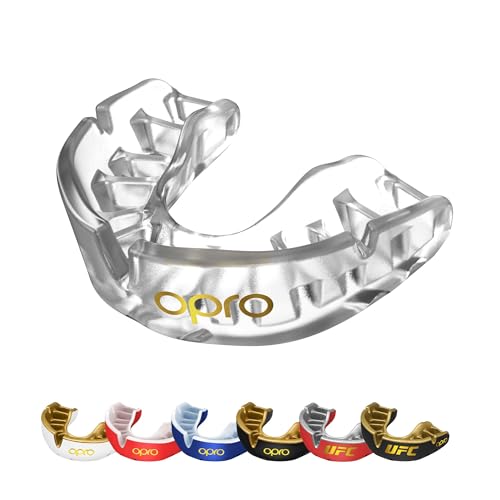
OPRO Gold Level Mouthguard
- Self-fit, no strap
- Kids' and adult sizes
- Not for fixed braces
$19.99 at Amazon, as of Nov 17, 2026 01:07 UTC
Check price on Amazon
Shock Doctor Gel Max Mouthguard
- Boil-and-bite
- Youth and adult sizes
- Gel lining
$11.99 at Amazon, as of Nov 17, 2026 01:07 UTC
Check price on AmazonThese are mouthguard picks from our rugby pages; they are not league-certified, and we have not verified any performance claim a maker makes (for example, OPRO’s listed dental warranty is a maker claim). Ask a dentist about a custom guard.
Headgear, shoulder pads and other padding
A 2026 observational study of professional men’s Super Rugby (Brown and colleagues) found head injury assessment incidence was higher in players wearing regulation soft-padded headgear after allowing for tackles (incidence rate ratio 1.78), and noted that earlier studies also found no protective effect. Soft headgear may still prevent scalp cuts, but do not rely on it for concussion. For shoulders, we found no evidence that pads prevent injury, and the Laws name rigid shoulder pads as an item referees may order off. If you wear padding, check that it is soft and allowed in your league.
Boots and clothing
Boot choice depends on the ground. As general advice, moulded studs suit firm ground and longer screw-in studs suit soft ground, but make sure they comply with your league’s rules and are not worn or sharp. Check that laces, eyelets and studs are intact before each game (the Laws name projecting eyelets or nails as a hazard). Tape and light supports are common; hard plastic or metal braces are the kind of items to check with the referee first. Keep nails short and take off all jewellery.
Inspecting gear before every game
- Mouthguard fits and has no cracks.
- Studs are secure, not worn to sharp edges, and the right type.
- No jewellery, rings or watches.
- Any tape, support or padding is soft and allowed.
- The ball is inflated to the competition’s standard (ask your club).
Recovery gear
Foam rollers and massage tools are comfort items, not equipment of the sport; see our recovery page for what the evidence says.
Frequently asked questions
What equipment do I need to play rugby league?
A jersey, shorts, socks, studded boots and, as widely advised, a fitted mouthguard. Beyond that, follow your club’s and league’s rules.
Is a mouthguard required?
We could not confirm a general rule for rugby league. USA Rugby’s union guidance says every player should wear one every time, and a 2026 review found frequent dental and orofacial injuries in rugby. Ask your club.
Do scrum caps stop concussions?
A 2026 study of Super Rugby found no protective effect on head injuries from soft headgear. They may reduce scalp cuts, but check your league’s rules.
Are shoulder pads allowed in rugby league?
The Laws name rigid shoulder pads as something referees may order off, and allow protective clothing with nothing rigid or dangerous. Check your league on soft padding.
How do I know my mouthguard fits?
It should sit securely without clamping, allow breathing and speech, and cover the upper teeth. A dentist can check or make a custom guard.
Can I use union boots and balls?
Boots are generally similar, but check studs against your league rules. For balls, the Laws say size is approved by the IRL Board; ask your club which to buy.
Sources
- International Rugby League, Laws of the Game 2026, Sections 3 and 4
- Chaboussie and Baudet 2026, orofacial and dental injuries in rugby, PMID 41871283
- Brown et al. 2026, soft-padded headgear and head injuries, PMID 41419445
- USA Rugby, Protective Equipment and Clothing Guidelines (union)
- World Rugby, Regulation 12 (union equipment regulation)
- OPRO Gold Level mouthguard, Amazon listing
- Shock Doctor Gel Max, Amazon listing
General information for education only, not medical advice. It does not replace a visit with a sports medicine doctor, physical therapist or athletic trainer. See how we research and write our pages in our editorial policy. Related: injury prevention, the rugby league hub and the sports hub.