This article contains affiliate links: if you buy through them we may earn a commission, at no extra cost to you. Learn more.
A cold March afternoon, the first practice of the spring, and the field is all sound: the clack of sticks, a ball snapping into a mesh pocket, a coach yelling “ground ball!” as eight kids dive for the same spot. By May it’s playoff lacrosse under the lights, and on Memorial Day weekend the college champions are crowned. Lacrosse is one of the fastest games on grass, and it keeps growing: in 2024-25, 113,696 boys and 99,292 girls played it for their high schools, according to the National Federation of State High School Associations (NFHS). That puts girls’ lacrosse at No. 10 among all girls’ high school sports.

Lacrosse, page by page
- Rules: how the game works at every level
- Leagues & associations: pro, college, high school and youth
- Youth & high school: ages, safety and recruiting, for players and parents
- Injuries & sports health: prevention, concussion, when to see a pro
- Training & conditioning: before: off-season to in-season
- Game day: during: fueling, hydration, heat
- Recovery: after: games, tournaments, sleep
- Nutrition & supplements: what to eat, tested supplements
- Best wearables: trackers and watches for the sport
- Gear: the complete equipment list
Buying guide · Our Lacrosse buying guide compares the gear we'd pick, with prices and sizing:
This page is lacrosse for players, parents and coaches: how the game works, why boys’ and girls’ lacrosse are really two different sports, box and sixes, every level up to the Los Angeles 2028 Olympics, and, above all, how to stay healthy. Sports health is the heart of it: the lacrosse injuries players get most, concussion, the girls’ headgear debate and the chest protectors that guard against a rare but deadly blow to the heart. Then training, recovery and gear.
Lacrosse at a glance
| Players per side | Men’s and boys’ field lacrosse: 10 (3 attack, 3 midfield, 3 defense, 1 goalie). Women’s and girls’: 12, one of them a goalie. Box: 5 runners and a goalie. Sixes: 5 field players and a goalie. |
|---|---|
| Game length | College (NCAA), men and women: four 15-minute quarters. High school (NFHS), boys and girls: four 12-minute quarters. NLL box: four 15-minute quarters. Sixes: four 8-minute quarters. |
| Field | Men’s: 110 × 60 yards. Women’s: up to 120 yards long and about 65 yards wide (NCAA). Box is played on turf inside a hockey rink. |
| Shot clock | 80 seconds in NCAA men’s lacrosse, 90 seconds in NCAA women’s, 30 seconds in the NLL and in sixes. High school states may add one from 2027. |
| Contact | Boys’ and men’s lacrosse allows body checking (from age 14 in USA Lacrosse youth rules). Girls’ and women’s lacrosse has no body checking; stick checks are limited and phased in by age. |
| Governing bodies | World Lacrosse worldwide; USA Lacrosse in the US; NFHS for high school; NCAA, NAIA and NJCAA for college. |
| Most common injuries | Concussions, ankle and knee sprains (including ACL tears, especially in girls), muscle strains, bruises and fractures from sticks and balls. |
How lacrosse works
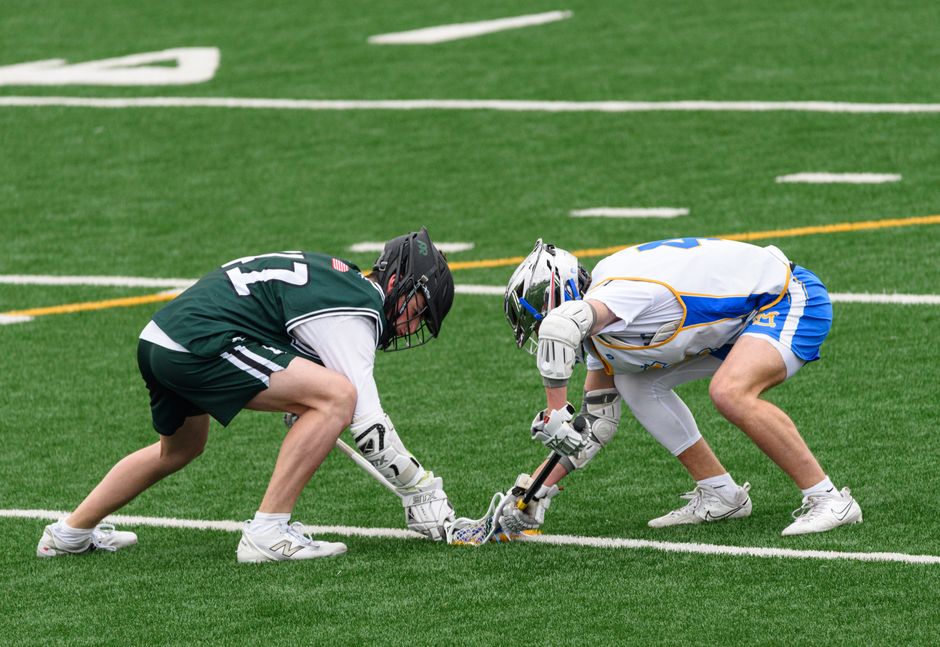
Lacrosse began as a game of Indigenous peoples of North America, and French Jesuit missionaries saw it played in the St. Lawrence Valley in the 1630s. It still carries that history: the Haudenosaunee Nationals compete internationally in their own right. The modern game is simple to explain. Players carry, pass and shoot a solid rubber ball with a stick (the “crosse”) that has a mesh or strung pocket, trying to put it in a 6-by-6-foot goal. You can’t touch the ball with your hands unless you’re the goalie. Every possession starts with a fight for the ball: a faceoff at midfield in the men’s game, a draw in the women’s game. Loose “ground balls” decide a lot of games.
The boys’ and men’s game is a contact sport. Players wear helmets, gloves, shoulder pads and arm pads, and a defender may body check the ball carrier (or a player within 5 yards of a loose ball in college) from the front or side, above the waist and below the neck. Up to four players per team may carry a long pole of 52 to 72 inches; everyone else uses a 40-to-42-inch short stick. The girls’ and women’s game is built around space instead: no body contact, stick checks only away from the head, required eye protection, and fouls enforced at an 8-meter arc and 12-meter fan in front of the goal. Our lacrosse rules page lays both games side by side, along with high school, box and sixes rules.
Three ways to play: field, box and sixes
- Field lacrosse is the main version in the US: the game played in high schools, colleges and the Premier Lacrosse League.
- Box lacrosse (indoor) is played on turf laid over a hockey rink, with boards and glass. It’s Canada’s national summer sport and the game of the National Lacrosse League, where teams combine for about 25 goals a game.
- Sixes was created in 2018 as a faster, smaller-field game: six players a side, four 8-minute quarters, a 30-second shot clock and no specialty positions. It’s the version that will be played at the LA28 Olympics.
Lacrosse at every level
Kids and youth
USA Lacrosse writes the youth rules for ages 14U and under, and they shrink the game: cross-field games with fewer players for the youngest kids, shorter sticks, running clocks and less contact. In boys’ youth lacrosse, body checking is illegal through 12U and allowed from 14U, with no “take-out” checks. In girls’ youth lacrosse there’s no stick checking at 8U and 10U, “modified” checking at 12U and “transitional” checking at 14U. Many kids start with Flex6, a non-contact format that needs almost no equipment. Our youth lacrosse guide covers ages, contact rules, headgear and recruiting.
High school
High school teams play NFHS rules, written with USA Lacrosse. Lacrosse is an officially sanctioned state championship sport for boys and girls in 25 states, with Nevada next in 2027, and club and varsity programs play in almost every state. Boys’ and girls’ games are four 12-minute quarters (girls switched from halves in 2024). Starting with the 2027 season, state associations may add a 70-second shot clock for boys and a 90-second possession clock for girls.
College
There are more than 900 NCAA varsity lacrosse programs across Divisions I, II and III, up from about 600 a decade ago, according to USA Lacrosse. The NAIA and junior colleges (NJCAA) add more, and hundreds of club teams play in the MCLA, WCLA and NCLL. In 2026, Princeton won the NCAA Division I men’s title, its first since 2001, and Northwestern won the women’s title. More on our leagues and associations page.
Pro
The Premier Lacrosse League (PLL), founded by Paul and Mike Rabil, plays field lacrosse with eight teams; in 2026 each played 12 regular-season games from May to August, and the Philadelphia Waterdogs won the title in September. The PLL also runs the Women’s Lacrosse League (WLL), which began in 2025 with sixes and added full-field games in 2026. The National Lacrosse League (NLL), founded in 1986, is the indoor box league: 14 teams in the US and Canada, 18 regular-season games each, from late November into May.
International and Olympic
World Lacrosse governs field, box and sixes worldwide, with 97 member nations in four continental federations as of 2026. Lacrosse was an Olympic medal sport in 1904 and 1908, and it’s coming back: the International Olympic Committee approved it for Los Angeles 2028 in October 2023. Six men’s and six women’s teams will play sixes at Exposition Park Stadium from July 24 to 29, 2028, the first time women’s lacrosse has been in the Olympics. The US qualifies as host if it takes part in the qualifying events.
Adult and recreational
College club teams, post-collegiate leagues, summer box leagues and adult tournaments keep plenty of people playing for decades. Coming back after years off? Ease in with wall ball and light running before full-speed games.
Sports health for lacrosse players
Lacrosse mixes sprinting, cutting, hard sticks and a hard ball, so injuries come with it. This section is general information, not medical advice. If you’re hurt, see a sports medicine doctor, a physical therapist or an athletic trainer.
The most common lacrosse injuries
Large US studies in which athletic trainers recorded every injury that kept a high school or college player out at least a day give a clear picture:
- Boys and men: lower-limb injuries, muscle strains and ligament sprains were common at both levels, and concussion was the most frequent diagnosis in games for every high school position. Injury rates were about three and a half times higher in games than in practice.
- Girls and women: concussion was the most common diagnosis in high school, usually from contact with a stick or ball, and ligament sprains were close behind. Injury rates were higher in college than in high school, and in games than in practice.
- Knees, especially in girls: in high school girls’ lacrosse, the ACL made up almost half (46.6%) of serious knee ligament and cartilage injuries, and the ACL injury rate rose over the years studied.
- Young players: in youth leagues (ages 9–15), most injuries were bruises, usually from a stick or ball, and boys had a higher injury rate than girls.
Concussion: recognize and remove
The CDC’s HEADS UP program asks coaches and parents to watch for a player who looks dazed or confused, moves clumsily or is slow to respond, and to listen for headache, dizziness, balance problems, sensitivity to light or noise, or trouble concentrating.
- Remove the player from play right away after a blow to the head or body if you see any signs. No helmet or headgear prevents every concussion.
- Keep them out for the rest of the day and until a healthcare provider clears them. Don’t judge how serious it is yourself.
- Return in steps: getting back to sport is gradual and usually takes a week or more.
- Call 911 for danger signs: a seizure, passing out, growing drowsiness, a headache that gets worse and won’t go away, repeated vomiting, or one pupil larger than the other.
Rules help too: after NFHS toughened penalties for hits to the head and neck and on defenseless players (2012–2014), high school boys had fewer head, face and neck injuries from checking.
Girls’ headgear: what the research says
Headgear is optional at every level of girls’ and women’s lacrosse, but any headgear worn must meet the ASTM F3137 standard. Florida requires it for high school players. In a study of the 2019–2021 seasons, Florida high schools had a concussion rate of 0.27 per 1,000 athlete-exposures versus 0.44 in states without a mandate. A separate video study of games found more head impacts in Florida, mostly from sticks, so the debate isn’t settled. USA Lacrosse calls headgear one factor, along with coaching, officiating and technique. Our lacrosse gear guide explains the standard.
Commotio cordis: why chest protectors changed
Commotio cordis is cardiac arrest caused by a blow to the chest right over the heart at a precise moment in the heartbeat. A lacrosse ball can do it, and the blow doesn’t have to be hard. It’s rare: a four-decade study of US lacrosse counted 15 cases from 1982 to 2020, and fatality rates from cardiac arrest and commotio cordis fell 95% after 2007. To lower the risk further, NOCSAE wrote the first chest-protector standard, ND200, in 2017. Goalies’ chest protectors have had to meet it since 2021, and since 2022 all boys’ and men’s field players must wear shoulder pads or chest protection that meets it. Immediate CPR and an AED are what save lives, so every team should have an emergency action plan and know where the nearest AED is.
Overuse, rest and young players
Spring school seasons, summer club tournaments and fall ball add up. USA Lacrosse encourages kids to play other sports instead of specializing early, because broad athleticism lowers injury risk, and the American Academy of Pediatrics warns that early specialization can harm young athletes physically and mentally. In one study of boys’ summer club tournaments, nearly a fifth of the injuries athletic trainers recorded were concussions, and the authors note that club players may not have medical coverage at all, so ask who’s covering before you go.
When to see a doctor, physical therapist or athletic trainer
Don’t play through pain. See a professional for pain that doesn’t settle, swelling, a knee that pops or gives way, an ankle you can’t walk on, a hand or wrist that’s swollen after a stick check, or any concussion signs. A sports medicine physician manages most sports injuries without surgery and refers to physical therapy or a surgeon when needed. A physical therapist guides rehab and the return to play. Athletic trainers are licensed or regulated health care professionals in all 50 states; if your school has one, start there.
Training and conditioning for lacrosse
Off-season and preseason: lacrosse asks for repeated sprints, quick changes of direction and a lot of time on your toes, so mix interval running, agility and footwork (see our speed training equipment guide) with leg, hip and core strength. For girls especially, landing and cutting technique is part of protecting the knees. And nothing replaces wall ball with both hands.
In season: keep some strength work, warm up before every practice and game, and watch total load when a player is on a school team and a club team at once. Many players track sprint load with a GPS vest (see GPS trackers for team sports) or sleep and recovery with a wearable (Whoop vs Oura vs Garmin, HRV for athletes).
Game day: the sports-nutrition position statement from the American College of Sports Medicine and two dietitians’ groups recommends a pre-exercise meal high in carbohydrate, moderate in protein, low in fat and fiber, of familiar foods, eaten roughly 1–4 hours before. On long or hot tournament days many players add electrolytes (see our electrolyte powder guide).
Recovery after lacrosse games
Recovery starts with the basics. Sleep comes first: the CDC, citing the American Academy of Sleep Medicine, recommends 9–12 hours a night for children 6–12, 8–10 hours for teens and 7 or more for adults. Then a real meal and fluids after the game; many players reach for a protein shake when food is hours away (see our protein powder guide).
After a two-game tournament day, simple tools help many players feel better: a foam roller or massage gun for tight hamstrings, quads and calves, compression boots after a long weekend, and soft recovery shoes once the cleats come off. They’re about comfort, not treatment; pain or swelling that doesn’t go away needs a professional. Our recovery tools guide compares the options.
Gear for lacrosse
- Boys and men: a stick, a NOCSAE-certified helmet, gloves, shoulder pads that meet NOCSAE ND200, arm pads, a mouthguard and a protective cup. Goalies add a throat protector and an ND200 chest protector.
- Girls and women: a stick, a mouthguard and eyewear that meets ASTM F3077. Headgear (ASTM F3137) and gloves are optional. Goalies wear a helmet, throat protector, padded gloves and an ND200 chest protector.
- Balls: game balls must meet the NOCSAE ball standard; youngest players often use soft balls.
Four picks to start a bag: the STX Stallion 200, a beginner boys’ complete stick with a soft mesh pocket that STX says meets NCAA and NFHS rules (about $50); the STX 4Sight+ S goggles, which meet ASTM F3077 for women’s lacrosse (about $60); the Shock Doctor Gel Max mouthguard in youth and adult sizes; and the OOFOS OOahh Slide from our recovery shoes guide for after the final whistle. Our lacrosse gear guide covers helmets, pads, headgear and sticks in detail.
STX Stallion 200 Boys Complete Stick
- Attack/midfield, soft mesh pocket
- Alloy handle
- Meets NCAA and NFHS rules (maker)
STX 4Sight+ S Goggles
- Meets ASTM F3077 (women's lacrosse)
- SEI certified
- Silicone padding
Shock Doctor Gel Max Mouthguard
- Boil-and-bite fit
- Youth and adult sizes
- Helmet strap included
OOFOS OOahh Slide
- OOfoam slide
- APMA Seal of Acceptance
- Machine washable
Lacrosse FAQs
How long is a lacrosse game?
College games, men’s and women’s, are 60 minutes in four 15-minute quarters. High school games are 48 minutes in four 12-minute quarters. Youth games are shorter, often with a running clock, and Olympic sixes games are four 8-minute quarters.
What is the most common lacrosse injury?
In high school, concussion is the most common diagnosis in girls’ lacrosse and the most frequent game injury in boys’ lacrosse. Ankle and knee sprains and muscle strains are also common, and girls have a notable share of ACL tears.
What’s the difference between boys’ and girls’ lacrosse?
Boys play 10 a side with body checking, helmets and pads, and long poles on defense. Girls play 12 a side with no body checking, limited stick checks, required goggles and optional headgear, and fouls enforced around an 8-meter arc. The sticks and pockets follow different rules too.
Is lacrosse in the Olympics?
Yes, again. It was a medal sport in 1904 and 1908 and returns at Los Angeles 2028 as sixes, with six men’s and six women’s teams playing July 24–29, 2028. It will be the first Olympic women’s lacrosse tournament.
Do lacrosse players need a chest protector?
Goalies in boys’ and girls’ lacrosse must wear a chest protector that meets NOCSAE ND200, and boys’ and men’s field players must wear ND200 shoulder pads or chest protection. Girls’ field players may wear an ND200 compression shirt but aren’t required to.
The players who last warm up, sleep, wear certified gear and take head and heart safety seriously. Keep exploring: Nutrition & Supplements for game days, our soccer guide for a fall sport, and every sport on our sports hub.