This article contains affiliate links: if you buy through them we may earn a commission, at no extra cost to you. Read our affiliate disclosure.
Ten minutes before a spring Saturday game, the girls’ team is in two lines on the sideline doing skips and lunges while a dad tapes up a sister’s ankle, and next door the boys are checking chin straps and tugging on shoulder pads. Lacrosse injury prevention means the warm-ups, rules, training habits and certified gear that lower the chance of getting hurt on the field. It can lower risk. It cannot remove it, and the boys’ and girls’ games ask for different things.
Quick answer: Build fitness before preseason, warm up with jumping, landing and balance work, wear the gear your rulebook requires (certified and fitted), plan for hot days, and take out any player who might have a concussion. Anyone who is hit in the chest and collapses needs 911, CPR and an AED right away. See a doctor, athletic trainer or physical therapist for a head injury, a knee that popped or gives way, or pain that keeps getting worse.
Warm up and build the preseason on purpose
In NCAA data for 2014-15 to 2018-19, both men’s and women’s lacrosse had higher injury rates in the preseason than in the regular season, which is a case for arriving in shape instead of getting in shape at the first practice. For the warm-up itself, the best-studied model comes from soccer: the FIFA Medical Network’s 11+ program. A meta-analysis found it cut injuries by about 39% in soccer players. No lacrosse federation publishes an equivalent program that we could confirm, so the soccer version is a model, not a lacrosse proof. Ask your coach or athletic trainer for a warm-up that includes running, strength, balance, jumping and landing. See our training page and the soccer injury prevention page for 11+.
The same kind of program matters most at the knee. The American Academy of Orthopaedic Surgeons (AAOS) describes the typical ACL tear as a plant, pivot or awkward landing, which is what a dodge looks like. A 2026 survey of 522 high school teams found only 3.5% used an ACL prevention program, mostly because of a lack of trained staff and time. If your team has none, ask for one.
Boys’ and girls’ lacrosse: different contact, different risks
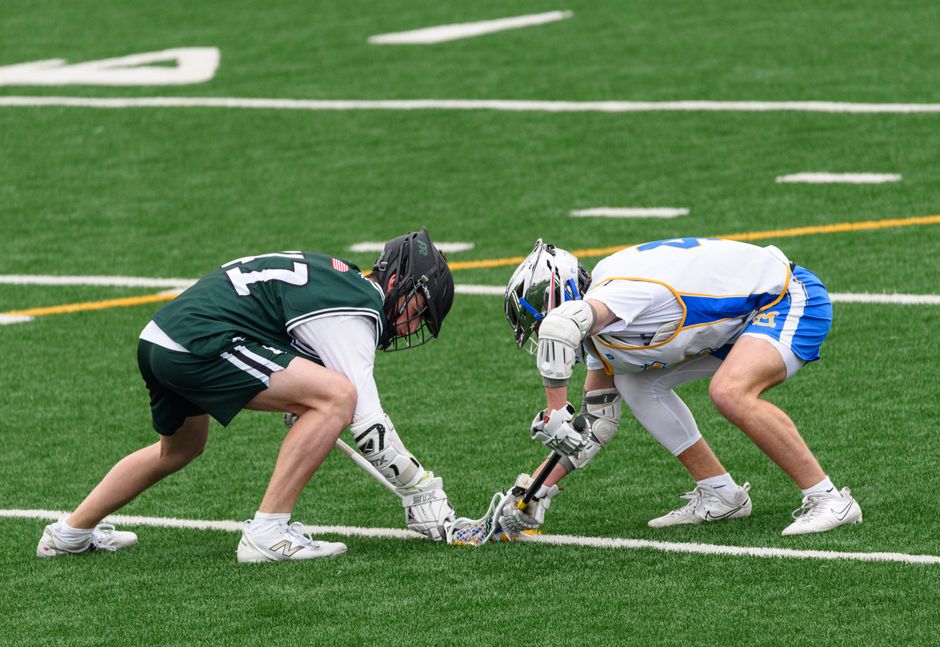
The two games are not the same sport when it comes to safety. Boys’ and men’s lacrosse allows body checking above the waist and below the neck, with helmets, shoulder pads, arm pads and gloves. Girls’ and women’s lacrosse limits body contact, and a dangerous stick in the “sphere” around the head is penalized. In the NCAA women’s rules, field players need eyewear and a mouthpiece, and headgear is optional. Penalties are on our rules page.
That difference shows up in the injury data. In US high school girls’ lacrosse from 2008-09 to 2013-14, the main mechanism of injury was contact with a stick or ball, and concussion was the most common diagnosis, as it was in game injuries to boys. Rules changes are one of the few prevention measures with lacrosse numbers behind them: after high school boys’ rules raised the penalty for hits to the head and neck (2012-13) and banned body checks on a defenseless player (2013-14), concussions from delivering checks fell by roughly half, according to a 2021 study in the Journal of Athletic Training.
For young players, USA Lacrosse’s 2026 boys’ youth rules make body checking illegal at 10U and 12U and legal at 14U, with no “take-out” checks and a three-minute non-releasable penalty for targeting. Girls’ play shifts with age too. The youth lacrosse page has the age-by-age rules.
Concussion: recognize and remove
Prevention reduces concussions; it does not eliminate them, so every sideline needs the same plan. The CDC’s HEADS UP program asks coaches, officials, parents and teammates to watch for a player who looks dazed, moves clumsily, answers slowly, or reports headache, dizziness, nausea or sensitivity to light or noise after a hit to the head or body. If you see signs, remove the player from play. Do not test them on the sideline. They stay out for the rest of the day and until a health care provider clears them, and the return is gradual. Call 911 for danger signs such as a worsening headache, repeated vomiting, seizure, slurred speech or growing confusion.
One more reason not to rush: in a seven-year study of women’s lacrosse at one college, the risk of an ACL injury in the year after a concussion was about five times higher, according to a 2021 report in Current Sports Medicine Reports. It is one college, so treat it as a reason for patience.
Protective equipment: required, certified and fitted
What a player must wear depends on which game they play. Here is how USA Lacrosse’s equipment page, the NCAA rules books and the 2026 youth rule books describe it.
- Boys’ and men’s field players: a helmet certified to the National Operating Committee on Standards for Athletic Equipment (NOCSAE) standard and carrying the SEI mark, a mouthpiece, gloves and arm pads made for lacrosse, a cup, and shoulder pads that meet the NOCSAE ND200 standard for chest protection.
- Girls’ and women’s field players: eyewear that meets ASTM F3077 and a mouthpiece. Headgear is optional, and if worn it must meet ASTM F3137.
- Don’t alter it. The 2026 youth boys’ rule book says equipment must be original and unaltered, and the NCAA men’s rules require reconditioned helmets to be recertified. Check the labels and the chin strap before every game.
- Fit is the part you control. USA Lacrosse says a glove should let the hand fully insert and that arm pads should be worn the way the maker intends. A helmet that slides or a chin strap that is loose is not doing its job.
Headgear in girls’ lacrosse is not settled. A study comparing Florida, which requires headgear in high school, with 31 states that do not found a lower concussion rate in Florida (0.27 versus 0.44 per 1,000 athlete-exposures). A 2025 consensus meta-analysis in the British Journal of Sports Medicine rated the evidence for headgear in adolescent female lacrosse and soccer as very low certainty, and a video study of 189 games found more head impacts, not fewer, in games where headgear was required. Ask your league what it requires; goggles and a mouthpiece are required either way.
Chest protection, commotio cordis and the AED plan
Commotio cordis, a blow to the chest at the wrong instant of the heartbeat that stops the heart, is rare, but US researchers counted 17 cases in lacrosse from 1982 to 2023, second only to baseball. Two things lower the risk of dying from it. The first is a chest protector built to the ND200 standard: researchers who helped develop it describe it as lowering risk, not eliminating it, which is why the second matters just as much. The second is quick CPR and an AED. In the US Commotio Cordis Registry, 40% of people survived when resuscitation began within three minutes, against 5% when it started later. Ask where the nearest AED is and who has CPR training.
Goalie gear
USA Lacrosse and the NCAA rules require goalies to wear a helmet, throat protector, padded gloves, mouthpiece and an ND200 chest protector, and the 2026 youth girls’ rule book adds a pelvic protector plus shin and thigh padding. ND200 chest protection has been required for goalies at all levels since January 1, 2021. We found no injury study comparing goalie equipment brands, so check standard labels and your league’s list. Our lacrosse gear guide goes through the bag piece by piece.
Ankle and knee
In NCAA data for 2014-15 to 2018-19, ankle sprains were 7.7% of men’s injuries and 9.1% of women’s, the leading injury for women. The National Athletic Trainers’ Association (NATA) names a previous sprain as the most consistent risk factor and recommends taping or bracing all practices and games after a sprain, plus a balance and neuromuscular training program of at least three months. For the knee, the high school evidence puts girls at about 1.6 times the boys’ ACL risk per exposure, but boys’ lacrosse still carries real risk, so a jump-and-land program is for both. One study of 128 female lacrosse and soccer players found conical studs associated with more ACL injuries than turf shoes; it is a single study, so ask your athletic trainer before changing footwear.

STX 4Sight+ S Goggles
- ASTM F3077-17, SEI certified (maker)
- Oval wire design
- Silicone padding

ASO EVO Ankle Stabilizer
- Lace-up with figure-8 straps
- Fits left or right foot
- Low profile, fits in cleats

Shock Doctor Gel Max Mouth Guard
- Youth and adult sizes
- Gel-fit liner
- Detachable helmet strap
$11.99 at Amazon, as of Nov 17, 2026 01:07 UTC
Check price on AmazonHeat and the lacrosse uniform
Lacrosse is played in spring and summer in pads and helmets, which holds heat against the body. NATA’s exertional heat illness statement recommends 7 to 14 days of gradual acclimatization when training in the heat, and cold-water immersion as the most effective way to cool a person with heat stroke, with the rule to cool first and transport second. A 2022 lab study of ten men in lacrosse uniform at 35°C and 50% humidity found a lower core temperature at the end of the fourth quarter when two-minute breaks were added mid-quarter. It is a small lab study; breaks, shade and water are the common sense that follows. See our game-day page for a hot-weather checklist and recovery for after the game. Confusion, collapse or a very hot body in the heat means call 911.
Overuse, youth and what prevention can’t do
About a quarter (25.2%) of injuries in NCAA women’s lacrosse were overuse in the 2014-15 to 2018-19 data. The American Academy of Pediatrics (AAP) advises young athletes to take one to two days a week off their main sport, to take several months a year away from it in blocks, and to play more than one sport until puberty. Prevention measures lower risk in groups of players. They do not guarantee that any individual will stay uninjured. A certified helmet cannot prevent every concussion, ND200 chest protection can lower but not remove the risk of commotio cordis, and braces do not replace strength and balance work.
When to see a professional
See a sports medicine doctor, physical therapist or athletic trainer for any head injury, a knee that popped, swelled fast or gives way, an ankle you cannot put weight on, a deformed hand or collarbone after a stick or ball hit, or pain that worsens with each practice. NATA says an injured leg should perform at least 80% as well as the healthy one before sport-specific drills, and a clinician is the one to judge that. Injury types and symptoms are on our lacrosse injuries page.
Frequently asked questions
Does lacrosse need a warm-up program like FIFA 11+?
We could not confirm a lacrosse-specific published program. The soccer 11+ is the best-studied model, and a lacrosse warm-up built on the same ideas (running, strength, balance, jumping and landing) is a reasonable ask of a coach or athletic trainer.
Do girls need to wear headgear?
Usually no. Eyewear meeting ASTM F3077 and a mouthpiece are required for field players; headgear is optional and must meet ASTM F3137 if worn. Florida requires it at high school level. The research so far is mixed.
Why do boys wear helmets and girls mostly do not?
Boys’ and men’s rules allow body checking, so players wear helmets and pads. Girls’ and women’s rules limit body contact and penalize dangerous stick play near the head, so goggles and a mouthpiece are the required protection.
What should I do if a player gets hit in the chest and collapses?
Call 911, start CPR and use an AED immediately. In the US Commotio Cordis Registry, survival was far higher when resuscitation began within three minutes.
Can a brace prevent ankle sprains?
NATA recommends a brace or tape after a previous sprain, together with a balance training program of at least three months. A brace alone is not the plan.
Is it safe to play lacrosse in hot weather?
It can be with preparation: gradual acclimatization, extra breaks, water and shade, and a plan to cool anyone with signs of heat illness. Call 911 for collapse or confusion.
Sources
- CDC HEADS UP: how to respond and signs and symptoms
- USA Lacrosse: equipment, commotio cordis and cardiac safety and women’s eyewear
- USA Lacrosse 2026 boys’ youth rule book and girls’ youth rule book
- NCAA men’s lacrosse rules 2025-26 and women’s rules book
- D’Alonzo et al.: NCAA men’s lacrosse injuries (J Athl Train, 2021) and Bretzin et al.: NCAA women’s lacrosse injuries (2021)
- Pierpoint et al.: high school and college boys’ lacrosse (J Athl Train, 2019) and girls’ lacrosse (2019)
- Guillaume et al.: high school boys’ lacrosse rule changes and injury (J Athl Train, 2021)
- Lutz et al.: ACL injury after concussion in women’s lacrosse (Curr Sports Med Rep, 2021)
- Herman et al.: Florida headgear mandate (Br J Sports Med, 2022), FAIR consensus meta-analysis (Br J Sports Med, 2025) and Caswell et al.: head impacts video study (Ann Med, 2024)
- Shore et al.: commotio cordis in US organized sports (Inj Prev, 2026), Maron et al.: US Commotio Cordis Registry (Heart Rhythm, 2013) and Dau et al.: NOCSAE ND200 (Circ Arrhythm Electrophysiol, 2024)
- NATA position statement: conservative management and prevention of ankle sprains (J Athl Train, 2013)
- Gornitzky et al.: ACL injury in high school athletes (Am J Sports Med, 2016), Popper et al.: ACL prevention programs in 522 high school teams (2026) and Cass et al.: cleats versus turf shoes (Orthop J Sports Med, 2025)
- Thorborg et al.: FIFA 11+ meta-analysis (Br J Sports Med, 2017)
- NATA position statement: exertional heat illnesses (J Athl Train, 2015) and Osakabe et al.: breaks in lacrosse uniform in the heat (J Hum Kinet, 2022)
- AAP: sports specialization and intensive training in young athletes (Pediatrics, 2016)
General information for education only, not medical advice. It does not replace care from a doctor, athletic trainer or physical therapist who knows you. See our editorial policy for how we research and write. More lacrosse: the hub, injuries, gear and youth.